
Former University of Southern California president CL Max Nikias said students and faculty tested him from day one.
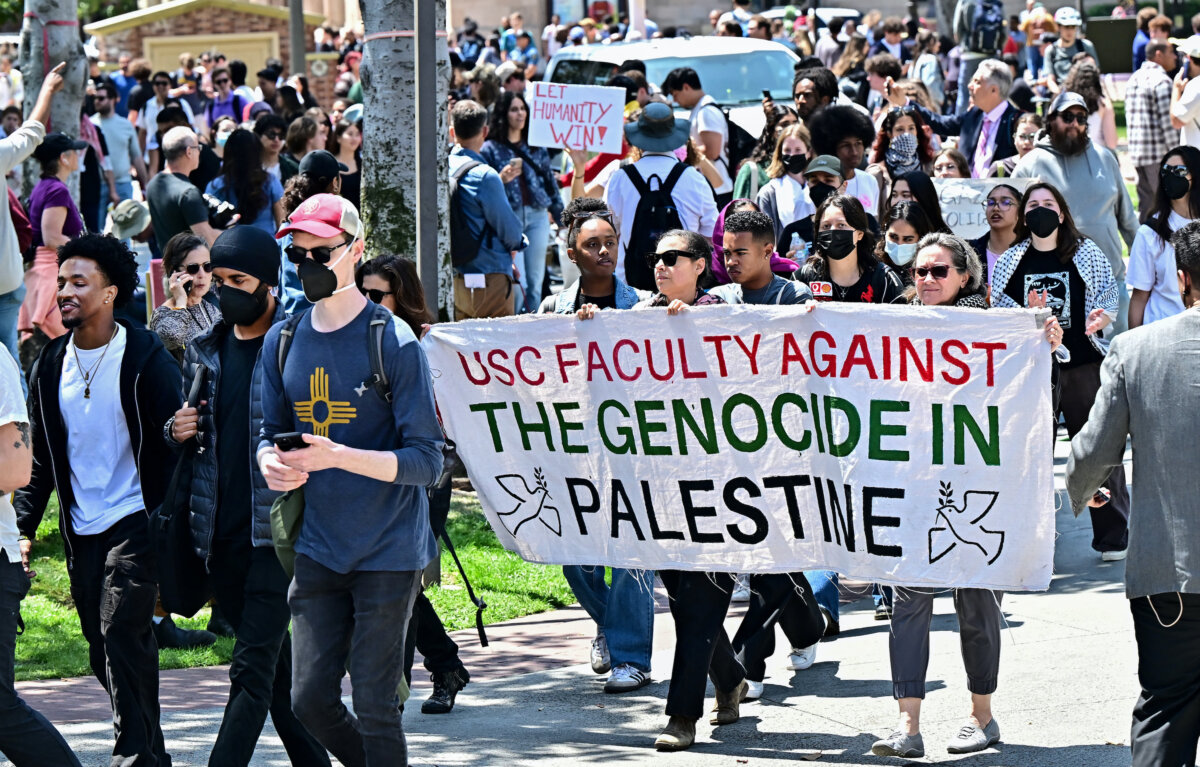
When campus members of the pro-Palestinian Boycott, Divestment, and Sanctions movement demanded that he cut ties with Israel, he responded by leading a delegation of trustees and administrators to visit Israel and strengthen their relationships with universities there, Nikias told EpochTV.
When students occupied his office and demanded the campus be unionized, Nikias ordered them pizza and advised them to leave by 9 p.m. or face expulsion. Then he directed his vice president of student affairs to call their parents.
“And I have to tell you, the cell phones of the kids were ringing. You could hear the parents screaming at them,” Nikias said, adding that the students left by 8 p.m.
Nikias, who resigned from USC in 2018 after eight years at the helm, recently discussed his university leadership experience and his latest book, “American Trojan: Leadership, Resilience, and the Renewal of Higher Education,” with Jan Jekielek of EpochTV’s “American Thought Leaders.”
The book details Nikias’s upbringing in his native Cyprus, his engineering background, his climb to the top of one of America’s leading universities, and his recommendations for reforming higher education from within.
“I have to say for any immigrant that comes to the United States, yes, you work very hard because you want to prove yourself,” he said, adding that giving education back to underprivileged kids was his way of giving back to America.
“Nobody can take it from you. Everything else, you may lose it overnight from forces that you do not control. But education will allow you to create and recreate and recreate.”
Nikias fled Cyprus after the Turkish occupation in 1974 and studied electrical engineering on scholarship in the University at Buffalo’s graduate program.
He completed his post-graduate work as U.S. defense systems transitioned from analog to digital. At his first teaching job with the University of Connecticut, he worked on-site at the Naval submarine base in New London, providing instruction on advanced digital signal processing methods.
As an academic, Nikias witnessed firsthand the erosion of higher education, which he said began three decades ago and came to a “sudden collapse” in the past five years as universities lost sight of their core mission—teaching, knowledge transfer, and research.
He said he watched students and faculty demand that university presidents take a stance on political issues, domestically and internationally, and that if school leaders disagreed, they deemed them immoral and aired their gripes on social media.
“It’s a recipe for disaster and, unfortunately, this has been what’s going on,” he said. “Cancel culture has no place on the American university campus.”
Colleges and universities have policies to discipline insubordinate professors and students, such as banning evening encampments or demonstrations, but presidents too often hesitate to act before problems get out of control, he said.
“You want the university campus to be a neutral environment where all views can be expressed and debated,” he said. But “if you have an encampment and you let it stay for one night, you lost.”
The federal government brought some reforms, mainly in the area of combating anti-Semitism, through a series of congressional hearings where university presidents resigned after the bad publicity. But, according to Nikias, these events shouldn’t have happened when institutions already have policies to address the problem and can make reforms on their own.
He said his book advises university leaders on how to negotiate and work with team members.
“You can be friendly, but you need to be careful and keep the distance a little bit,” Nikias said.