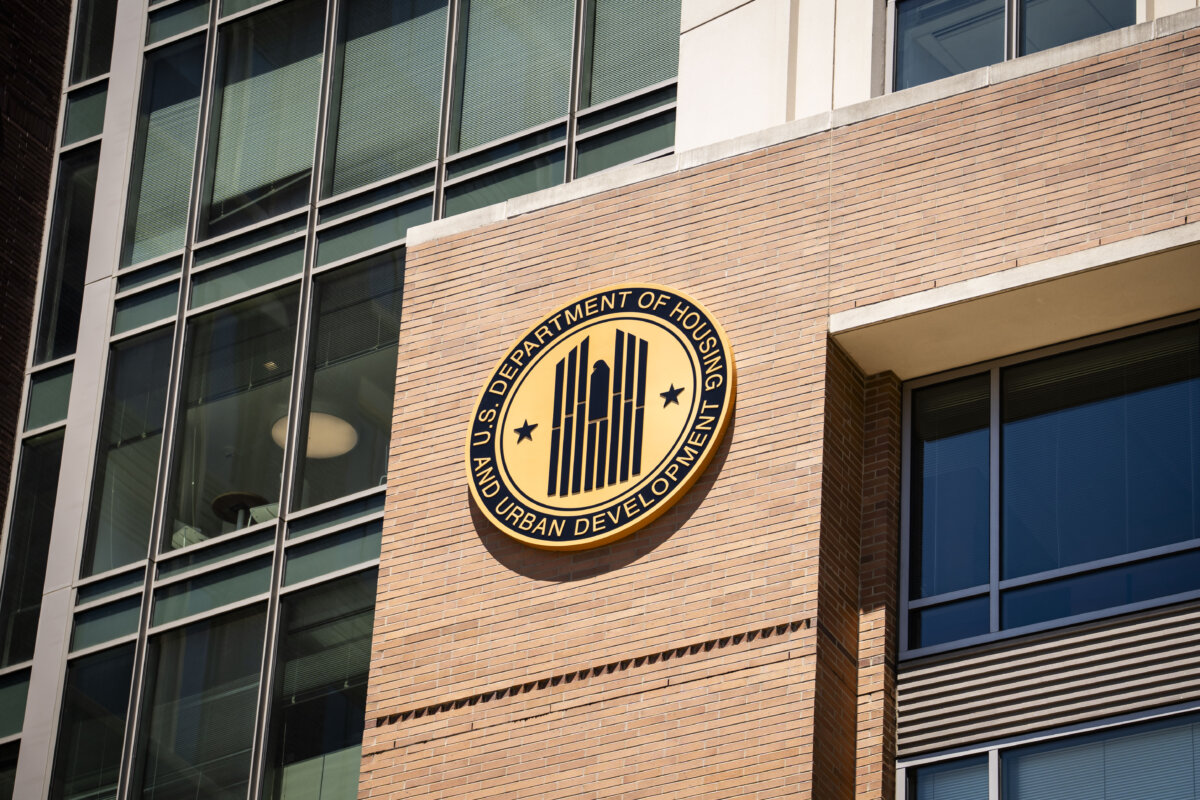

President Donald Trump announced a new public housing directive Monday, building on his administration’s earlier moves to give local housing authorities more latitude to consider criminal records when deciding whom to admit or evict.
The president made the announcement at a Washington event at the Department of Justice (DOJ) headquarters, with families of murder victims in the audience.
“I’m also directing the Department of Housing and Urban Development to compel public housing authorities to strengthen tenant screenings and make it easier to remove problematic tenants, of which people know who they are,” Trump said.
“Law-abiding families in need should not be forced to live beside dangerous criminals turning affordable housing into dens of violence and crime and horrible, horrible way to live.”
Housing Secretary Scott Turner replied on X within an hour.
“On it, Mr. President! Thank you for taking the safety of our communities seriously. Public Housing must be SAFE housing,” he wrote.
The event at the DOJ headquarters centered on a memorandum signed by the president directing the department to expedite federal executions and seek the death penalty for particularly heinous federal capital crimes, including first-degree murder of a minor; murder committed during rape, sexual abuse, sexual exploitation of a child or sex trafficking; and murder committed during kidnapping or human trafficking. [SOURCE]
The public housing directive he announced for HUD was not part of the memorandum.
Stricter Housing Rules
HUD has not yet released details on how it will carry out the directive. Federal regulations already allow housing authorities to deny admission to or evict tenants involved in drug-related or violent criminal activity.
The directive builds on other recent housing actions.
HUD completed a rule this month ending indefinite prorated assistance for mixed-status households, allowing it temporarily while eligibility verification is pending. It takes effect Dec. 14.
By mid-January, housing authorities must notify tenants who haven’t yet submitted proof of status that they must provide it or risk losing assistance.
“It’s unacceptable that America’s homeless veterans, disabled, elderly, and victims of domestic violence languish on waitlists while illegals and ineligibles scam our system. American taxpayers will no longer foot the bill,” Turner said in a statement Nov. 10.
In February, the agency proposed the ban on illegal immigrants and mixed-status households.
About a year ago, the agency took several steps to tighten public-safety rules in federally assisted housing.
On Nov. 25, 2025, Turner sent a letter to public housing authorities and owners of HUD-assisted multifamily housing informing them that the department had rescinded prior guidance governing the use of arrest and conviction records in admissions and evictions. [SOURCE]
Turner reminded authorities of mandatory denial rules for certain drug-related activity and lifetime sex offenders, as well as their ability to conduct optional broader criminal-history reviews.
He directed them to monitor households and remove people who threaten the safety and peaceful enjoyment of their units.
He also announced a national hotline the same month, allowing residents to report “criminals, illegal aliens, sex offenders, human traffickers, and those guilty of gang activity, drug distribution, and fraud.”
“Illegal aliens have no place in public housing,” Turner said at the time.
“It’s outrageous that people who should not be here come across our borders, and now usurp spots and housing units that support American people.
“Establishing this hotline is an important step in fighting this injustice for both the people of Memphis and for Americans nationwide.”
In an Aug. 29, 2025 letter, Turner gave housing authorities 30 days to submit proof of citizenship or eligible status for people in public housing or using Section 8 vouchers.
“No longer will illegal aliens be able to leave citizenship boxes blank or take advantage of HUD-funded housing, riding the coattails of hardworking American citizens,” he wrote.
Noncompliant authorities risked funding reviews.
These steps followed Trump’s February 2025 executive order, which directed agencies to ensure “no taxpayer-funded benefits go to unqualified aliens.”