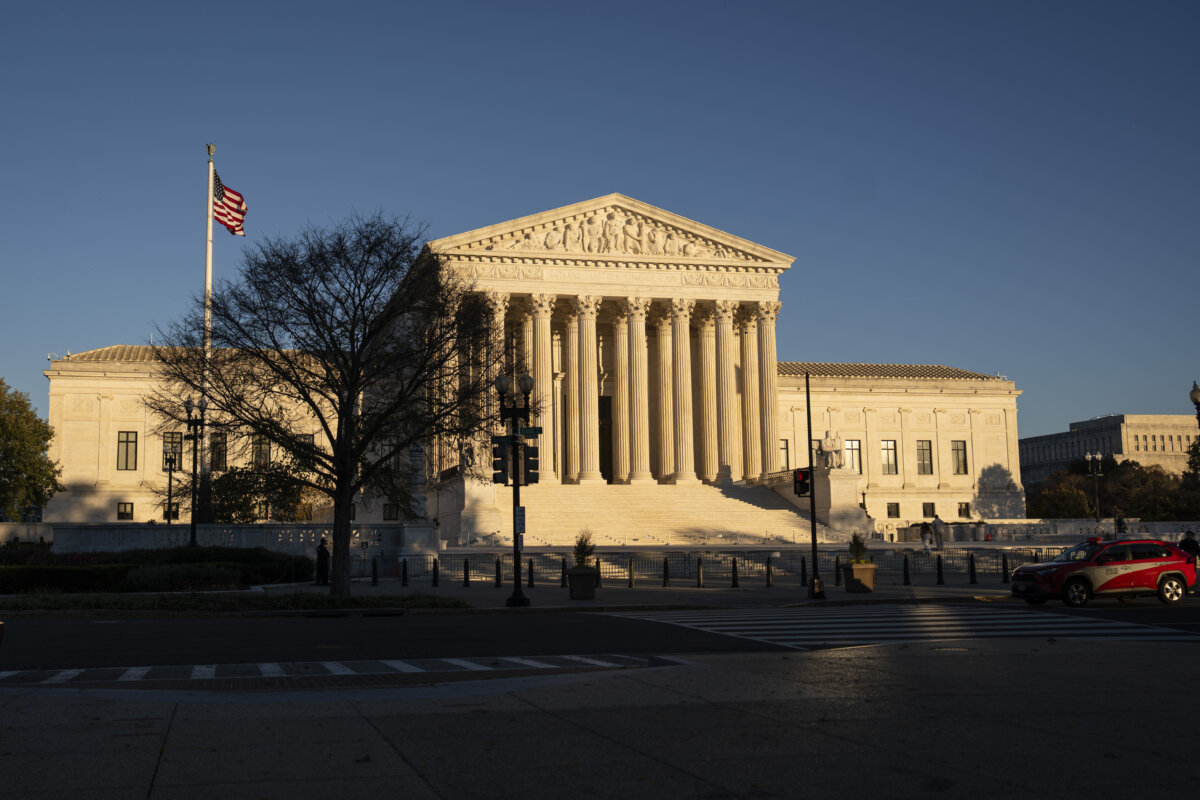

The U.S. Supreme Court on Nov. 16 turned away an appeal from activists who were cut off while speaking against a bill in Colorado that aimed to make it easier for people convicted of a felony and who identify as transgender to change their names.
No justices explained the decision to deny the appeal from the group Gays Against Groomers.
At least four of the nine justices must agree to accept a petition to hear a case, or the appeals are rejected.
Activists with Gays Against Groomers, which describes itself as a nonprofit made up of people “who oppose the sexualization, indoctrination, and mutilation of children under the guise of radical” lesbian, gay, and transgender activism, and several others brought the case.
They had attempted to testify against the Colorado proposal and were cut off from talking because lawmakers said they misgendered a male convict who now identifies as female.
The proposal, which was later approved and enacted, permits name changes to match a convict’s gender identity and allows the courts to require a public notice of the change.
The lawsuit alleged lawmakers violated the activists’ First Amendment rights and sought a judicial injunction against future instances of censorship.
State legislators enjoy immunity against such claims, a federal judge ruled in 2024. A U.S. Court of Appeals for the Tenth Circuit panel upheld the ruling.
The Supreme Court should take up the case because there are differences among appeals courts on whether officials who are sued in their official capacity may assert legislative immunity, lawyers for the activists said in their petition to the nation’s top court.
“The Tenth Circuit’s decision adds to that divide, sowing confusion about the nature of official-capacity suits and the scope of personal defenses like legislative immunity,” they wrote.
“This court has also long held that legislative immunity turns on the function at issue. Here, the legislators were not legislating when they enforced a facially viewpoint-discriminatory public comment policy that banned misgendering or critical remarks. The legislators had invited the public to state their own opinions.”
Officials said in response in a brief to the Supreme Court that justices should reject the appeal, asserting that officials are allowed to enforce rules to prevent disruptive behavior among those testifying in favor of or against proposed legislation.
They also said there is no circuit split for the Supreme Court to resolve.
“Legislative immunity for official-capacity actions has essentially been recognized by the First, Second, Third, Fourth, Sixth, Seventh, Eighth, Tenth, and Eleventh Circuits. And while Petitioners contend that the Ninth Circuit comes to the opposite conclusion, Petitioners rely on an unpublished, nonprecedential decision to support that contention,” they said.
A lawyer for the officials did not respond to a request for comment by the time of publication.
“We’re disappointed that the court declined to take up this case,” said Institute for Free Speech Senior Attorney Del Kolde, who has been representing the activists, said in a statement.
“Coloradans who want to weigh in on trans-related legislation must still choose between using government-mandated gender terminology and being silenced. The Tenth Circuit’s ruling gives legislative majorities a roadmap for censoring criticism by citizens who hold dissenting views, with no court able to stop them. That is bad for free expression.”