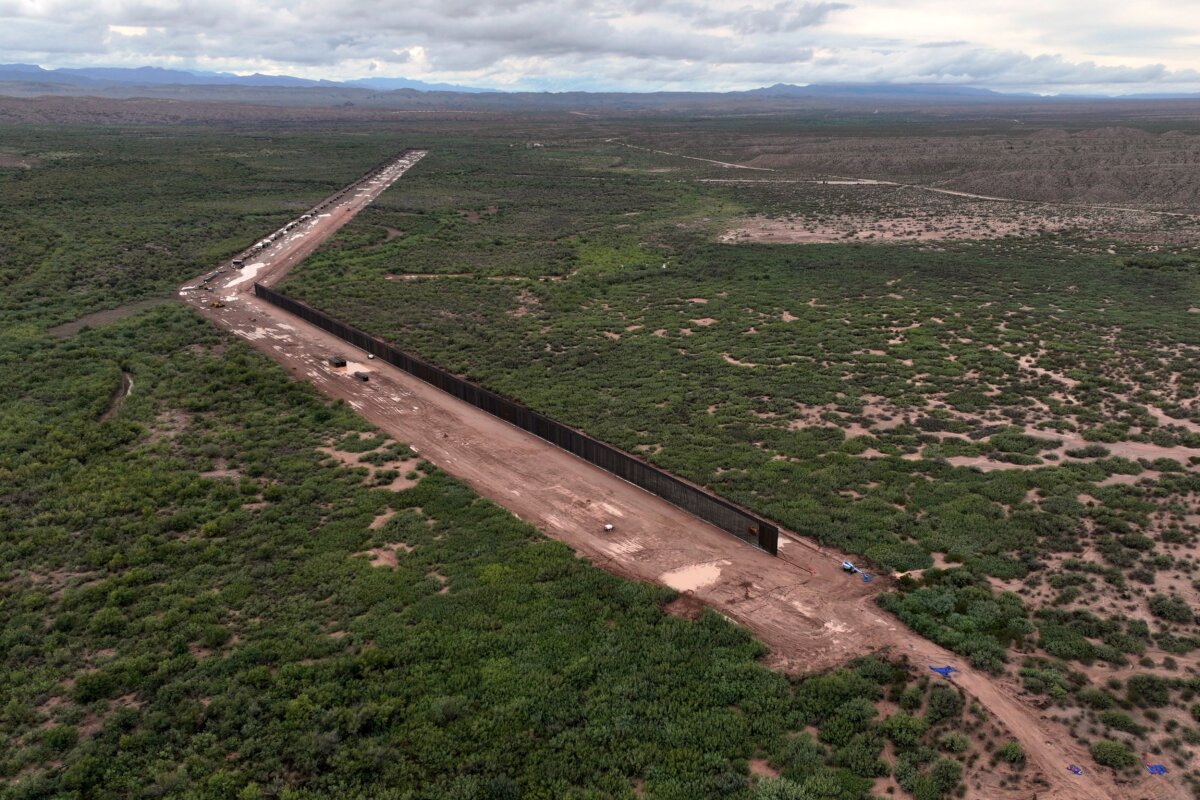

The Supreme Court on Nov. 9 paused a preliminary injunction that had blocked the Trump administration’s border barrier construction in an area including Big Bend National Park in Texas, allowing work to resume while the litigation plays out.
Justice Ketanji Brown Jackson dissented from the court’s order. She did not explain her decision.
In an emergency application filed with the high court on Oct. 21, lawyers for the federal government asked the justices to lift a lower court order halting construction of President Donald Trump’s key project, which began during his first term in office.
In an Oct. 2 order, U.S. District Judge Kathleen Cardone sided with an environmental group and others who claimed that the project was unconstitutional, breached the separation of powers, and took land from residents.
“This case involves a baseless injunction that halts a major portion of the construction of the border wall,” U.S. Solicitor General D. John Sauer wrote in the emergency application. “Moreover, leaving a 300-plus-mile gap in border defenses would act as a dangerous magnet for cartels and other bad actors to exploit as other routes close off.”
The Trump administration argued that continuing construction was crucial because the Big Bend region encompasses nearly one-quarter of the U.S.–Mexico border.
In its new ruling, the nation’s highest court stated that Section 102 of the Illegal Immigration Reform and Immigrant Responsibility Act of 1996 gives the homeland security secretary broad authority to build border barriers and roads “to deter illegal crossings in areas of high illegal entry into the United States.”
The same section also authorizes the secretary “to waive all legal requirements” as “necessary to ensure expeditious construction” of those barriers and roads and “sharply limits judicial review of all claims arising from such waiver determinations.”
The act states that “‘[a] cause of action or claim may only be brought alleging a violation of the Constitution of the United States’” and that courts “shall not have jurisdiction” over claims not alleging a constitutional violation, the court stated.
Earlier this year, Homeland Security Secretary Markwayne Mullin invoked Section 102’s waiver authority to initiate a border-construction project at the U.S.–Mexico border, in a region that Customs and Border Protection calls the “Big Bend Sector.”
The secretary found that the sector “is an area of high illegal entry” that needs additional border barriers and waived a variety of environmental and conservation laws to allow construction to proceed, the court stated.
The justices reasoned that the environmental lawsuit was really about whether Mullin exceeded the authority Congress gave him, not about whether he violated the Constitution. Dressing up a statutory complaint as a constitutional one falls outside what the statute allows, they said.
The plaintiffs had argued that the waivers violated the major questions doctrine under the Constitution. That doctrine states that Congress must speak clearly when it hands an agency power over an issue of vast economic or political significance, rather than letting the agency infer that authority from vague language.
The district court agreed that this counted as a constitutional claim because it viewed the doctrine as a clear statement rule grounded in the separation of powers. The separation of powers is a constitutional doctrine that divides the government into three distinct and independent branches to prevent the concentration of power.
The Supreme Court disagreed. It stated that the doctrine is a tool courts use when interpreting statutes, not a free-standing constitutional claim.
“There is no such thing as a ‘constitutional’ major-questions claim,” the court stated in its written opinion.
The Supreme Court also stated that the remaining factors for a stay favored the government. The injunction delays construction and is costing almost half a million dollars per day in expenses that “cannot be recouped.”
Weighing the two sides, the justices noted that Congress, by giving the secretary waiver authority, had already chosen expeditious border construction over the environmental and recreational harms the plaintiffs alleged.
Troy Myers contributed to this report.