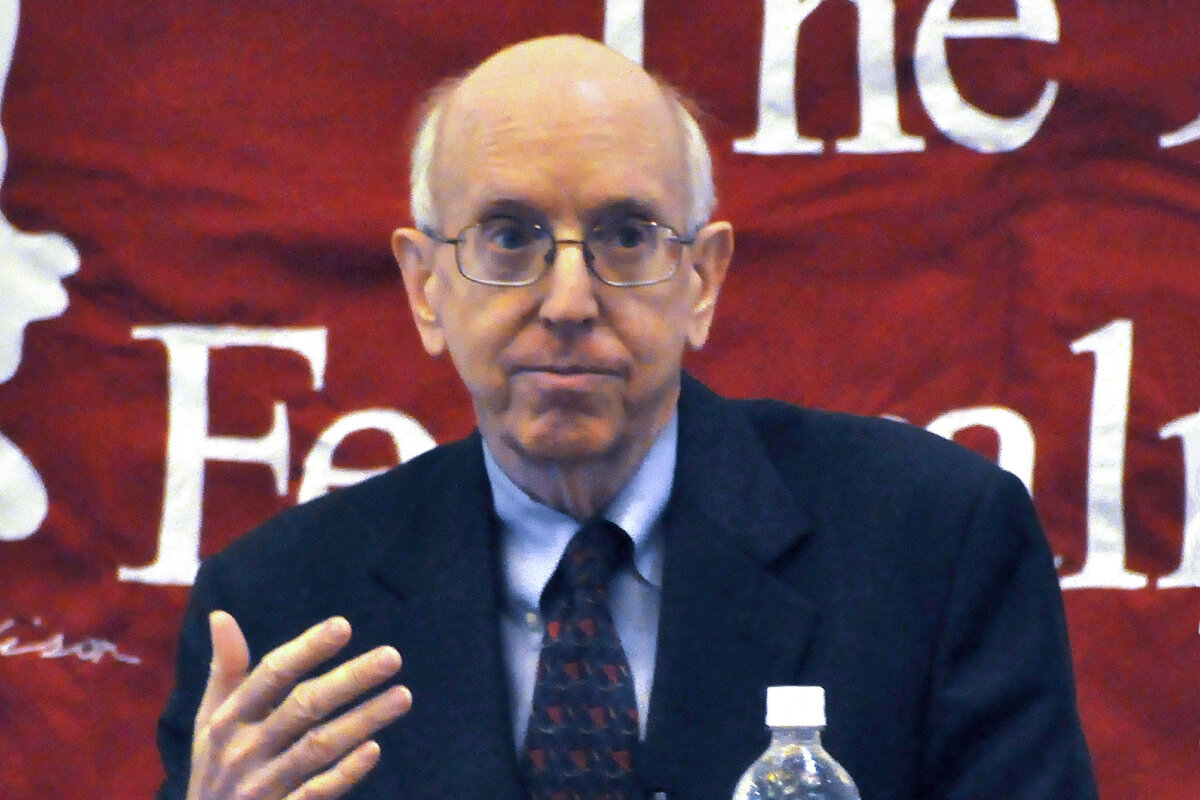

Former federal appeals court judge Richard A. Posner, a widely respected and influential legal thinker, died on Nov. 10, the University of Chicago Law School said. He was 87.
Posner, who joined the law school faculty in 1969, served as a judge of the Chicago-based U.S. Court of Appeals for the 7th Circuit for 36 years, and received broad recognition as “the most influential legal scholar of all time,” the school said in a statement on Nov. 11.
The school did not report a cause of death. Posner was diagnosed with Alzheimer’s disease about six months after he retired from the appeals court in September 2017, according to a February 2022 letter from his attorney, Reuters reported in March 2022.
Posner was nominated to the 7th Circuit by President Ronald Reagan and confirmed by the U.S. Senate in November 1981. He was the circuit court’s chief from 1993 to 2000.
While serving on the bench, he was also “considered to be among the most powerful jurists outside the Supreme Court,” the school said, adding that he wrote thousands of court opinions and dozens of books. He was also considered to be one of the leading academics in the field of law and economics, the school said.
That academic discipline uses economic reasoning and data to test how legal rules work in practice and to determine which ones produce better results.
Among his better-known books are “Economic Analysis of Law” (1973), “How Judges Think” (2008), and “Public Intellectuals: A Study of Decline” (2001).
In “How Judges Think,” he argued that judges occasionally function as legislators rather than passive umpires simply calling balls and strikes.
“When conventional legal materials run out, judges are on their own, navigating uncharted seas with equipment consisting of experience, emotions, and often unconscious beliefs,” Posner wrote.
In the majority opinion in Baskin v. Bogan (2014), he rejected the argument that longstanding bans on same-sex marriage were valid because they had a long history.
“Laws forbidding black-white marriage dated back to colonial times and were found in northern as well as southern colonies and states,” he wrote.
“Tradition per se therefore cannot be a lawful ground for discrimination—regardless of the age of the tradition.”
The law school paid tribute to Posner’s legacy on Nov. 11.
“There has never been a legal scholar quite as prolific, influential, and endlessly curious as Dick Posner—he was a giant whose influence on our legal system, the field of law and economics, and on our law school cannot be overstated,” said Law School Dean Adam Chilton, the Howard G. Krane Professor of Law.
“As a law and economics scholar and torts professor, I doubt there has been a week that’s gone by since I started teaching at the Law School where I haven’t talked about one of Dick’s ideas or opinions. We will mourn his loss deeply, and on behalf of the entire Law School community, I extend our deepest condolences to his family.”
Former federal prosecutor Neama Rahmani called Posner “a legend in law and economics.”
“We lost one of the great legal minds of our generation,” Rahmani told The Epoch Times.
Steven J. Allen, a senior fellow at the National Legal and Policy Center, described Posner as “one of the greatest legal minds in American history.”
“A brilliant scholar can affect the direction of the debate, and can change how people think,” Allen told The Epoch Times. “That’s what Posner did.”







