
A Madonna and Child portrait that has survived for five centuries is bringing a touch of Renaissance art to the U.S. Postal Service’s holiday stamps.
The stamp features a rare, richly symbolic image from a painting in the collection of the Sterling and Francine Clark Art Institute in Williamstown, Massachusetts, USPS said.
“This painting caught my eye because of the beautiful red folds in the Madonna’s dress and the unusual background,” said Greg Breeding, a USPS art director.
“The background offers more detail and context than we sometimes see in Madonna and Child paintings, and I find it unusually interesting and beautiful.”
The stamp continues a tradition of U.S. Christmas stamps that began in 1962. A Madonna and Child design first appeared in 1966.
Until 2009, new Madonna and Child images were issued nearly every year, with occasional departures for other designs featuring traditional imagery such as angels and Nativity scenes.
Since 2011, the Postal Service has issued a new Madonna and Child stamp about every two years.
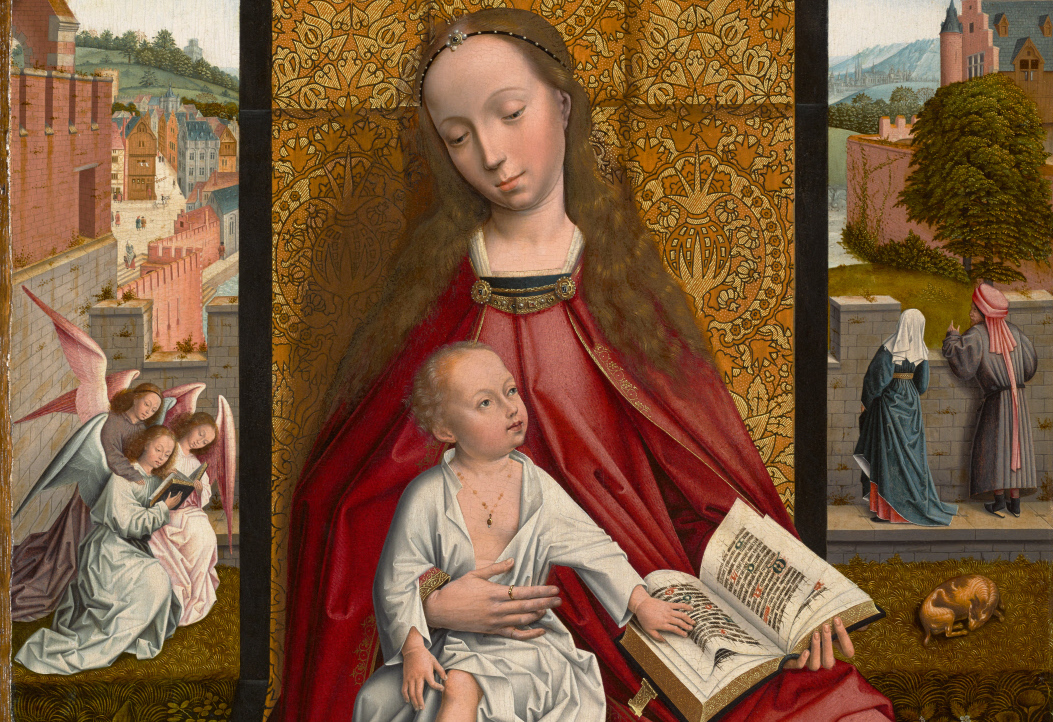
The stamp reproduces “The Virgin and Child Enthroned,” a painting dating to around 1500 that depicts the Virgin Mary and the Christ child, according to the Postal Service.
The masterpiece is attributed to the Master of the Embroidered Foliage, “a catch-all name referring to a number of painters active in Brussels and Bruges in the late 15th century,” according to the Clark Institute.
A number of works painted around 1500 and ascribed to this anonymous artist or artists are characterized by the delicate foliage seen in the painting.
The oil-on-panel painting features Mary seated prominently in red garments amid a wealth of symbolic details.
“Mary’s red garments are detailed with gold and jewels, and she is wearing a jeweled band with pearls on her head—all signs of her exalted status,” the Postal Service said.
Dressed in white, the Christ child sits in Mary’s lap, resting one small hand on a decorated book of hours, a collection of prayers intended for different times of day.
The painting also features brocade woven with gold and silver threads, angels, a heavenly Jerusalem and two small human figures, details characteristic of Netherlandish painting of the period.
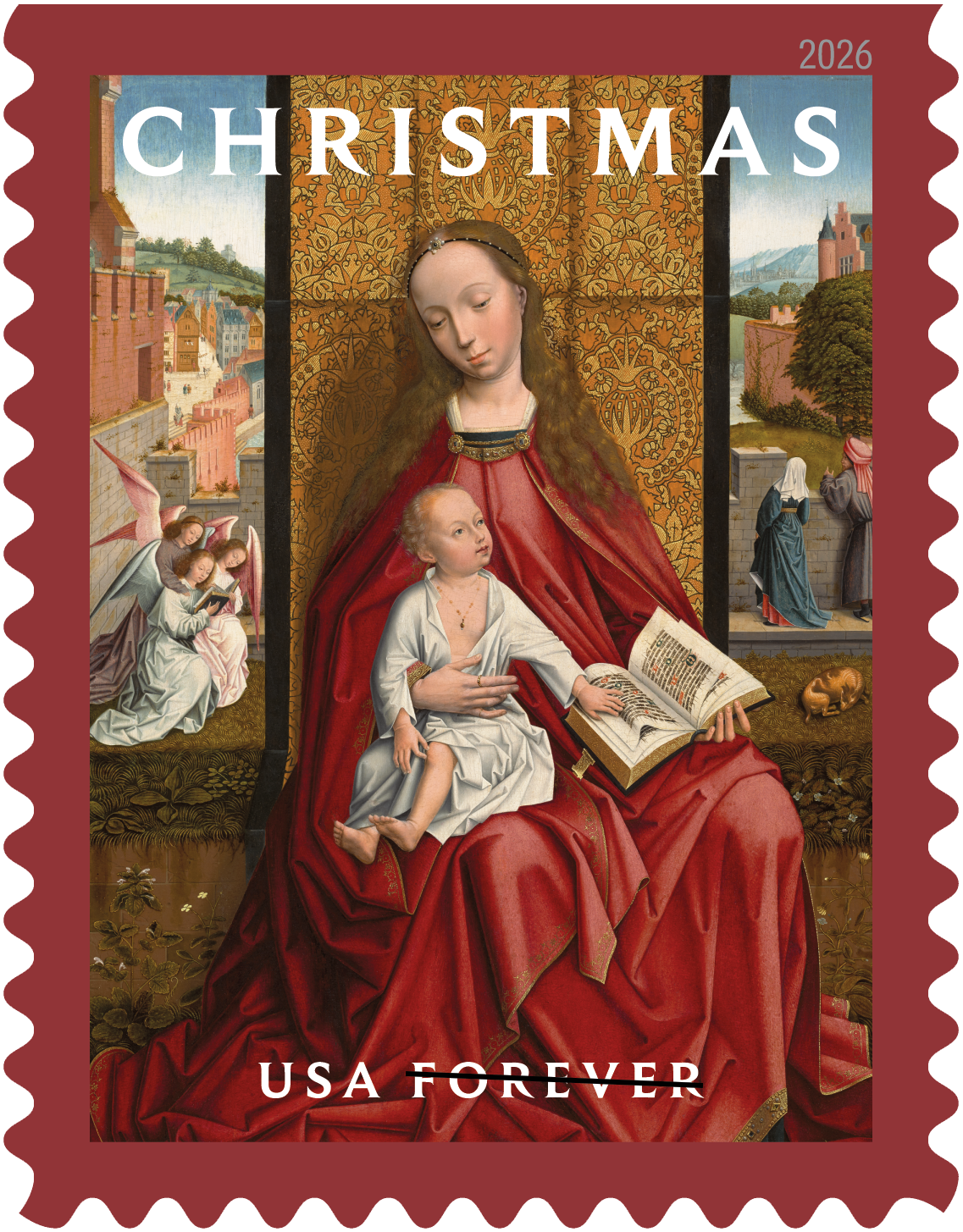 The new U.S. Postal Service Christmas stamp features an iconic 16th-century portrait of the Madonna and Child. (Courtesy U.S. Postal Service)
“Art historians have documented the numerous Christian symbols in this painting,” the Postal Service said.
For example, the Christ child wears a necklace featuring a red carbuncle, a symbol of martyrdom, and a pearl, which represents salvation. Pomegranates on the textile behind the figures suggest fertility and resurrection.
The Clark Art Institute identifies other possible symbols, including a small dog representing faith, plantains growing along the road to salvation, and strawberries symbolizing righteousness and good works.
The walled garden has been interpreted as a symbol of Mary’s purity.
Breeding told The Epoch Times that continuing the Postal Service’s long tradition of featuring Madonna and Child images on postage stamps was an inspiring challenge.
“It’s always a great challenge to bring almost any artwork down to stamp size,” Breeding said.
“For this series, I try to crop the artwork so that the primary figures are visible at stamp size. But honoring the dimensions of the work is important, so I enlarge these artworks carefully.”
Staying true to the original painting was a priority, he said.
“Because of Mary’s red dress, there is a triangle of her face, the infant, and of the scriptures that were important for me to retain. They form, I think, the essence of the painting,” Breeding said.
The Postal Service generally avoids altering historic artworks, with cropping to fit a stamp’s dimensions as the main exception, he said.
“What’s more, the decorative gold embroidery is a distinctive part of these historic paintings,” Breeding said. “And while we can’t show them in their fullness, having them displayed behind the Madonna gives the viewer a sense of the beautiful detail and texture.”
Historic artworks are scanned or photographed at high resolution. Breeding said the image quality of this painting was excellent, making production and printing easier.
“We strive to represent the color and details authentically, and although this image has a lot of detail, it did not prove to be problematic on press. As the technology has improved, we’re able to capture extraordinary detail,” Breeding said.
“For historic paintings, our primary motivation is to reproduce the art authentically. So we didn’t use special techniques other than, during the production, provide color corrections to ensure the printing matches the original.”
The Postal Service said it printed 185 million Christmas stamps, which will be issued in booklets of 20.
A few years ago, Breeding redesigned the series template to create more room within the frame and incorporate the typography into the image.
“The red robe [of the Madonna] is so beautifully painted that I was hoping the stamp would show off the intricate folds. I think they successfully hold up in the final stamps,” Breeding said.
The Postal Service offers a variety of holiday stamp designs to reflect diverse traditions.
The Madonna and Child series is part of that broader program, said Lisa Bobb-Semple, director of Stamp Services.
“There are so many Madonna and Child paintings that we choose only those that are in museums in the United States even though most of them were painted in Europe,” Bobb-Semple told The Epoch Times.
“And this one in particular stands out, as I have said, because of both the beautiful red robe and the gold decorative background.”
The Postal Service creates original art for many commemorative stamps but also frequently reproduces historic paintings and photographs.
“From my point of view, we create a great number of graphic and easily readable stamps for the public, but we’ve learned that they equally enjoy color and texture and detail, and don’t seem to be thwarted by how many of these stamps can be a visual challenge to see clearly,” Bobb-Semple said.
The Postal Service says the stamp series gives people an opportunity to encounter historic works of art in an everyday setting.
“A postage stamp can introduce artwork to audiences who might not otherwise come across it,” the agency said.
“Because stamps reach such a wide audience, USPS looks for artwork that is visually engaging and broadly recognizable. The goal is to create a design that works wherever the mail travels.”
As Forever stamps, the Postal Service says these stamps will always be equal in value to the current First-Class Mail 1-ounce price. For additional information, visit hashtag #MadonnaAndChildStamp.
Correction: A previous version of this article misstated the timeline of Madonna and Child stamp issuance.