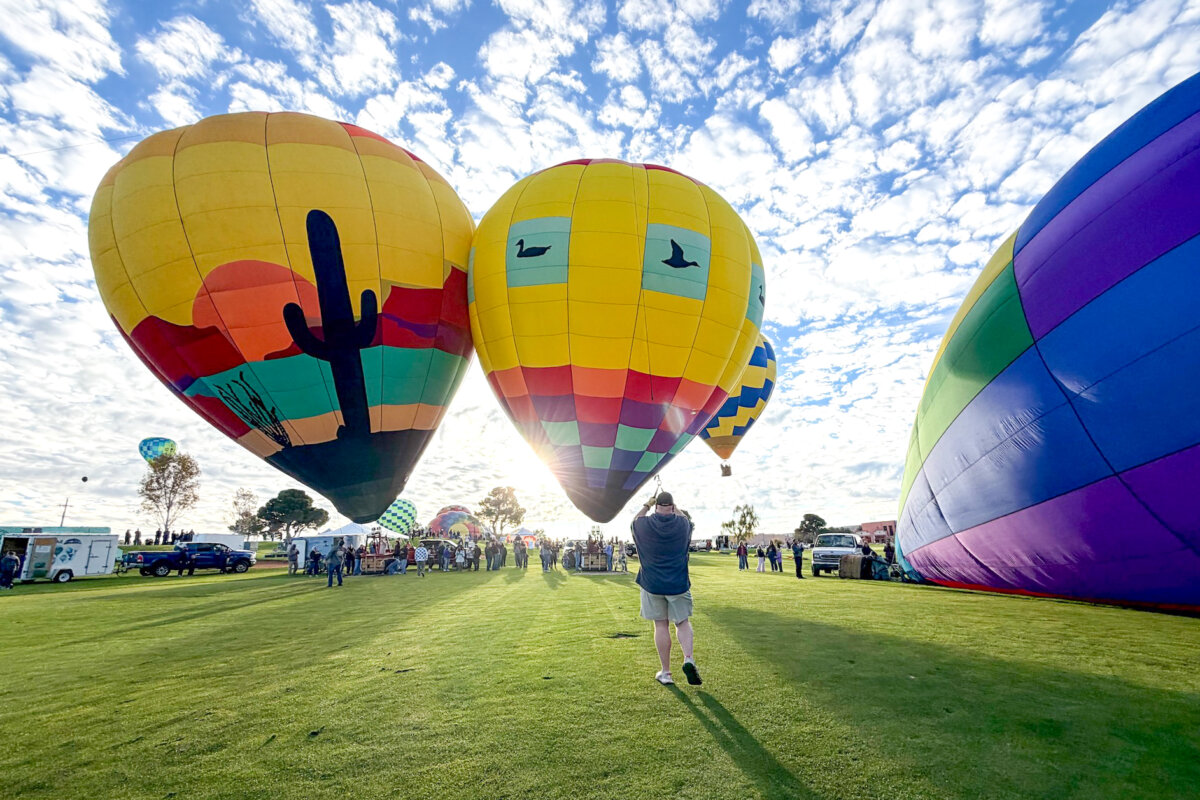

PAGE, Ariz.—Scattered cheers rang out across the golf course as a small red test balloon drifted into the morning desert sky.
All eyes followed the pilot balloon, or “pibal,” until it disappeared from view.
Atmospheric conditions—stable.
Wind velocity—favorable.
Enthusiasm—high.
The “balloonmeister” gave the all-clear. The 23rd annual Page Balloon Regatta launched on Nov. 5.
At Lake Powell National Golf Course, pilots unloaded wicker baskets from trailers and spread deflated balloon envelopes across the green.
Crews fired up powerful fans to inflate the colorful fabric until the envelopes took shape on the grass.
Propane burners roared to life, sending bursts of flame inside the envelopes. The hot air expanded the fabric until each balloon stood tall, stretched taut against its tether.
Hot-air balloon flying is “the opportunity of a lifetime,” said Misti Martin, 70, standing beside her yellow balloon, decorated with tropical-themed flip-flops.
“It’s addicting. You want to do it again and again,” she said.
Martin has worked on balloon crews for years, she said. Her husband, Allan, 59, is a student pilot.
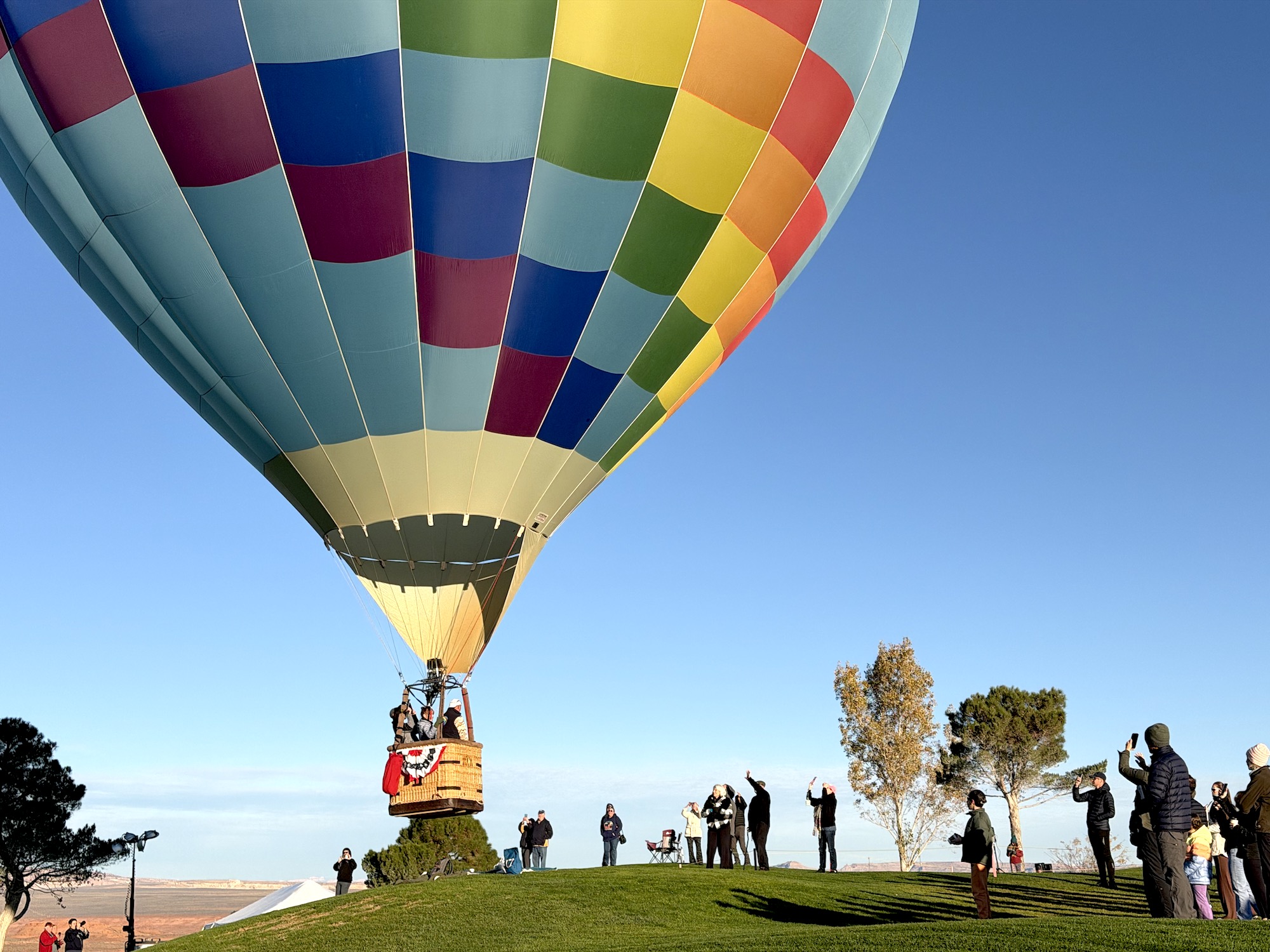 A hot air balloon slowly lifts off the green during the Balloon Regatta in Page, Ariz., on Nov. 6, 2026. (Allan Stein/The Epoch Times)
“We had been looking around for quite some time—just kind of checking it out, not really thinking about it. And then this balloon came up for sale,” Martin told The Epoch Times.
Their shared love of Jimmy Buffett and his Margaritaville spirit made the decision easier.
“Flip-flops were just a standard thing,” Martin said.
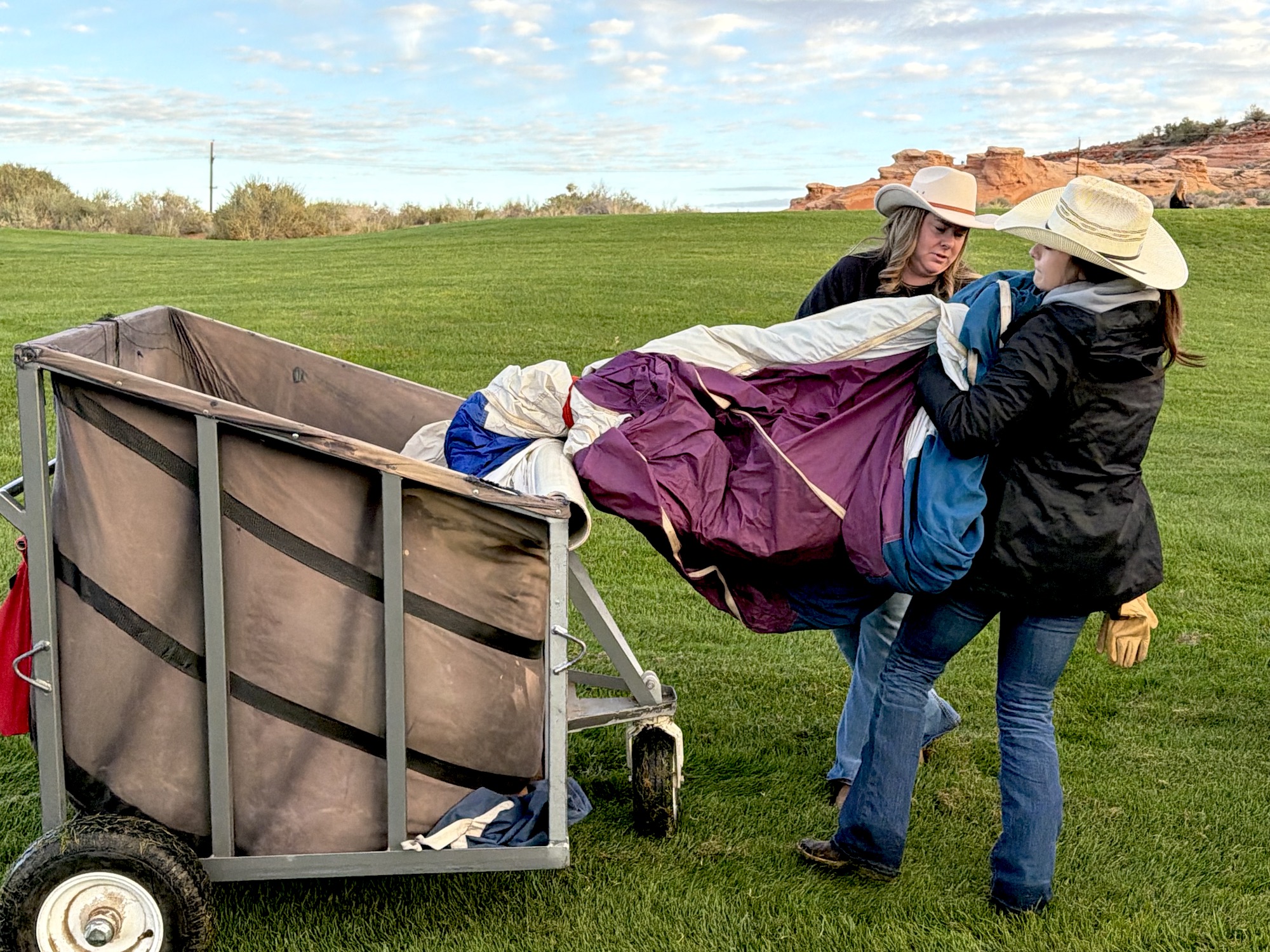 A hot air balloon crew pulls the deflated envelope from its container during the 23rd annual Page Balloon Regatta in Page, Ariz., on Nov. 6, 2026. (Allan Stein/The Epoch Times)
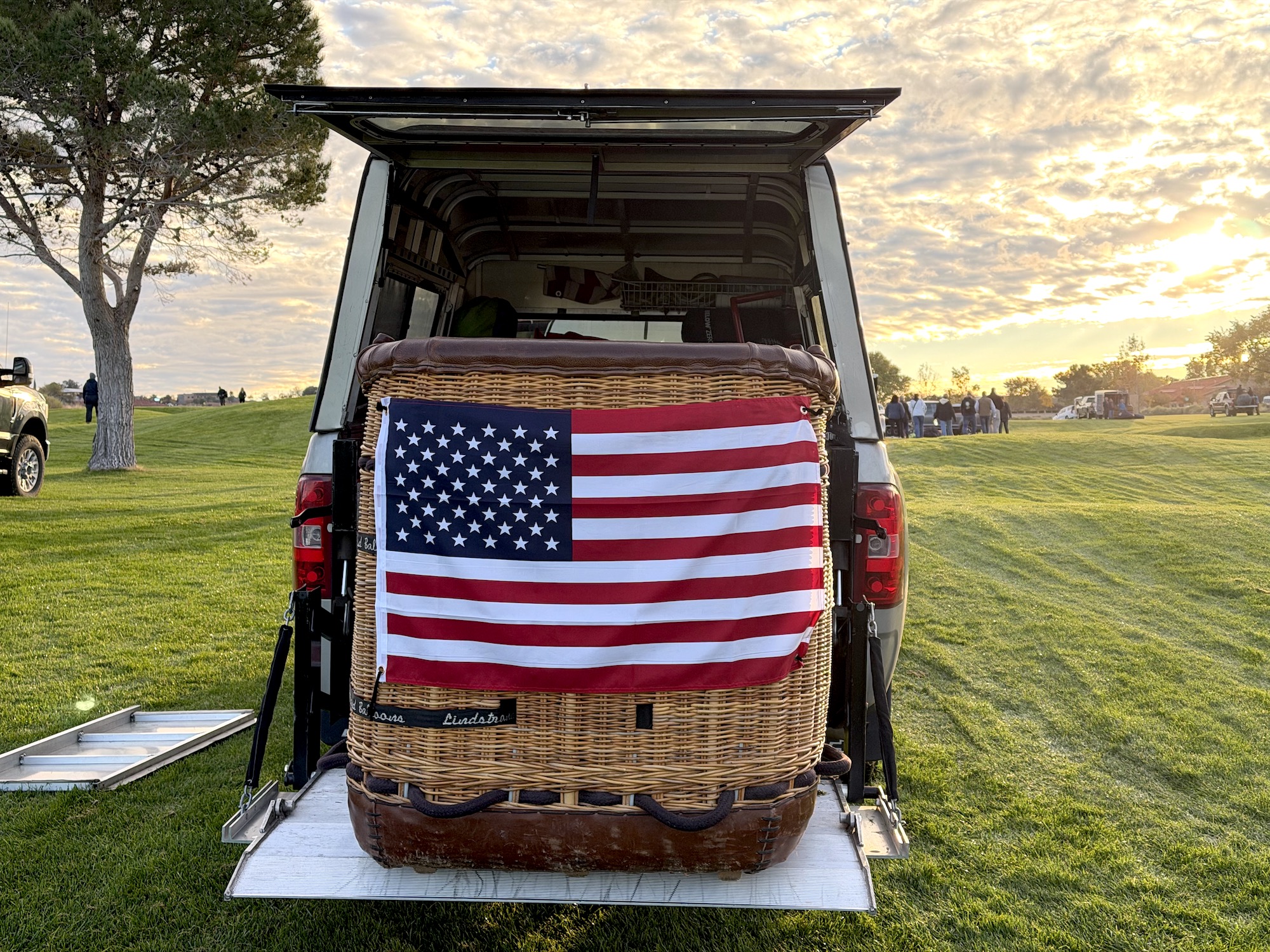 A flag-draped gondola awaits unloading. (Allan Stein/The Epoch Times)
“Our friends had a problem with their balloon and couldn’t fly it,” Martin said. “We offered our balloon.”
Sixty-three pilots took part in this year’s regatta, held Nov. 5 through Nov. 8. One by one, brightly colored balloons filled the morning sky, drifting hundreds of feet above Page.
Below, the city’s red sandstone mesas and rugged canyon landscape provided a dramatic backdrop to the spectacle.
Page events manager Lissette De la Cruz said the annual gathering attracts pilots from across the country and thousands of spectators.
“We’re so grateful to have this wonderful opportunity. It’s a tradition and a community event,” De la Cruz told The Epoch Times.
The event promotes ballooning and helps make Page a more attractive destination for visitors, she said.
The City of Page organizes the annual Balloon Regatta through its special events team, while the Page-Lake Powell Chamber of Commerce hosts the accompanying Street Fair.
The Canyon Club of Page also participates in the event with its annual Life’s a Ball fundraiser.
Bryan Hill, 62, played a central role in building the regatta’s reputation and popularity as balloonmeister, overseeing flight safety, weather assessments, and launch coordination.
 Former balloonmeister Bryan Hill at the 23rd annual Balloon Regatta in Page, Ariz., on Nov. 6, 2026. (Allan Stein/The Epoch Times)
“I just like to fly. It’s a different art,” Hill said. “You can’t steer a balloon.”
Balloonists rely on air currents rather than maneuvering along a predetermined course, he said.
Morning air generally offers the most stable conditions, Hill said. Pilots look for favorable currents at different altitudes, or “layers.” Pilots generally prefer wind speeds of 10 miles per hour or less.
“That’s why we fly in the morning. We fly different layers that hopefully go in different directions. You never get your way completely,” Hill said.
The regatta started more than 20 years ago with just 13 balloons and grew year after year, Hill said.
“It’s a great sport—the camaraderie. It’s a very social part of aviation,” he told The Epoch Times.
Learning to Fly
Federal Aviation Administration rules let private pilot applicants either receive ground training from an authorized instructor or complete a home-study course on the knowledge areas. Classroom instruction is not required.
Candidates must pass a written exam covering meteorology, federal aviation regulations, sectional charts, navigation, and balloon operations, according to the Arizona Balloon Club.
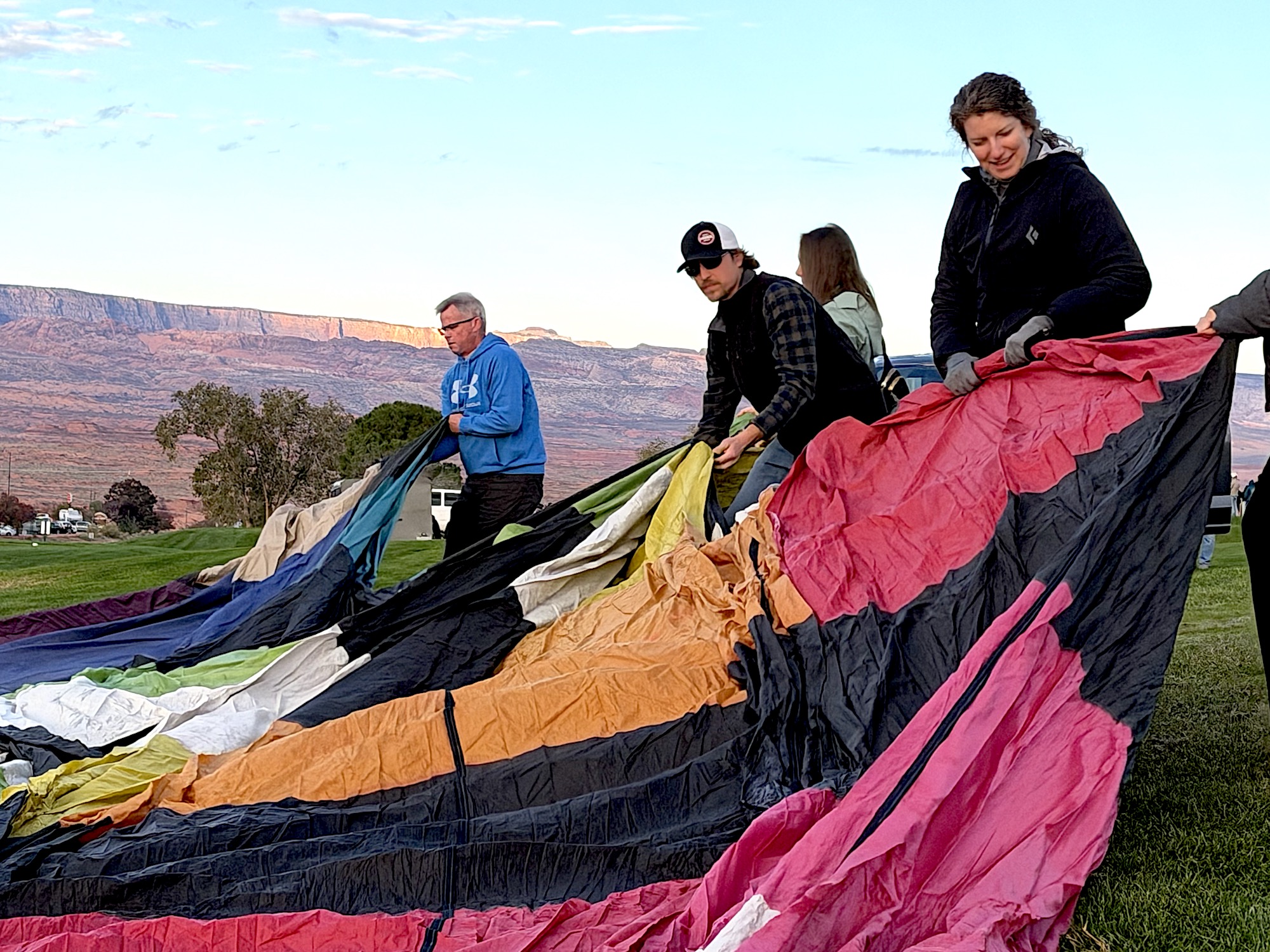 A balloon crew unfolds an envelope at the Balloon Regatta in Page, Ariz., on Nov. 6, 2026. (Allan Stein/The Epoch Times)
At least two one-hour instructor-led flights must occur within two calendar months of the final flight test, known as a check ride. Although 10 hours is the minimum, many candidates accumulate 25 to 30 flight hours before attempting the check ride.
Hill has remained active in the sport since his years as balloonmeister.
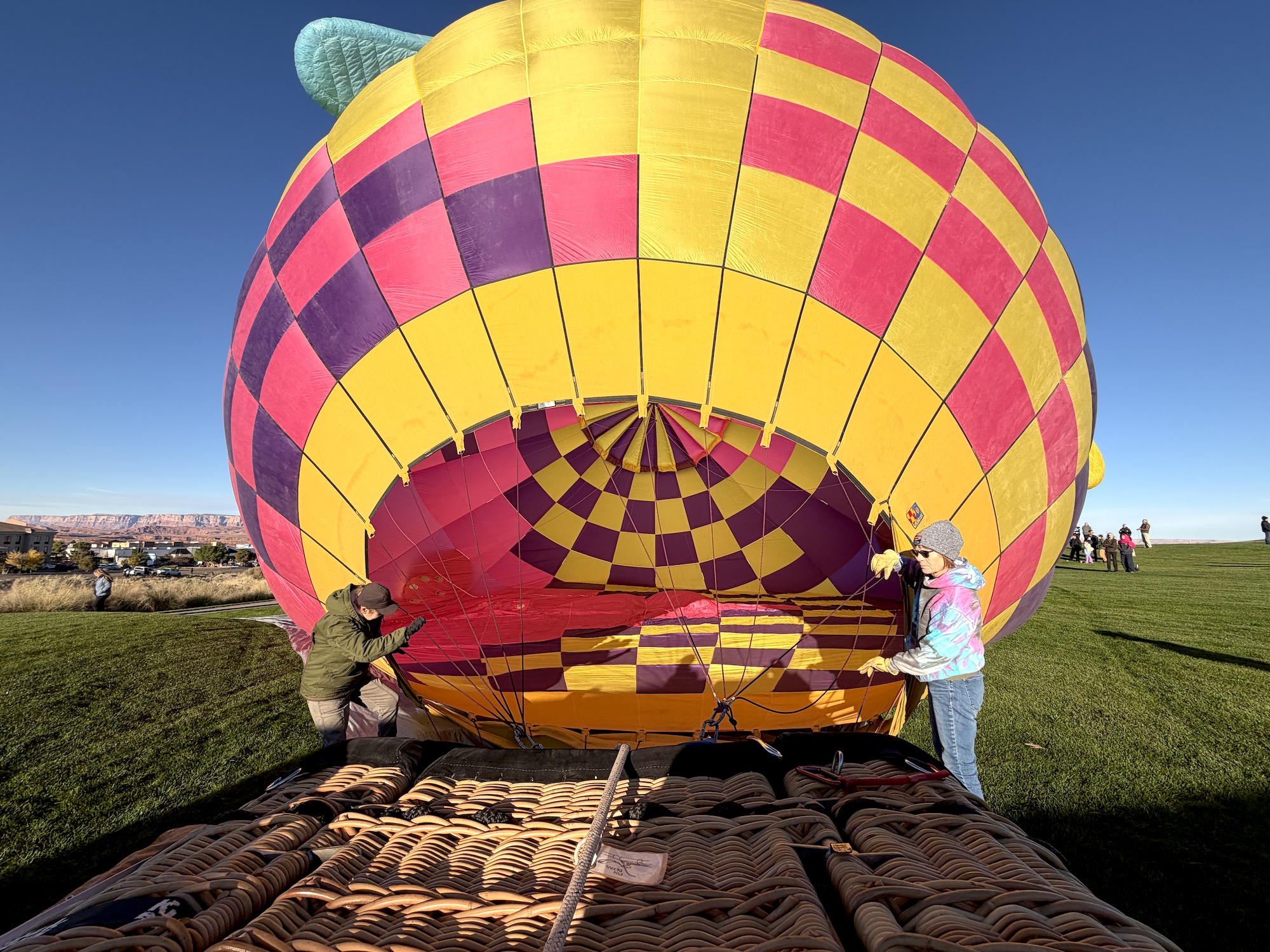 A balloon crew inflates an envelope with fan-blown air in Page, Ariz., on Nov. 6, 2026. (Allan Stein/The Epoch Times)
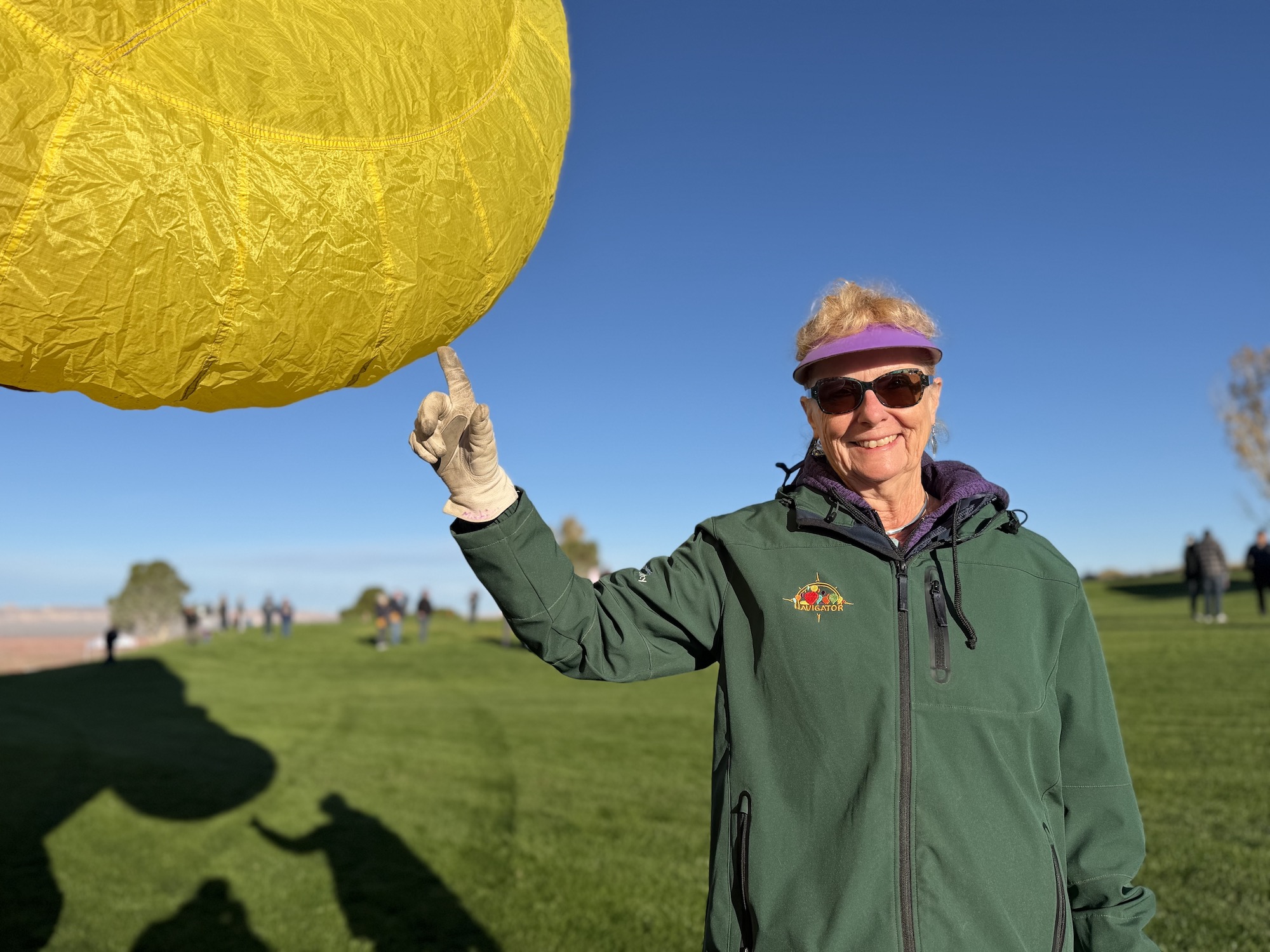 Balloon owner Misti Martin of Reno, Nev., beside her balloon in Page, Ariz., on Nov. 6, 2026. (Allan Stein/The Epoch Times)
“My friend got me involved. Bryan Hill taught me how to fly,” Godfrey told The Epoch Times. “I try to fly once a month at minimum.”
Godfrey’s 90,000-cubic-foot balloon, named Soar With Eagle, featured a colorful rainbow spiral pattern. At full inflation, its envelope holds the equivalent of 90,000 basketballs, he said. Godfrey joined Hill’s crew in 2004.
Now a licensed pilot, he has no fear of flying thousands of feet above the ground, suspended beneath a fabric envelope by cables and a wicker basket.
“It’s your mindset,” he said. “It’s like levitation.”
Godfrey described hot air ballooning as a very safe sport, with safety foremost in pilots’ minds.
“We call the weather. If there’s anything iffy, we don’t fly,” he said.
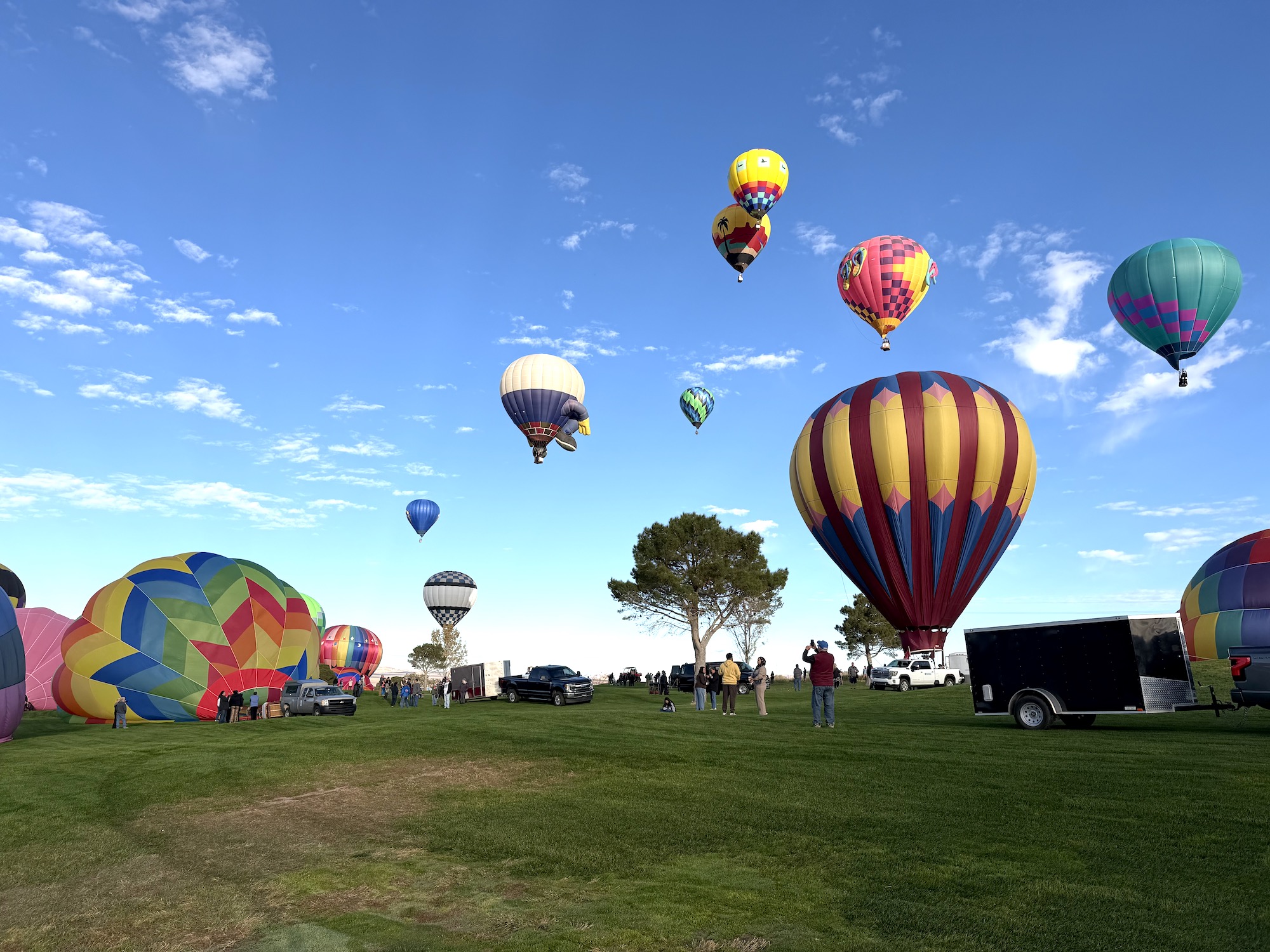 Balloons take off in Page, Ariz., on Nov. 6, 2026. (Allan Stein/The Epoch Times)
Balloons come in a variety of shapes, colors, and patterns, but all operate on the same basic principle of physics.
Heating expands the air inside the envelope, making it less dense than the surrounding air and creating buoyancy. Pilots climb by heating the air; they can descend by letting it cool or venting hot air.
The gondola assembly includes the wicker basket, burners, propane tanks, and parachute valve cord. The envelope is made of ripstop nylon, polyester, or other heavy-duty materials. The nylon skirt at the base of the envelope with coated with special fire resistant material.
At the top of the envelope, the parachute valve allows pilots to release hot air and control the balloon’s descent during landing.
“If we really hit it hard,” Martin said, “setup takes around 30 minutes before takeoff.”
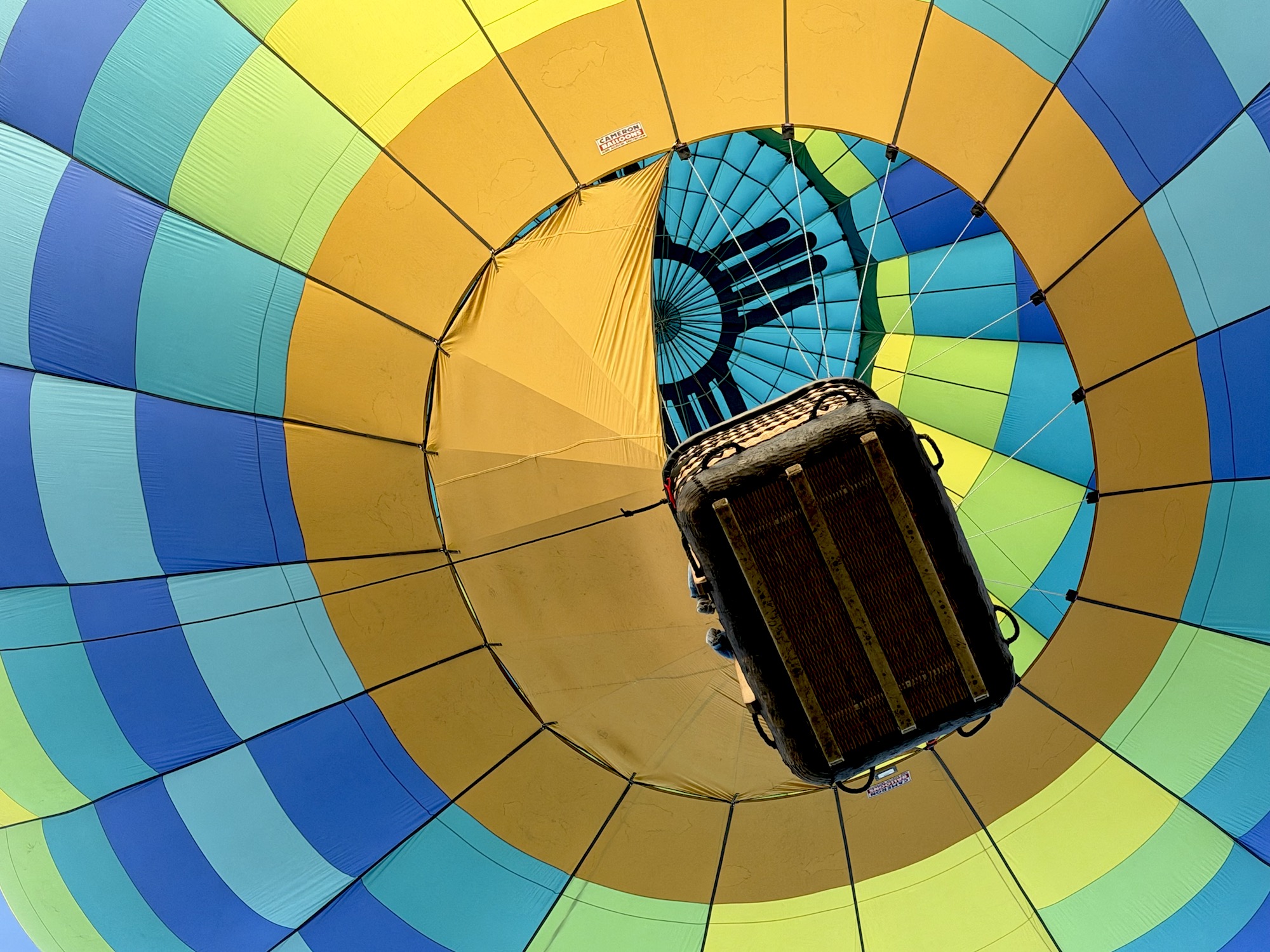 A balloon gondola as seen from below in Page, Ariz., on Nov. 6, 2026. (Allan Stein/The Epoch Times)
Many pilots at the regatta had chase vehicles following their flight paths to retrieve the balloons and passengers after landing.
“Hot air balloons don’t land in pre-decided locations like planes and helicopters,” a 2026 Balloon Regatta brochure reads.
“When the basket touches down, sometimes there is a bump, and the basket can occasionally tip over slightly. This is quite safe and normal. Balloons have been landing like this for over 200 years, and modern balloon baskets are designed for this.”
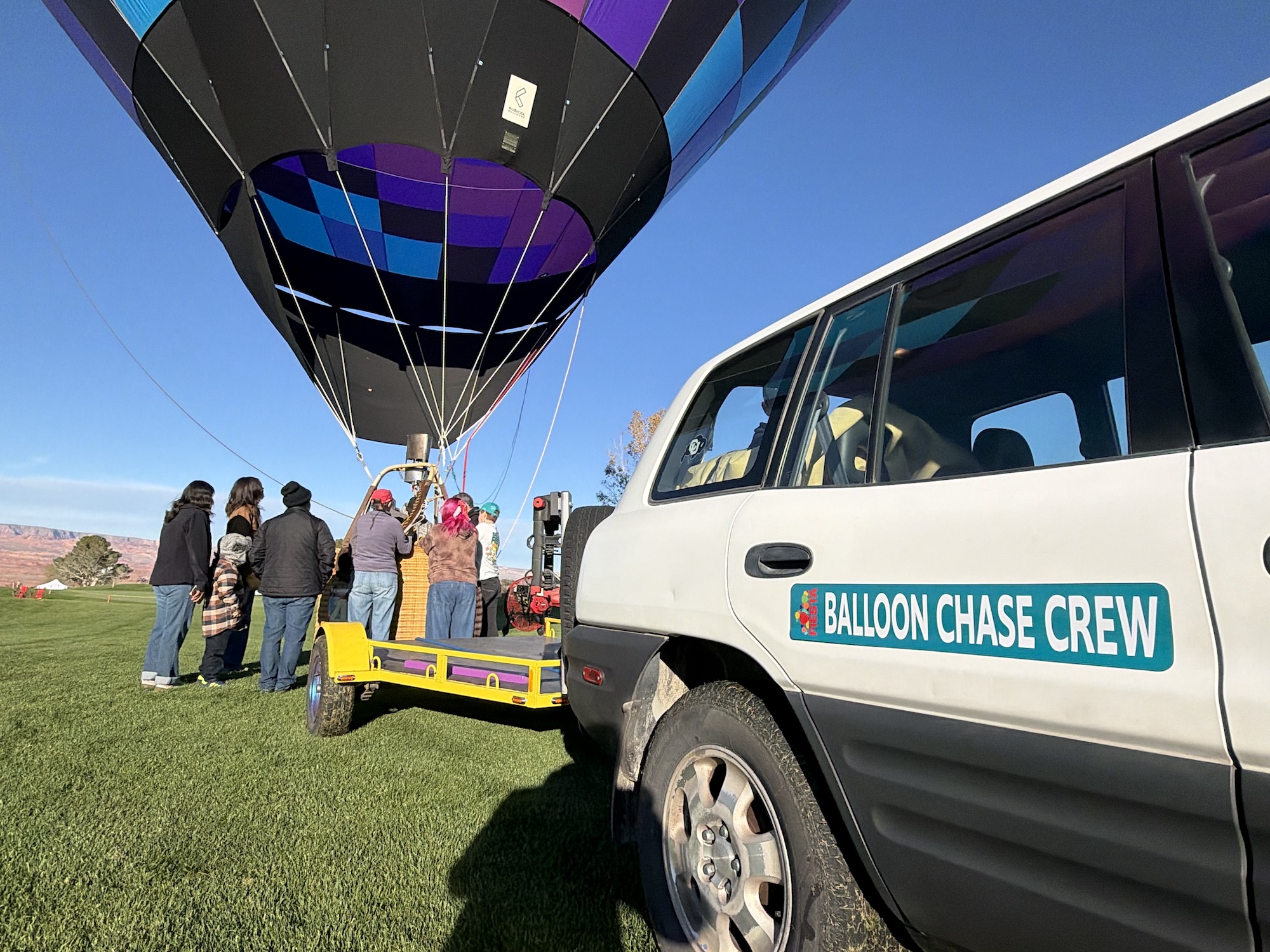 A balloon chase crew vehicle sits ready to follow a hot air balloon before takeoff during the Balloon Regatta in Page, Ariz., on Nov. 6, 2026. (Allan Stein/The Epoch Times)
Fear of Heights
Robert Mass of Albuquerque, New Mexico, has been flying balloons for 38 years. His interest in ballooning began after his Air Force service during the Vietnam era, when a friend invited him to give it a try.
He has flown with passengers of all types—even those who were “petrified of heights.”
Some passengers found the experience helped them overcome their fear. One, who initially had a “death grip” on the basket, eventually went on to fly sailplanes.
“One gal I recruited for three years was afraid to walk into a baseball stadium and go up. She was just petrified of heights,” Mass told The Epoch Times.
“I said, ‘Hey, get in the basket. I’ll get six inches off the ground. The guys can hold the basket and let the wind push us. Then you can say you flew in a balloon.”
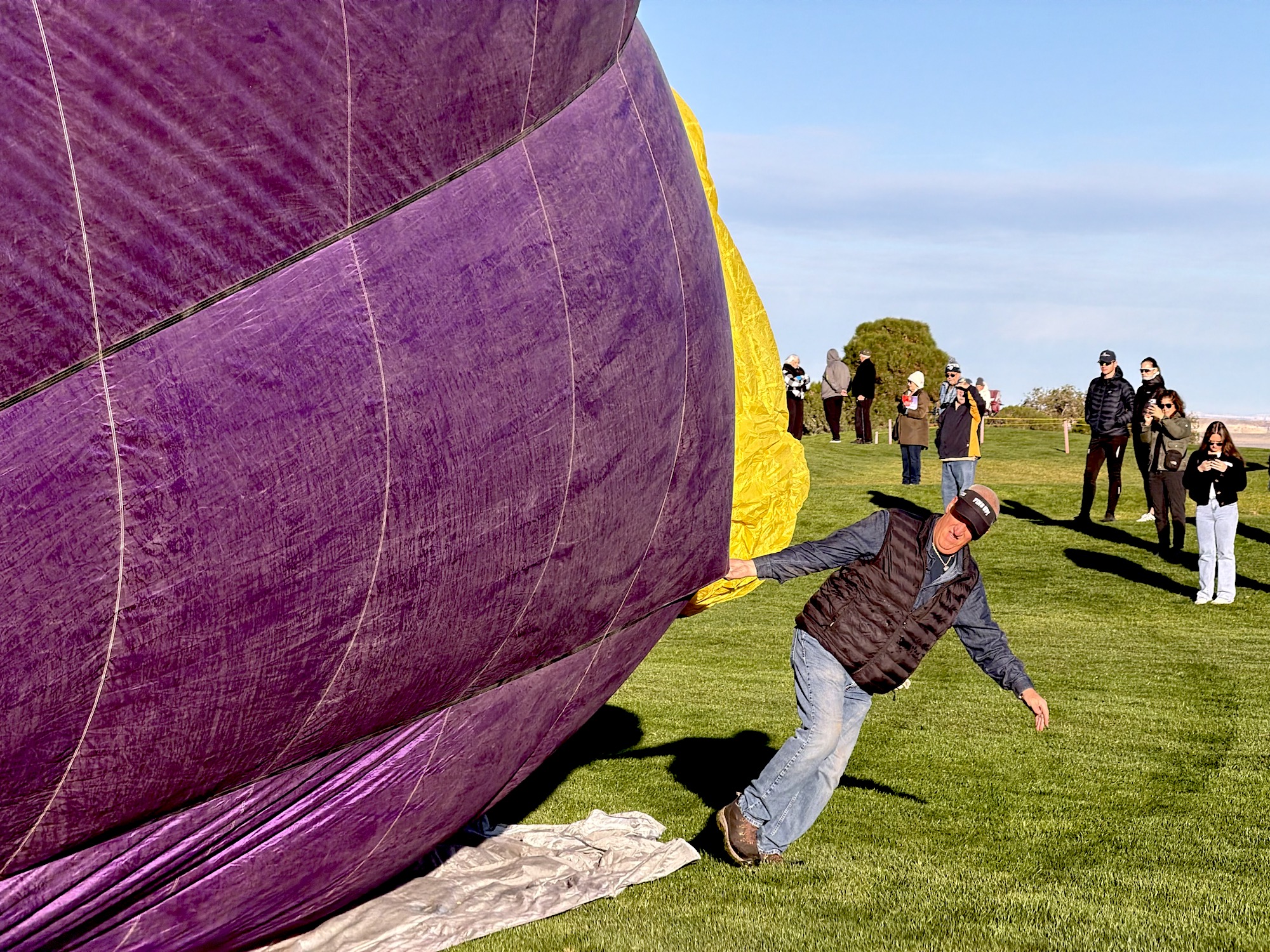 A crew member pulls a balloon envelope into position on Nov. 5, 2026. (Allan Stein/The Epoch Times)
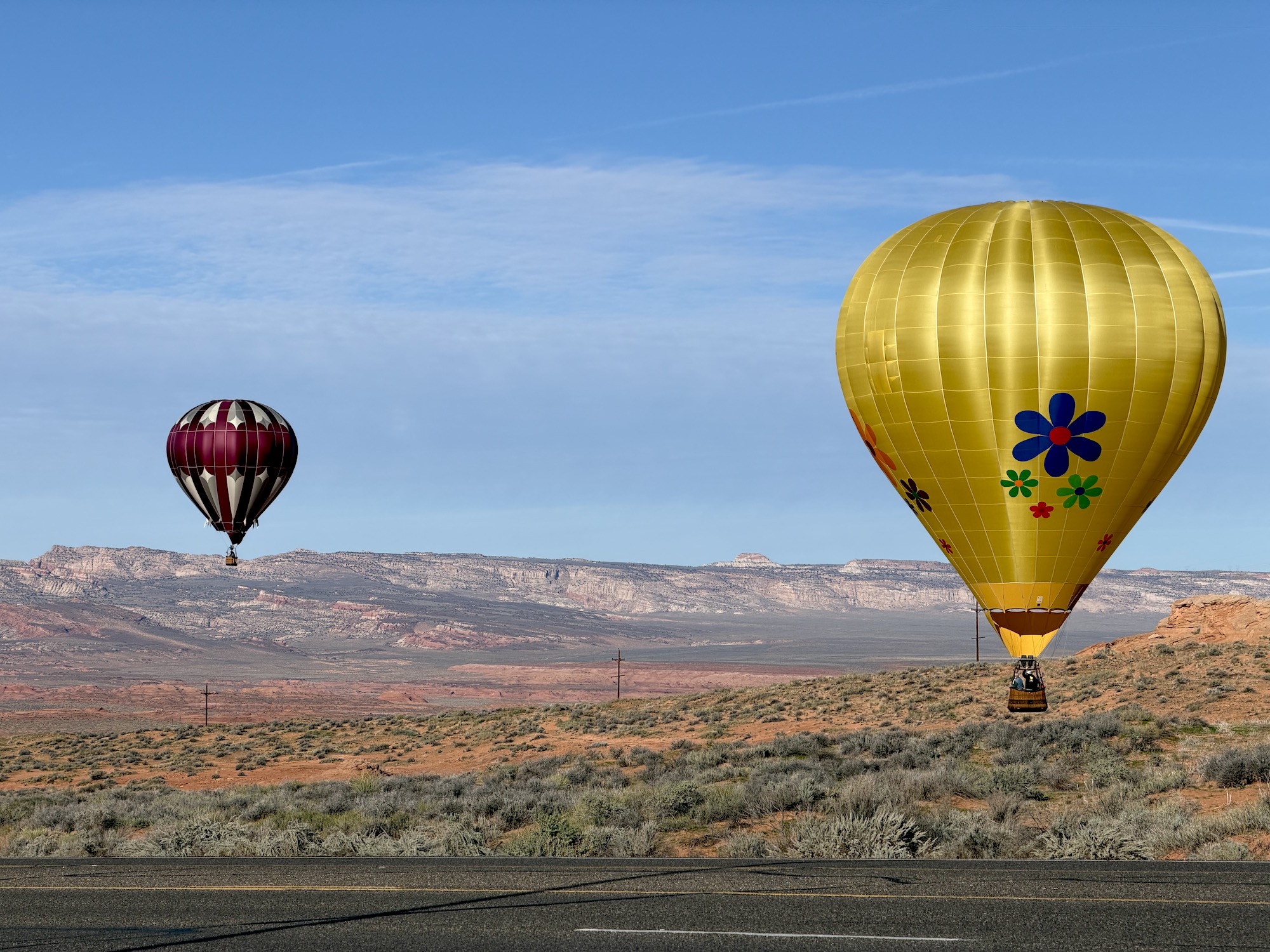 Hot air balloons drift across the desert landscape over Page, Ariz., on Nov. 6, 2026. (Allan Stein/The Epoch Times)
But if someone panics, “you land as fast as you can,” Mass said.
During one flight in Gallup, New Mexico, a passenger barely got 10 feet off the ground before she started screaming, demanding to land and get out.
“We came down and landed immediately. She didn’t wait. She jumped out. She went over to her car, and I’ve never seen her since,” Mass said.
Out over Antelope Canyon near Page, the views are so spectacular that it’s easy to forget one’s troubles amid the calm, rarefied atmosphere, he said.
“You think it’s beautiful down here? Wait until you see it up there,” Mass said.
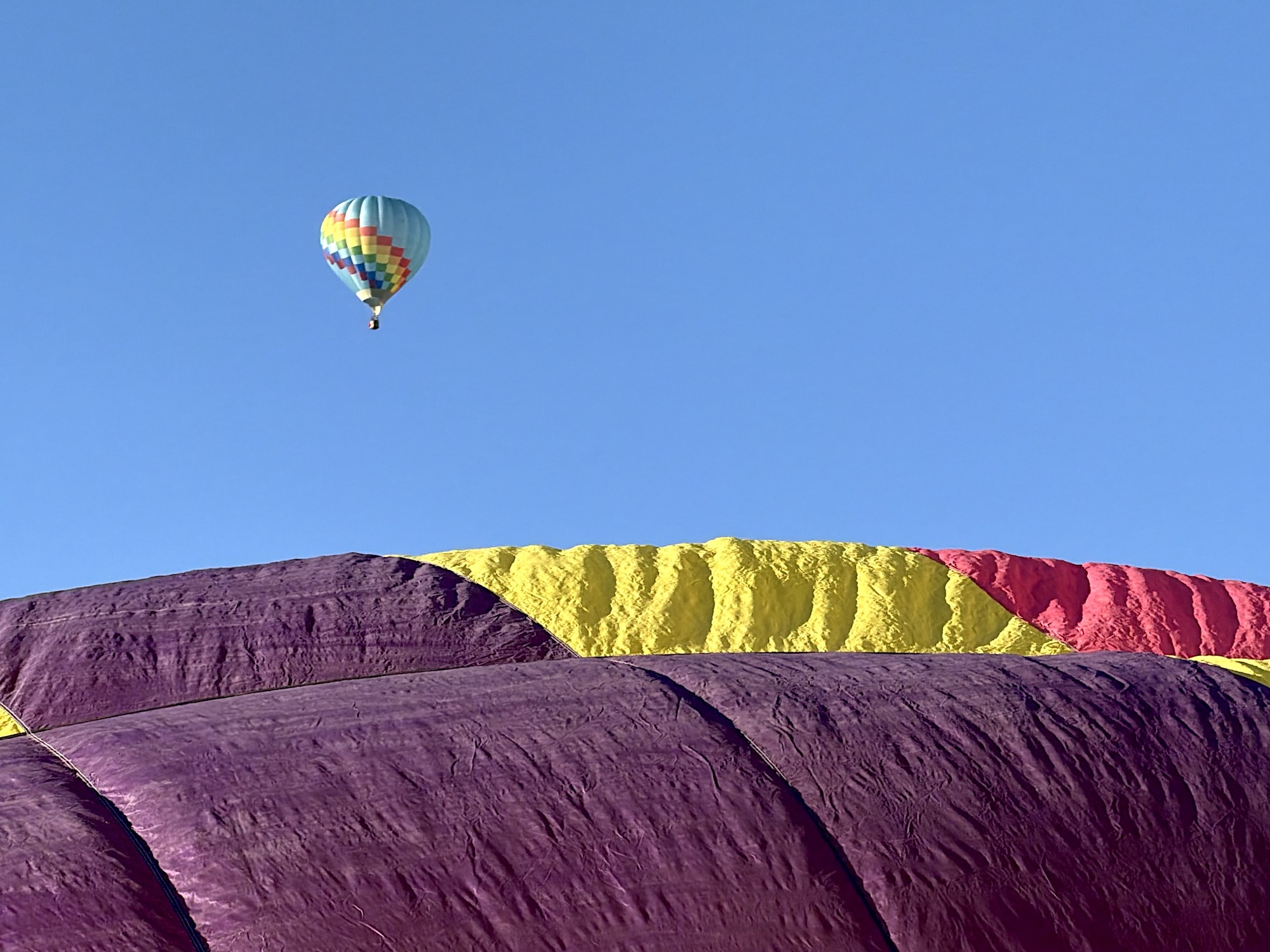 An airborne balloon seems to float above the inflating envelope of another balloon during the 2026 Page Balloon Regatta in Page, Ariz., on Nov. 5, 2026. (Allan Stein/The Epoch Times)
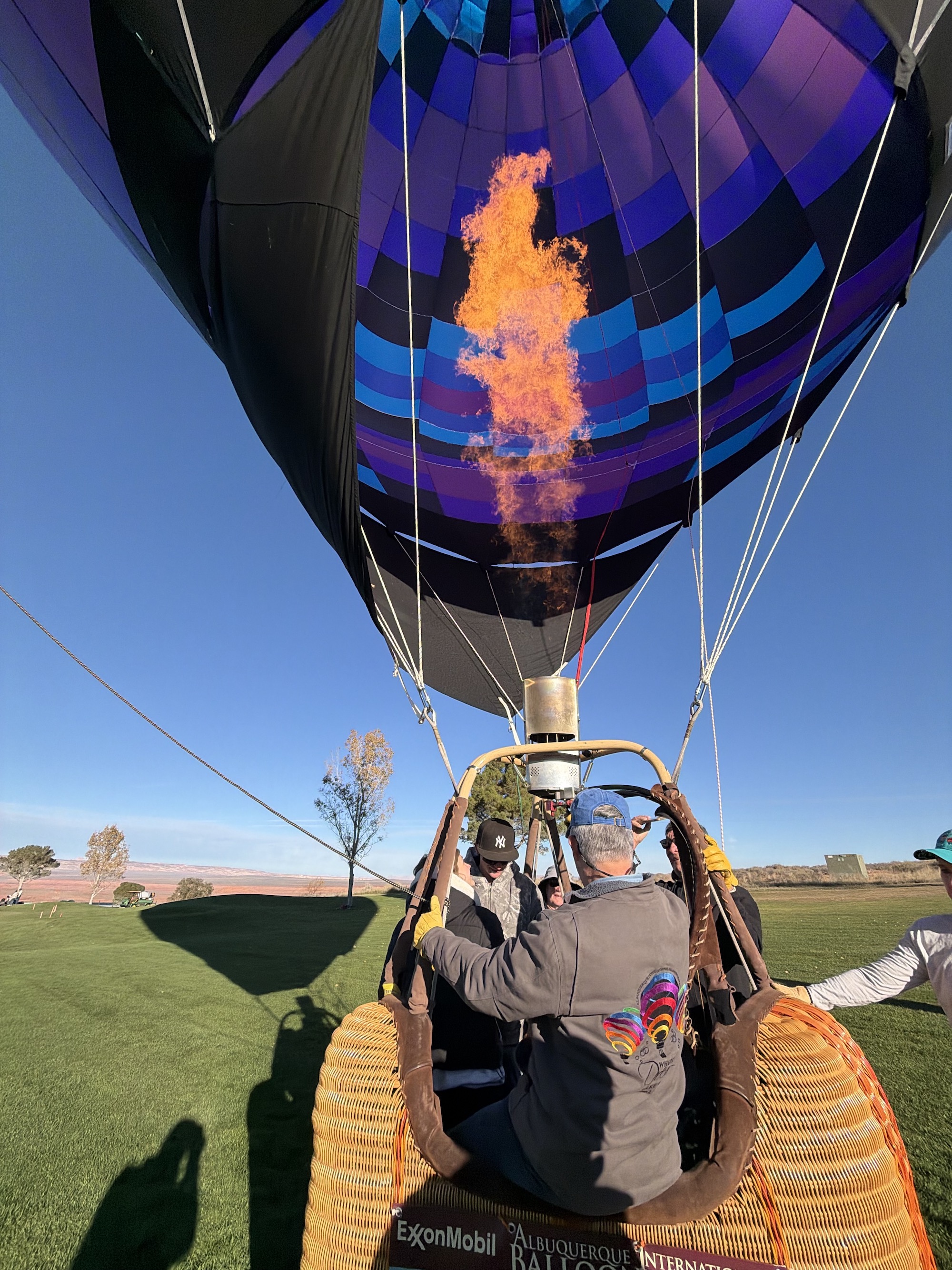 A burst of flame provides lift for this balloon before takeoff in Page, Ariz., on Nov. 5, 2026. (Allan Stein/The Epoch Times)
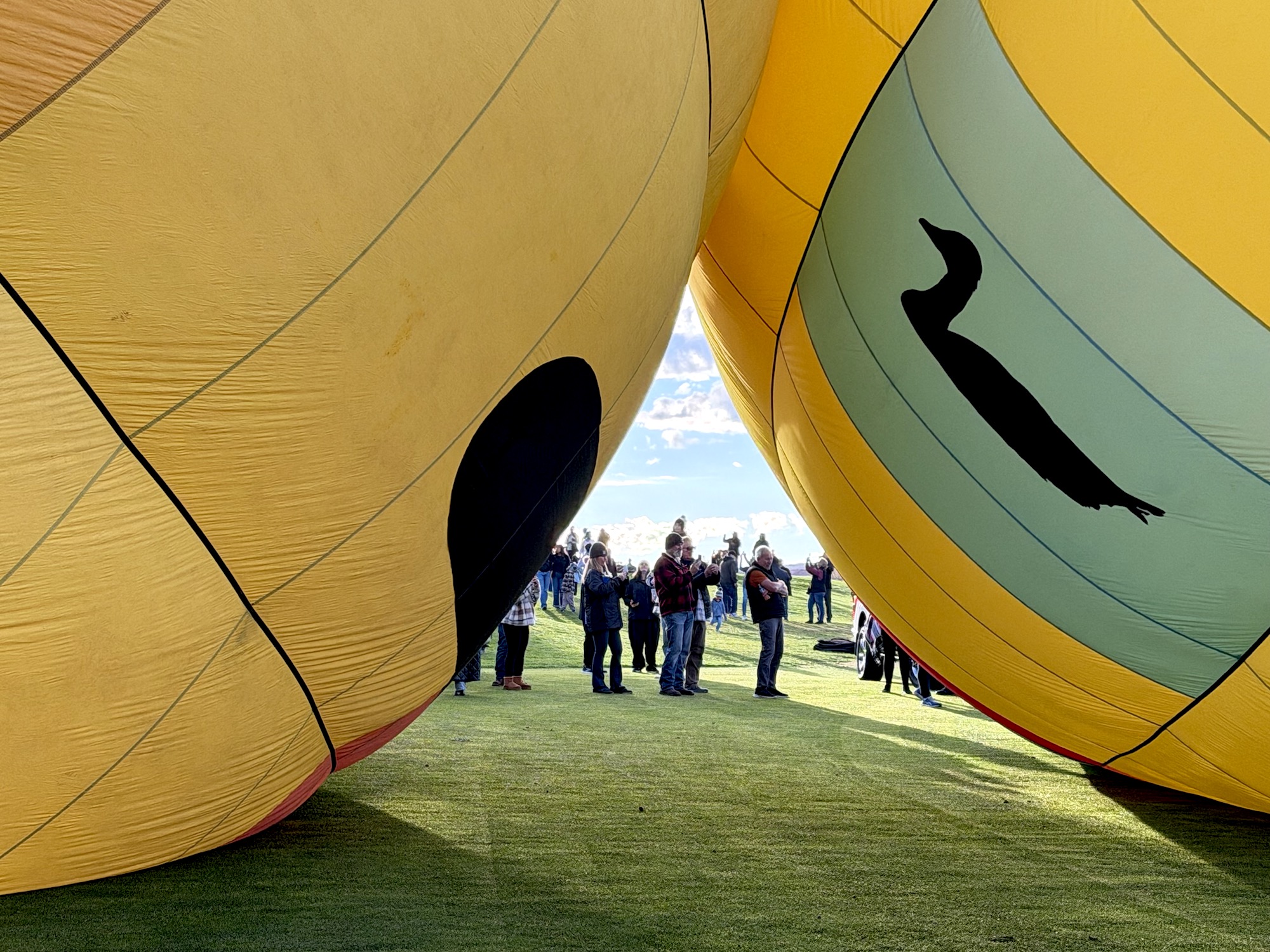 Visitors flanked by a pair of inflating balloons in Page, Ariz., on Nov. 6, 2026. (Allan Stein/The Epoch Times)
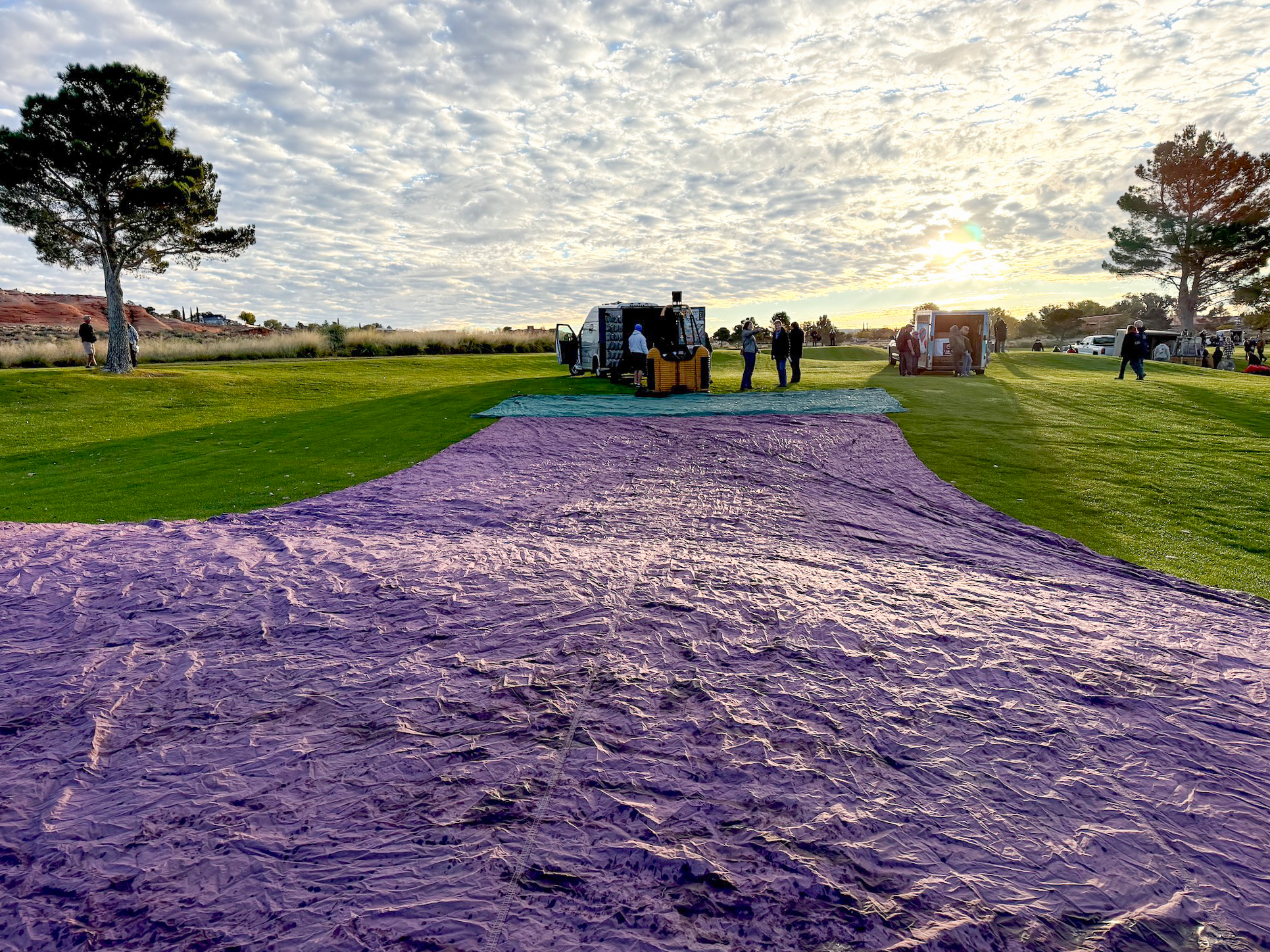
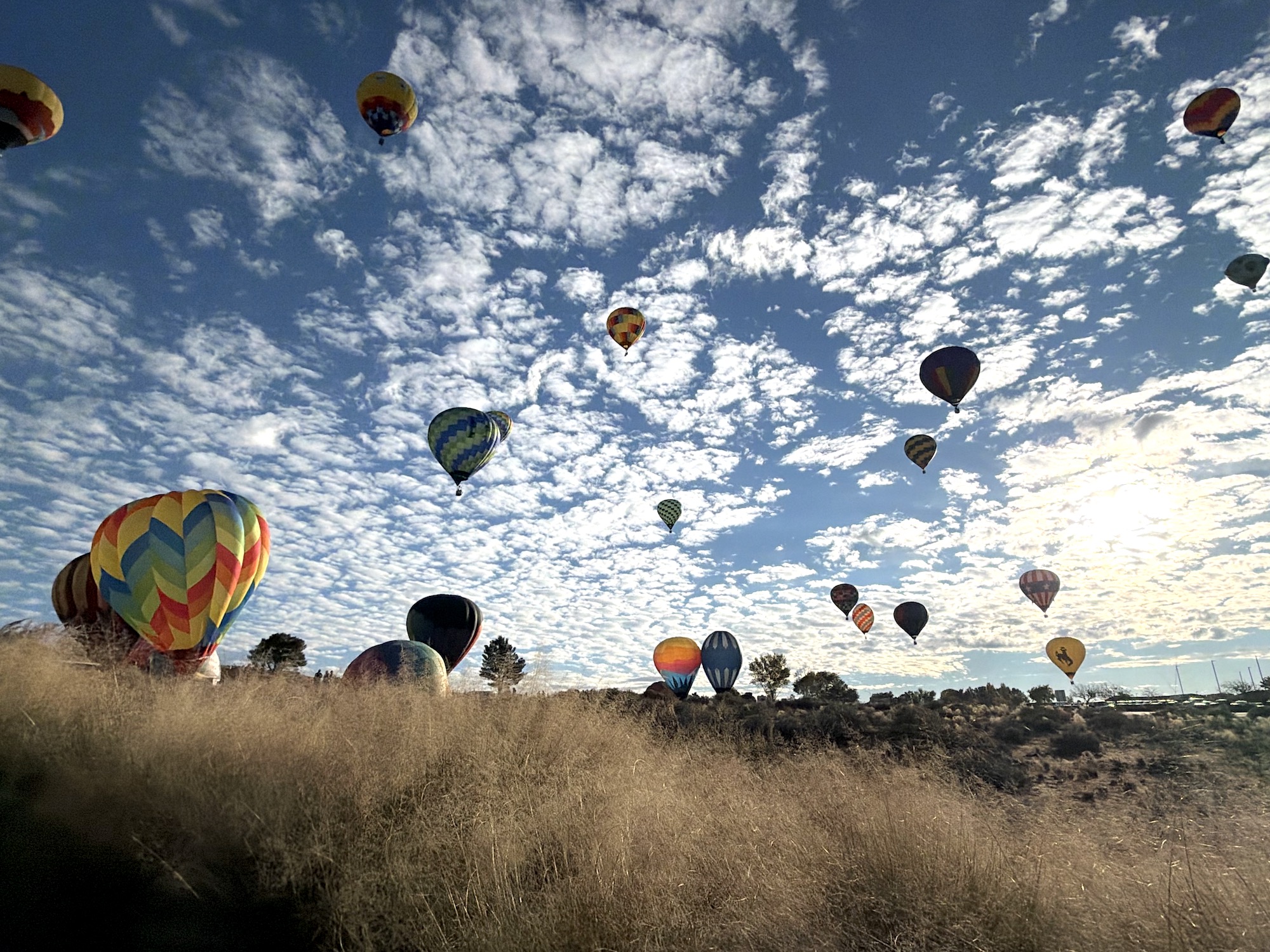 Hot air balloons take to the skies during the city’s 23rd annual Balloon Regatta in Page, Ariz., on Nov. 6, 2026. (Allan Stein/The Epoch Times)
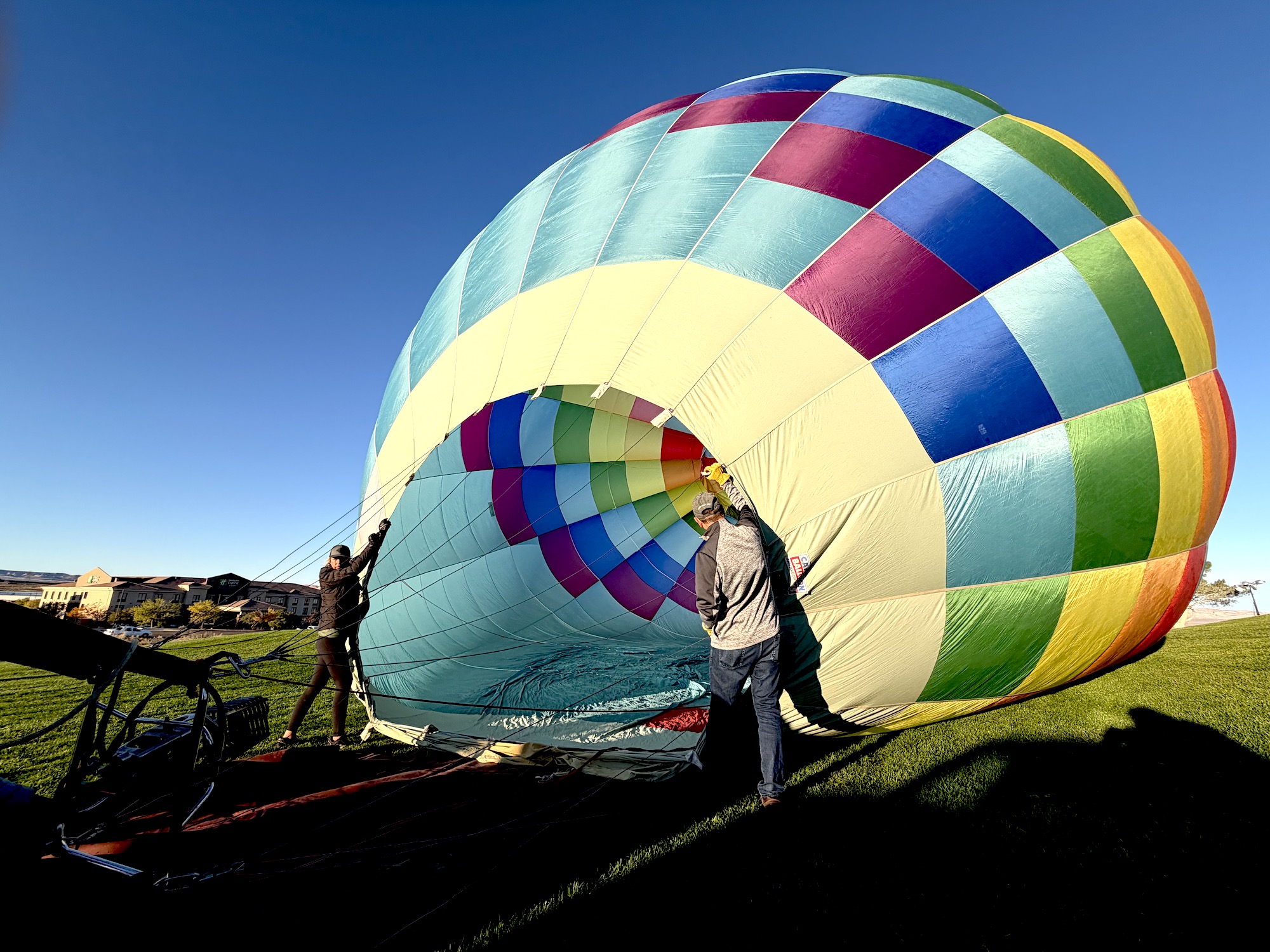 A nearly inflated hot air balloon in Page, Ariz., on Nov. 5, 2026. (Allan Stein/The Epoch Times)
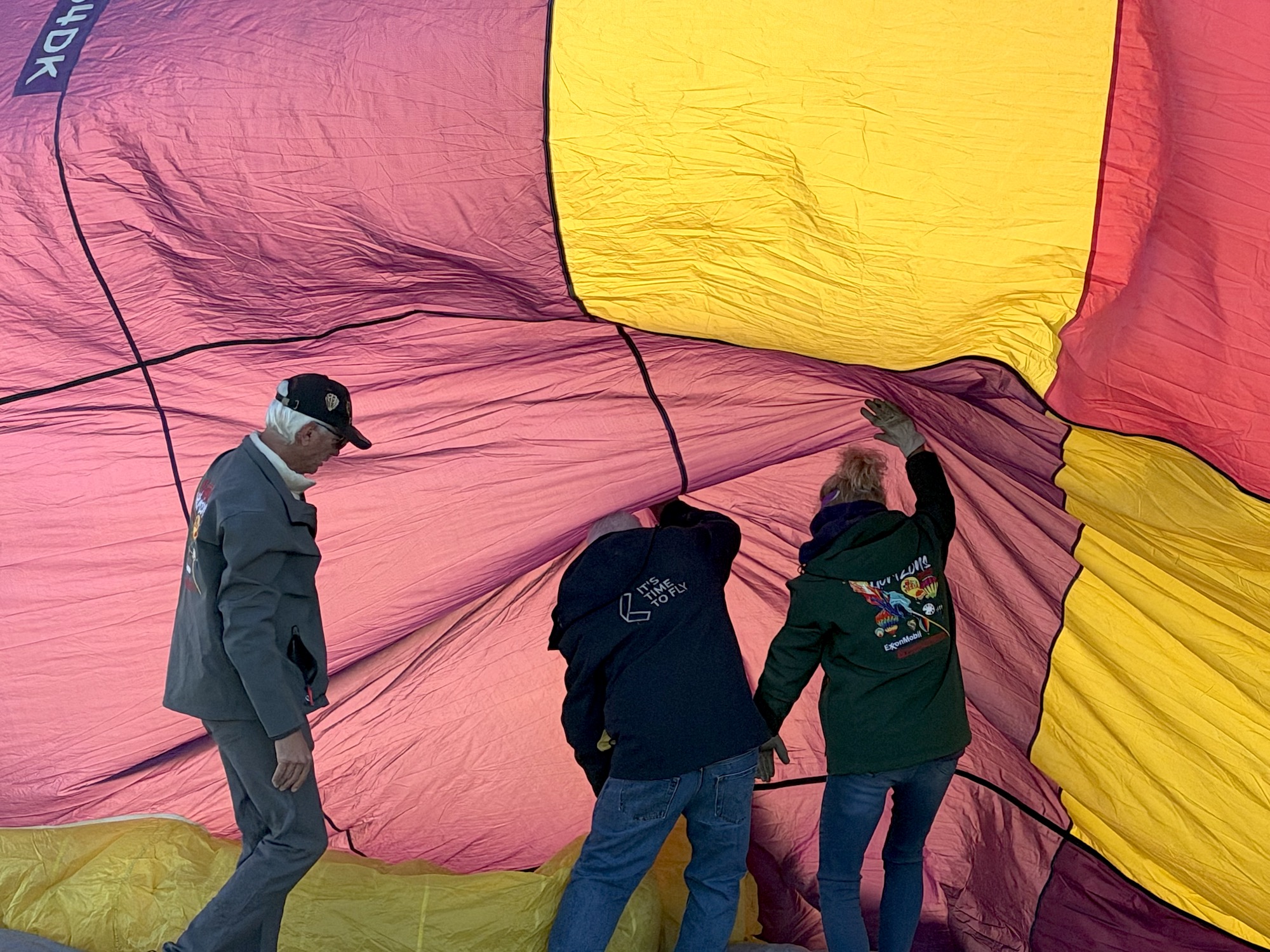 A crew lifts a hot-air balloon envelope in Page, Ariz., on Nov. 5, 2026. (Allan Stein/The Epoch Times)
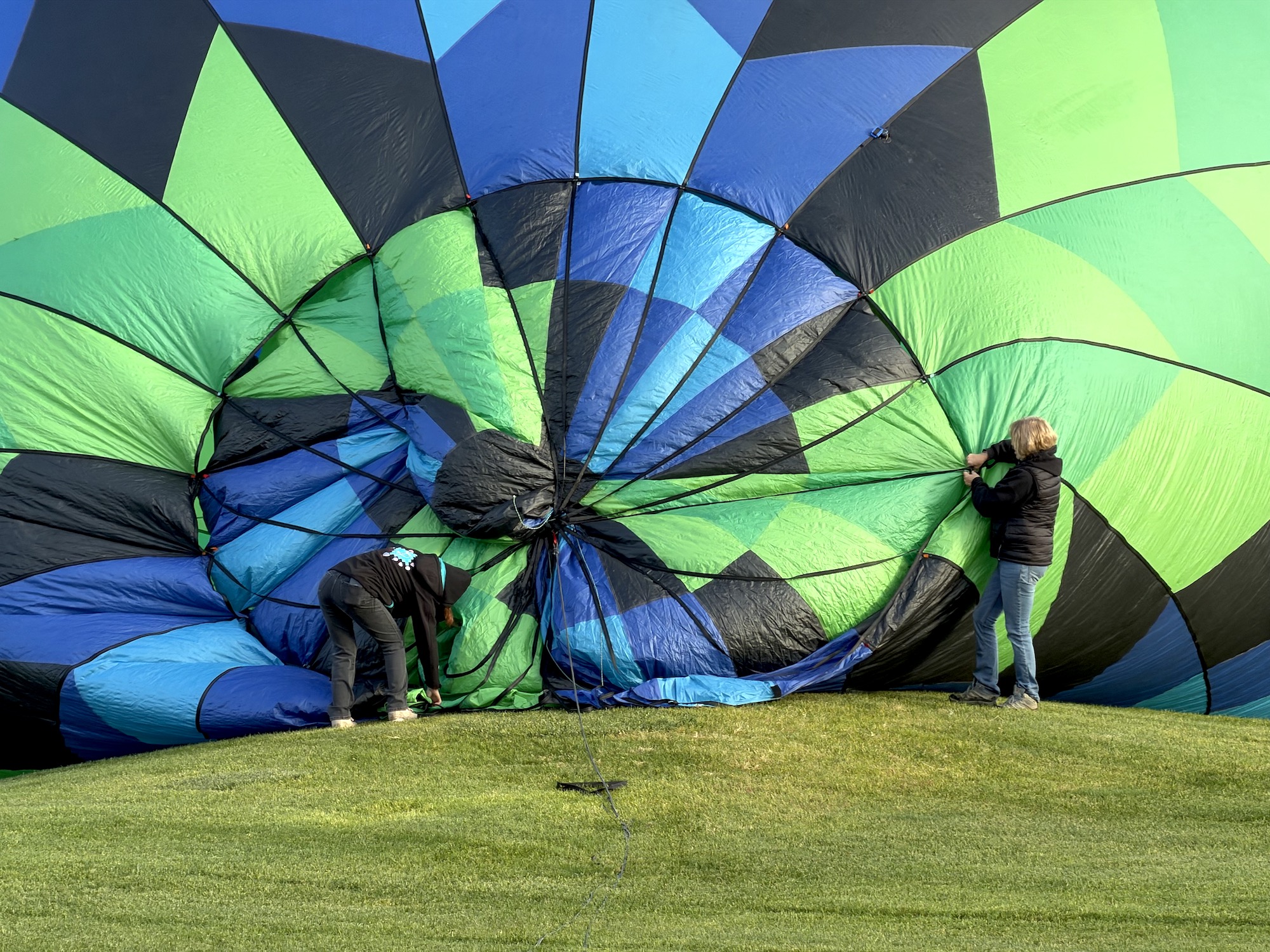 Two crew members spread an inflating balloon in Page, Ariz., on Nov. 6, 2026. (Allan Stein/The Epoch Times)
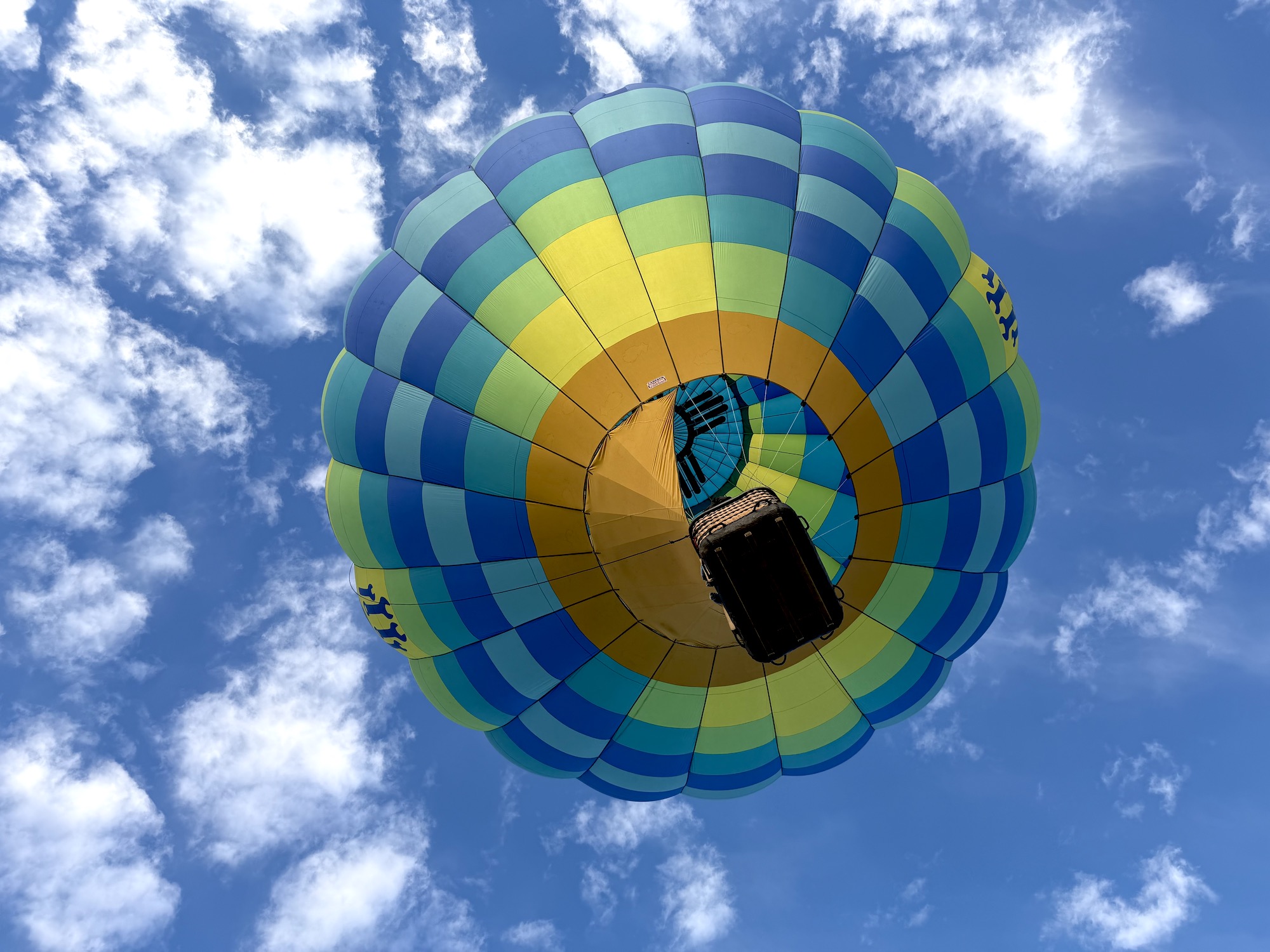 The balloon as it rises higher in the cool morning sky over Page, Ariz., on Nov. 6, 2026. (Allan Stein/The Epoch Times)