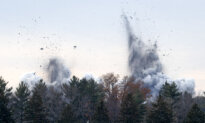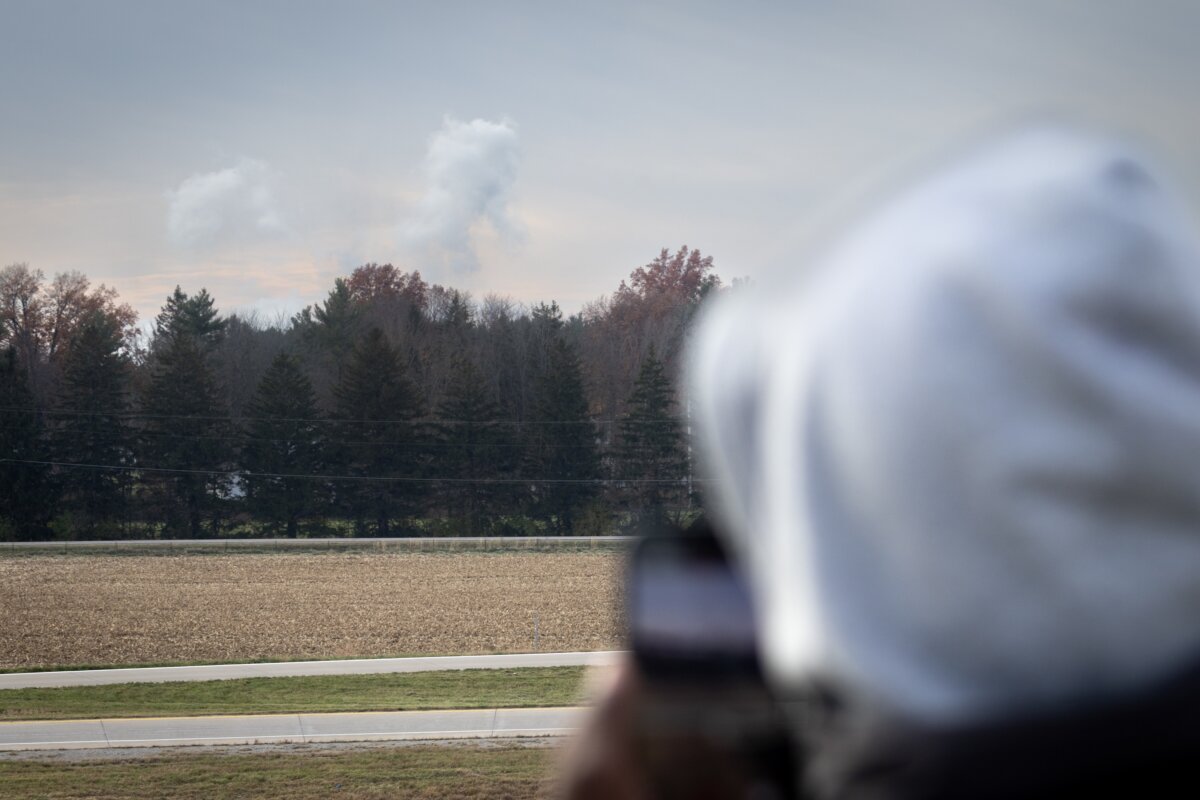

Initial testing after the detonation of bomb-making chemicals at a facility in Iowa showed no signs of lead in the atmosphere, officials said on Nov. 25 about two hours after the controlled explosions.
Preliminary evidence from the Environmental Protection Agency (EPA) and others showed a 0.0 detection level of lead in the air, a Federal Emergency Management Agency official said during a briefing.
The EPA said in a statement that all of its air monitors were reporting zero detection of airborne lead throughout the region.
There was a visible signature from the explosion, but that was primarily from aqueous foam, of which more than 3,600 gallons were applied by fire trucks, Maj. Gen. Eric Shirley, commanding general of the U.S. Army Sustainment Command, said in the briefing.
“I believe, absolutely, that we reduced as close to zero as is absolutely humanly possible the risk to the health and safety of the people of Middletown and the extended communities throughout Iowa,” Shirley said.
Authorities also said that the entire stockpile of lead azide was detonated in the explosions.
Nearly five tons of the lead azide had been stored at the Iowa Army Ammunition Plant in Middletown, in southeastern Iowa, since 2009, according to Robert Cekada, director of the Bureau of Alcohol, Tobacco, Firearms and Explosives.
A consensus developed that the chemicals could not be moved and the safest option was detonating them, officials said.
Besides the foam, mitigation measures included building a water wall and deploying gel blocks to contain the dispersion of particles.
“I absolutely can confirm that those mitigation efforts and the design plan laid out by the … personnel ensured that the blast drove the explosion into the ground and followed a blast channel that was designed to go down the right path to minimize any sort of dispersion of lead into the atmosphere,” Cekada said on Wednesday.
More than 1,200 soil, air, and water samples near the site were gathered prior to the detonations, and the government planned to collect additional samples after the detonations.
Iowa Gov. Kim Reynolds said in a statement that the blast appeared to be successful, that state agencies are monitoring data, and that the agencies would keep Iowa residents informed as details become available.
Rob Sand, set to become Iowa’s governor soon, said on X that “federal officials have reported that lead dispersal should be limited, Iowans are safe, and damage to property is limited.”
He said he was grateful to experts on the ground who did all they could to make the detonation as safe as possible while calling for “immediate transparency to understand how and why this situation became what it did” and any Iowa residents who have been impacted in any way to be “taken care of fully, right away.”
Concerns about lead dust exposure prompted a lawsuit against the government, and a federal court temporarily blocked the EPA permit for the detonations. But the court, after considering arguments from both sides, concluded that the EPA had adequately incorporated safeguards for minimizing the dispersal of the dust.
Still, officials had encouraged people living within five miles southwest of the plant to evacuate and said those who live in a zone modeled to potentially be impacted should remain indoors with doors and windows closed.
The Federal Emergency Management Agency said shortly after the detonations that residents within 20 miles who had not evacuated should stay inside until officials gave the all-clear.