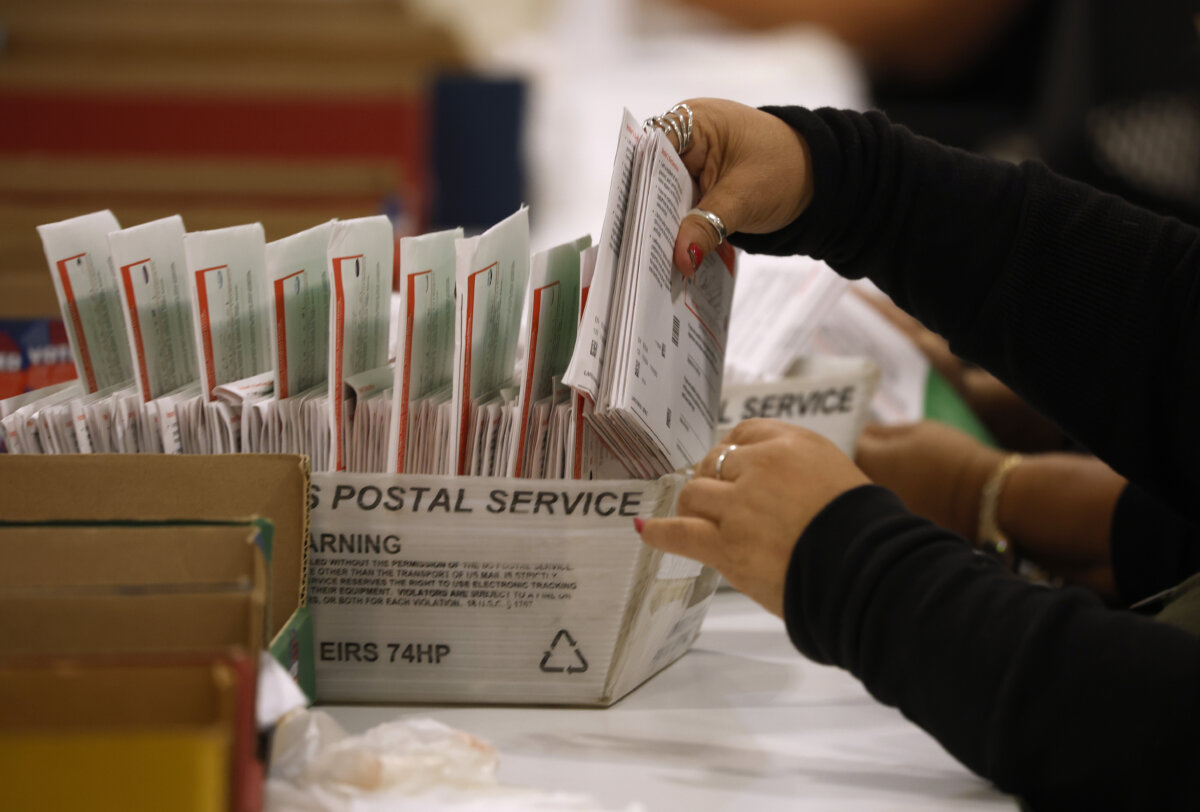

A federal appeals court on Nov. 2 ordered an en banc rehearing of the lawsuit challenging the Trump administration’s efforts to have state and local election officials segregate ballots from registered voters suspected of being noncitizens.
A three-judge panel of the Ninth U.S. Circuit Court of Appeals earlier ruled 2–1, granting the Department of Justice’s (DOJ’s) motion to stay a restraining order issued by Judge Trina Thompson of the U.S. District Court for the Northern District of California on Oct. 30, allowing the administration to require state and local election officials to set aside ballots from individuals it deemed ineligible.
The Ninth Circuit vacated that ruling hours later and ordered a full rehearing. It did not specify a date for the rehearing.
In its previous ruling, the appeals court determined that the government would suffer irreparable harm if the restraining order remained in place.
The order stemmed from a lawsuit filed by labor unions that accused the Trump administration of trying to interfere with state administration of the midterm elections.
“At most, plaintiffs fear a possibility of a future prosecution. If such a prosecution is ever brought, the prosecution itself supplies the means by which any defect, vindictiveness included, can be raised and remedied,” Judge Carlos Bea, joined by Judge Consuelo M. Callahan, wrote for the majority.
“The government’s injury—being barred from requesting that the states segregate ballots from suspected noncitizens—cannot be undone after the fact.”
Judge Mary Murguia dissented, saying that the administration’s efforts to investigate and prosecute election officials could hinder states’ ability to administer an election.
“The Constitution’s allocation of election procedures to the states is meaningless if defendants can coerce states into foregoing their chosen procedures by abusing their prosecutorial powers,” Murguia wrote.
Thompson’s order, set to expire on Nov. 16, prohibited the federal government from threatening state and local election officials with criminal prosecution for counting ballots cast by individuals it deemed ineligible to vote.
It also barred the administration from requiring election officials to remove registered voters from statewide voter rolls or deny ballots to specific registered voters.
Thompson said in an Oct. 30 ruling that the administration likely violated the Voting Rights Act, which prohibits intimidation and coercion in the voting process.
The judge also found that the DOJ had likely exceeded its authority under the elections clause, saying that the Constitution gives states the right to regulate congressional elections.
In an emergency motion filed on Nov. 1 seeking a stay of Thompson’s order, the DOJ argued that the order hindered its efforts to prevent unlawful voting by noncitizens and investigate potential violations of federal voting laws.
The department said its requirements for state and local election officials were not meant to intimidate them, but to ensure that only ballots cast by eligible voters were counted in elections.
“There is no reason to believe that, in enacting Section 11(b), Congress meant to prohibit the federal government from investigating and prosecuting potential illegal voting by noncitizens, or to insulate states and local election officials from liability for knowingly encouraging and facilitating illegal voting by noncitizens,” the DOJ said in its motion.