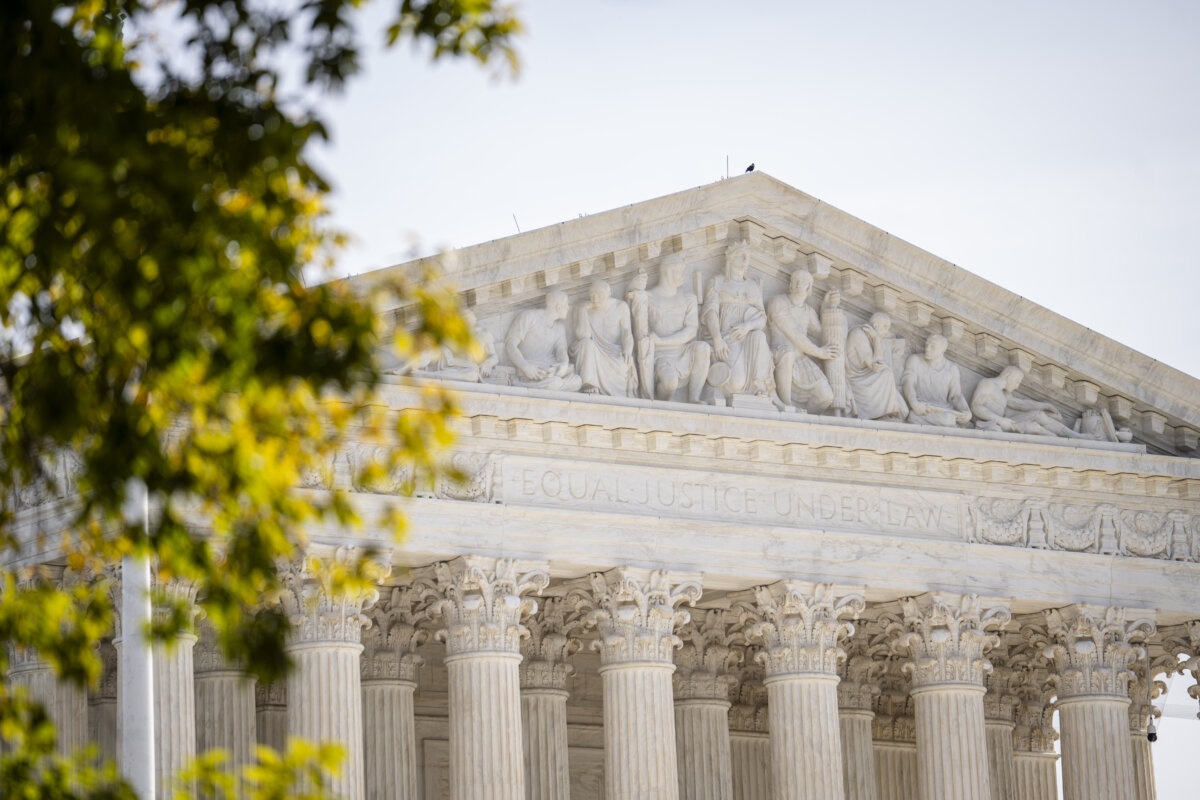

Meta Platforms has asked the Supreme Court to review Washington state’s political advertising disclosure law, arguing the rules are so onerous that they violate the First Amendment and have effectively shut down digital political ads in the state.
The dispute sits at the center of a yearslong clash over whether states can compel platforms to disclose detailed political ad data to the public.
The court docketed Meta’s petition on Nov. 18. Among Meta’s better-known platforms are Facebook, Instagram, and WhatsApp.
Washington’s Fair Campaign Practices Act and related rules require commercial advertisers, including Meta, to keep detailed records of political ads and produce them to any member of the public within two business days upon request. Among the required records are the buyer’s name and address, payment details, demographics and targeting information, impressions, and copies of ads. Failing to comply can lead to a fine of up to $10,000 per violation, or $30,000 if tripled, according to the petition.
The state law’s chilling effect was undeniable and “so burdensome that Meta, Google, and others have stopped disseminating political advertisements in Washington altogether,” the petition said.
Specifically, Meta is asking the justices to consider whether the First Amendment allows a state to impose burdensome “content- and speaker-based disclosure requirements on third-party platforms that make it financially irrational for those platforms to disseminate political speech.”
“Had Washington simply banned political ads from digital platforms altogether, that would be an obvious First Amendment violation,” Meta’s attorneys wrote in the petition. “The result should be no different when a state achieves the same end via the most burdensome political-ad disclosure regime in the Nation.”
The attorneys noted that the U.S. Court of Appeals for the Fourth Circuit enjoined a similar Maryland law.
In the underlying case, Meta said it produced most, but not all, of the required records. Washington sued, and a state-level trial court levied what the petition describes as a $35 million fine, the largest campaign finance penalty in the nation’s history.
The trial court found 822 violations. It imposed the statutory maximum of $10,000 per violation and then tripled the amount after concluding the violations were intentional, producing approximately $24.66 million in penalties plus about $10.5 million in attorney fees and costs.
Meta noted in the petition that between 2018 and 2021 it received requests under the law from only three people. The company argues that public demand for the information is “virtually nonexistent,” yet the compliance burden and penalty risk made running political ads not worth the cost.
Meta appealed, arguing the fine punished it for declining to hand over data it said the First Amendment protected. The Washington Supreme Court disagreed. In a fractured decision in June, it upheld the company’s liability and left the fine in place, rejecting Meta’s claim that the disclosure law violated its First Amendment rights. On the penalty, the justices split three ways, and the judgment stood because no position had a majority. A majority rejected Meta’s argument that the fine was unconstitutionally excessive.
Meta argues the Washington Supreme Court ruling conflicts with the Fourth Circuit’s decision in Washington Post v. McManus (2019), which enjoined Maryland’s version of the law.
Washington has not yet responded to the petition, but its position from the state courts was that the law serves voters’ right to know who is buying political ads and how they’re targeted, that Meta’s burden was manageable, and that the fine fit violations the trial court found were deliberate. A response is due by Dec. 18.