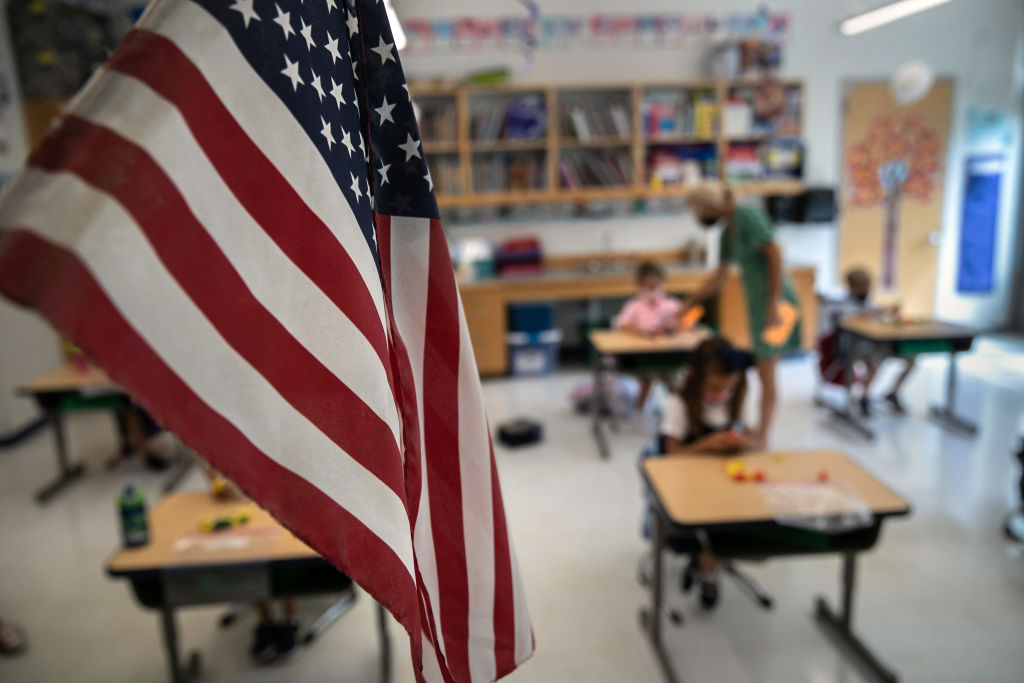

Most incoming kindergarteners in five states lacked foundational skills in areas such as language, according to a new report.
A minority of students entering kindergarten in Connecticut, Florida, Kentucky, Maryland, and Ohio were ready for kindergarten, according to the U.S. Government Accountability Office report published on Nov. 12.
The report analyzed data from kindergarten entry assessments given in those states for students beginning kindergarten in the fall of 2024 for four states, with Maryland’s data coming from kindergartners entering school in 2023.
The tests assessed topics such as social development, language skills, and math ability. Maryland, for example, assessed whether incoming kindergartners could count to 20. Connecticut assessments were based on teacher observations.
The report said that while 56 percent of kindergartners in Connecticut had the necessary motor and creative skills, only 45 percent were deemed socially sufficient and 41 percent met literacy benchmarks.
In Kentucky, 75 percent of incoming students passed the social-emotional part of the assessment, but only 47 percent could help themselves sufficiently, and just 32 percent were deemed to have adequate academic/cognitive skills.
Factors
Researchers found patterns across states in which groups of students were more likely to test well entering kindergarten and which groups were less likely to test well on the assessments.
Girls, Asian students, White children, students without disabilities, students described as “not economically disadvantaged,” and students whose primary language is English tested above average on the readiness scores.
Boys, black children, Hispanic students, children with disabilities, poorer students, and students whose primary language was not English tested below average.
Rural students ranked highest in Connecticut, lowest in Florida, and were about average in the other states. Suburban students scored the best in Kentucky and were about average in the remaining states. Urban students came in last in four states and scored highest in Florida.
The Government Accountability Office also found a statistically significant association between higher preschool enrollment rates and higher readiness rates in three states, but not in the other two. Researchers identified, in general, a link between districts with higher poverty rates and lower kindergarten readiness rates in all states except Maryland.
The new paper followed a 2024 report from the office that found 27 states required districts to administer a kindergarten readiness assessment in the 2023–2024 school year.
The U.S. Department of Education was provided a copy of the new report, according to the office. The department declined to comment on the document.
Literature Review
The Government Accountability Office included a review of studies examining whether participation in publicly funded preschools might affect how ready children are for kindergarten.
After narrowing an initial set of 156 potentially relevant studies to 11, excluding some determined not relevant and others for not covering certain areas, such as the impact on incoming students’ readiness in literacy or math, the researchers said 10 of the studies found positive associations between the programs and kindergarten literacy scores.
Seven found positive links between program attendance and sufficient math scores.
Other factors commonly found associated with being ready for kindergarten included family structure and parenting, such as positive interactions between children and parents; the home environment, including exposing children to books and reading with them; children’s ability to follow directions and focus on a task; and social behavior, such as positive temperament and being able to manage emotions.
The report said that factors negatively associated with kindergarten readiness included certain health conditions, socioeconomic status, gender, and race.