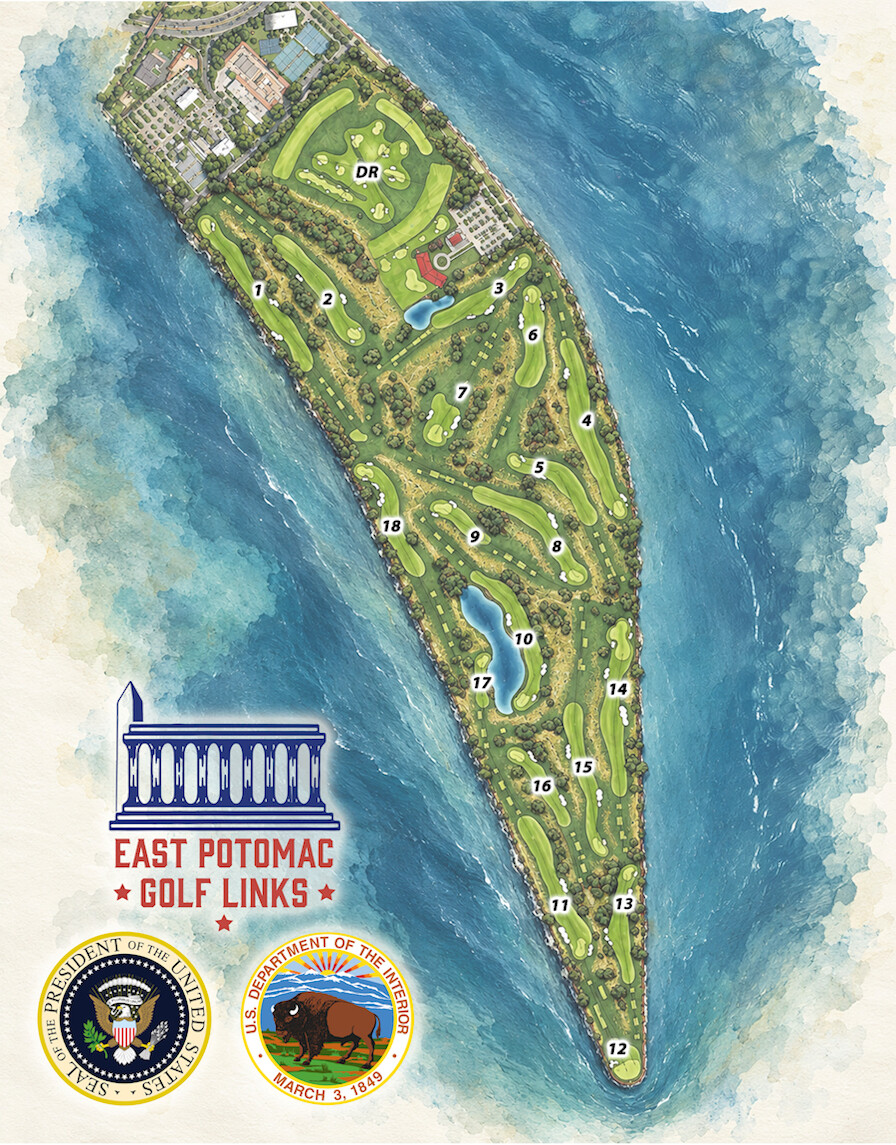

A federal judge on Nov. 10 ordered the Trump administration to preserve records about its plans to renovate the century-old East Potomac Golf Links in Washington.
Included is material related to five of President Donald Trump’s Truth Social posts, as part of an inquiry into whether government lawyers and other officials misled the court.
The dispute is over the 430 trees that the government cut as part of the renovation, after the DC Preservation League and two golfers had already launched a lawsuit against the Department of the Interior and National Park Service over the planned renovation of the historic public course.
Judge Ana Reyes, of the U.S. District Court for the District of Columbia, issued the order amid ongoing tension between her and the administration, which she is investigating to see whether it misled the court.
The order covers records created or modified since Aug. 1, 2025, including materials protected by attorney–client or executive privilege.
It also includes communications involving Interior Department employees, National Park Service employees, golf course designers Tom and Gavin Fazio, or representatives of the National Garden of American Heroes Foundation.
It specifically includes relevant communications on the personal cellphone of Gregory Wischer, the Interior Department’s deputy chief of staff .
The government must send the order by noon on Nov. 12 to employees of or people working on behalf of the Justice Department, Interior Department, and National Park Service who are likely to have relevant records.
The government must tell the judge by 6 p.m. on Nov. 16 who received the order, when people received the order, and who received earlier notices to save records.
The U.S. Department of Justice said it had no comment. The White House did not respond to an emailed request seeking comment.
DOJ lawyers said in an Oct. 28 filing that a preservation order was unnecessary because federal law already required agencies to retain records.
The Interior Department had instructed employees to save documents when the lawsuit began, the filing stated.
The DOJ lawyers said the Department of the Interior updated those instructions on Oct. 15 and that they had no reason to believe anyone was failing to comply.
The lawyers also argued that most Justice Department records in the case would be protected by legal privilege.
The filing said there was no basis to investigate whether officials disobeyed the court, because Reyes had not formally told the government it had to notify the court before cutting down the trees.
The dispute escalated after trees were cut down at the golf course on Oct. 10. The plaintiffs said 529 trees were removed, while the administration put the number at 430.
The administration said the work was part of a tree management plan dating to 2019, while Reyes questioned whether it was connected to Trump’s proposed redesign.
Reyes announced that there would be an inquiry at an Oct. 30 hearing after administration lawyers disclosed in a court filing that the course would close on Nov. 15 for renovation.
Trump had announced the same closure date on Oct. 18. Reyes questioned why government lawyers had previously represented that there was no plan when work on a design submission had been underway for weeks.
Associate Attorney General Stanley Woodward told Reyes that he did not recall the court asking whether the government was developing a plan.
Reyes barred cutting down any other trees at the course in an Oct. 26 injunction.
On Nov. 7, Reyes said she intended to appoint Jessie Liu, a former U.S. attorney for the District of Columbia, to investigate whether government lawyers and other officials misled the court about the golf course renovation.
DOJ Asks Judge to Step Aside
In an Oct. 16 motion signed by Woodward, the Justice Department asked Reyes to step aside, alleging that her treatment of government lawyers and officials showed bias.
The DOJ said Reyes belittled a government lawyer, questioned counsel’s honesty, and gave senior officials too little time to prepare to testify.
The motion alleges that the judge improperly demanded that a senior official testify on a national holiday from his car via phone without the opportunity to prepare or consult with counsel.
The filing also cited an Oct. 12 hearing at which Reyes criticized the government’s handling of tree removal, telling its attorney, “You did your absolute worst.”
The motion also cited Reyes’s conduct in another case related to the Trump administration, which pertained to restrictions on military service by people who identify as transgender.
According to the court filing, Reyes challenged Trump’s executive order that prohibits individuals who identify as a gender different from their biological sex or who have a history of gender dysphoria from serving in the military.
Reyes stated: “This executive order is premised on an assertion that’s not biologically correct. There are anywhere near about 30 different intersex examples. So, someone who does not have just an XX or XY chromosome is not just male or female; they’re intersex.”
On Oct. 18, Reyes rejected the motion requesting her recusal from the golf course case.
“It is easy to weaponize selective quotations to bring a baseless recusal motion,” Reyes wrote. “But it is much harder to meet the demanding legal standard against a full record. By any objective measure, the government fails to meet the standard for recusal. And the court does not, on its review, conclude it is mandatory.”
The renovation of the golf course has faced a legal challenge over tree removal and environmental reviews at East Potomac Golf Links.
The DC Preservation League and golfers Alex Dickson and Dave Roberts sued the Trump administration, claiming the renovation would violate the National Environmental Policy Act.
Their lawsuit alleges that soil and demolition debris from the White House East Wing were placed at the course without going through a mandatory environmental review.
Jackson Richman and Jacki Thrapp contributed to this story.