
A federal judge on Oct. 26 declined Novo Nordisk’s request to block pharmaceutical rival Eli Lilly from continuing advertisements for weight-loss drugs that the Danish drugmaker claims are false and misleading, affecting markets with tens of billions of dollars of annual sales.
Judge Zahid Quraishi of the U.S. District Court for the District of New Jersey in Trenton said Novo Nordisk’s claim did not merit a preliminary injunction, having failed to show that Lilly’s ads threatened sales, undermined its goodwill, or caused lasting damage to its clinical reputation.
The judge made his ruling after a two-day hearing in late August, finding Novo Nordisk’s claim of irreparable harm “inadequate to warrant the extraordinary relief it seeks.”
Novo Nordisk sued Indianapolis-based Lilly in July, claiming that ads for its weight-loss drugs Zepbound and Mounjaro, approved for diabetes, violated federal and state laws dealing with advertising and unfair competition.
The suit said that Lilly’s marketing and advertising compared higher doses of those products with lower doses of Novo Nordisk’s weight-loss drugs, Wegovy and Ozempic.
One commercial included a voiceover claim, with a written disclaimer, that people using Zepbound lost an average of 50 pounds while people using Wegovy on average lost 33 pounds.
‘Litigation Ongoing’
“While we are disappointed with the court’s decision, today’s ruling did not decide the question of whether Lilly’s advertising is false and misleading, and this litigation is still ongoing,” a spokesperson for Novo Nordisk said.
“Everyone deserves clear, accurate and up-to-date information when making decisions about their health.”
Lawyers for Eli Lilly, a multinational company headquartered in Indianapolis, denied all wrongdoing.
In the past few years, weight-loss drugs have become big business for large pharmaceutical companies. The United States is among just a handful of countries that allow direct-to-consumer advertising of prescription medicines.
 The logo of Novo Nordisk at the company’s office in Bagsvaerd, on the outskirts of Copenhagen, Denmark, on March 8, 2024. (Tom Little/Reuters)
Negligible Impact
In his 25-page decision, Quraishi said that while he found Novo Nordisk’s witnesses credible, Eli Lilly’s ads had at best a negligible market impact between April and July this year, with prescription numbers for Novo Nordisk’s products remaining stable.
The judge said money damages could compensate Novo Nordisk for any “nontrivial harm” it might suffer in the absence of an injunction.
Quraishi also found Novo Nordisk’s case “less than persuasive” based on a “very preliminary record,” though he did not rule on its merits.
Novo Nordisk reported combined 2025 sales of about $32 billion for weight-loss drugs and Ozempic, licensed for diabetes, court documents show.
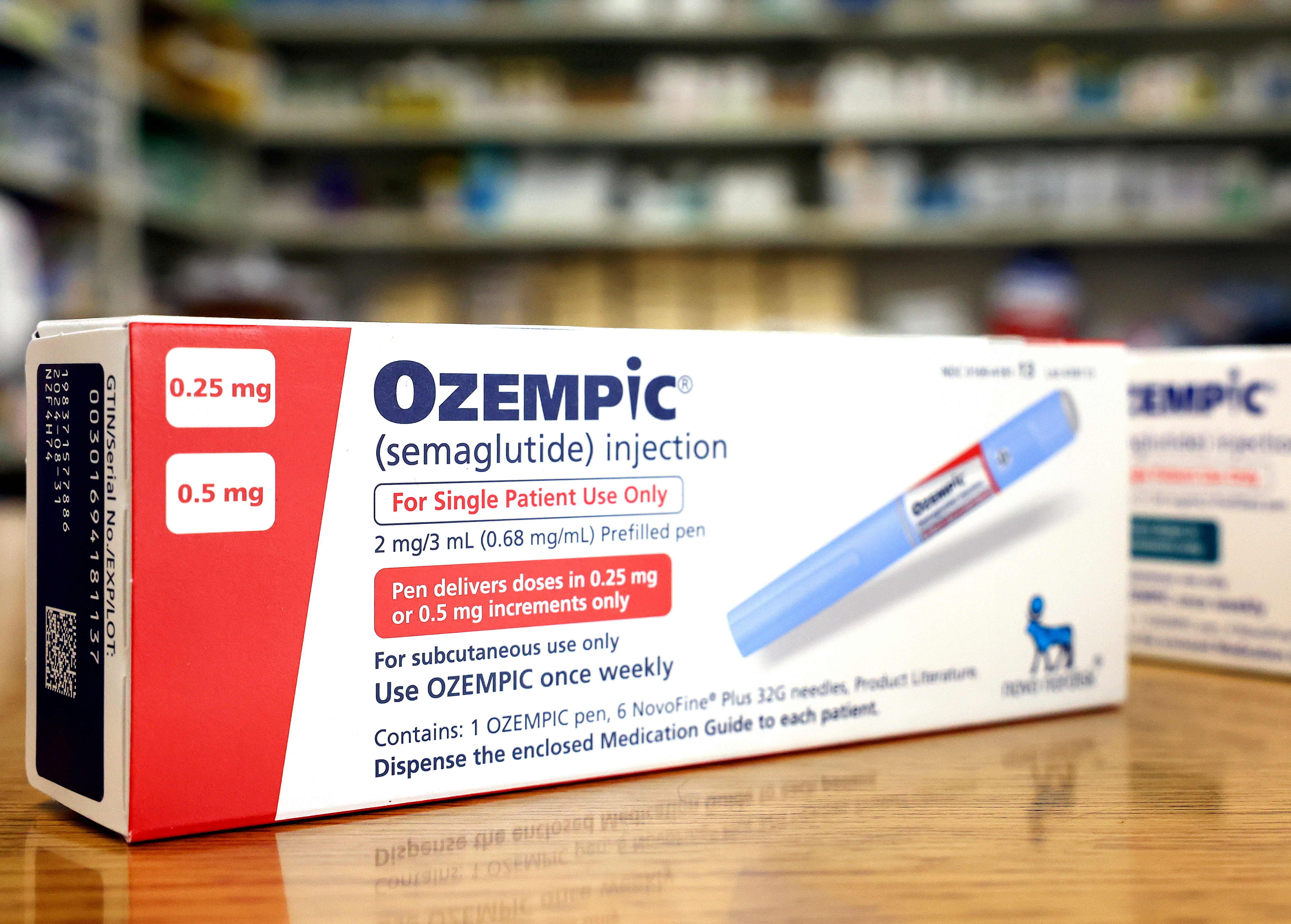 Boxes of the diabetes drug Ozempic on a pharmacy counter in Los Angeles on April 17, 2023. (Mario Tama/Getty Images)
A $100 Billion Market
The drugmaker is working to regain market share in the United States for its injectable obesity drugs, a market projected to exceed $100 billion by the end of the decade.
Lilly reported annual revenue of $65.2 billion in 2025, generating a profit of $20.6 billion. Novo Nordisk recorded annual revenue of $47 billion, with a profit of $15.4 billion. Lilly’s revenue grew 45 percent in 2025, compared with 6 percent growth for Novo Nordisk.
Goldman Sachs forecast in July that global sales of obesity drugs could reach $114 billion by 2030, with Eli Lilly and Novo Nordisk among the market’s dominant players. The bank’s earlier modeling estimated that Lilly could capture around half of the global weight-management market, with Lilly and Novo together accounting for about 80 percent, although those estimates were based on a 2023 forecast and market projections have since fluctuated.
Based on current trends, more than half the global population will be overweight or obese by 2035, compared to 38 percent in 2020, according to a World Obesity Atlas 2023 forecast.
Lilly was the first company to mass-produce both the polio vaccine in the 1950s and insulin in the 1920s, and is also known as the maker of the blockbuster SSRI antidepressant Prozac, first licensed in the United States in 1987.
In 2009, Lilly pleaded guilty to illegally marketing the anti-psychotic Zyprexa, after playing down the drug’s side effects, which can include the development of diabetes.
Lilly agreed to pay a $1.4 billion penalty, including a criminal fine of $515 million, which at the time was the biggest ever in a pharmaceutical case and the largest criminal fine for an individual corporation ever imposed in a U.S. criminal prosecution of any kind.