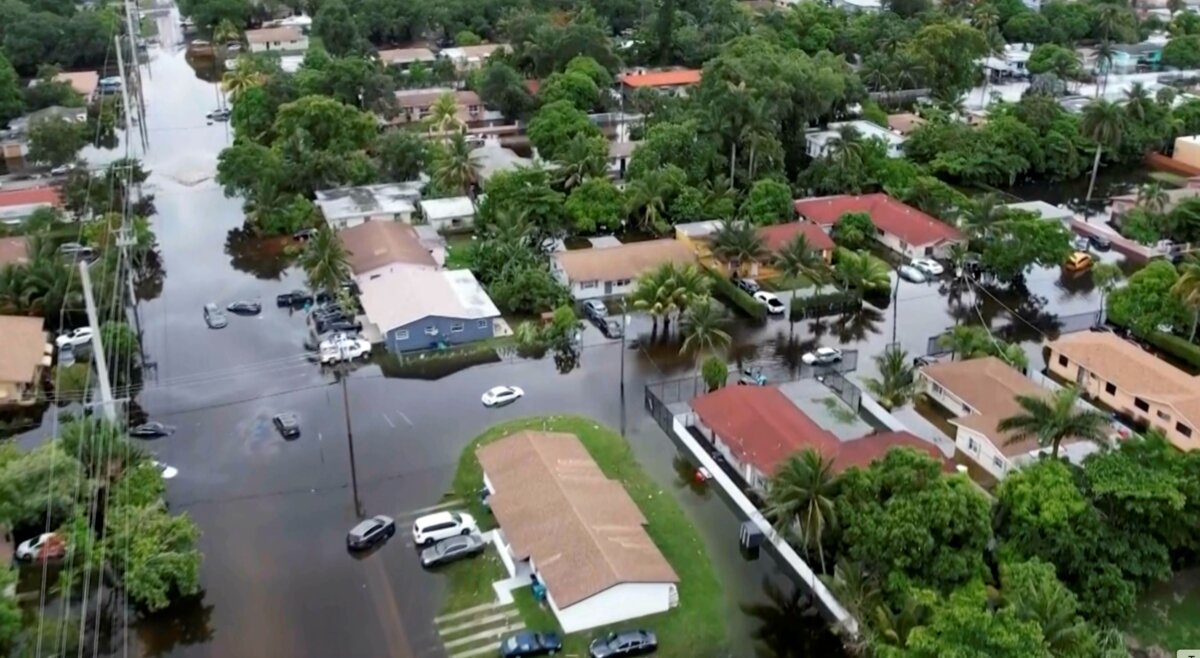

Florida is suing a company that issues climate-related risk scores for homes, alleging that its assessments exaggerate threats such as flooding and depress home sales.
The lawsuit, filed on Oct. 23 in Polk County state court, accuses First Street Technology Inc. of publishing “alarmist” risk assessments based on flawed models and of “marketing fear to advance a climate activism agenda.”
First Street provides property-level risk scores for flooding, wildfire, wind, extreme heat, and poor air quality.
Its ratings have appeared on major home-listing platforms and are also used by banks, investors, and insurers.
First Street says it relies on “validated and proven methodologies” to estimate how hazards could affect individual properties in the future under “new, unobserved climate scenarios.”
The state, however, argues that some of those estimates conflict sharply with government assessments and can mislead buyers about the risks of a home.
Differences in Risk Assessment
A major focus of Florida’s complaint is the difference between First Street’s Flood Factor ratings and flood zones produced by the Federal Emergency Management Agency (FEMA).
FEMA’s flood maps generally identify areas exposed to certain levels of flooding from rivers, streams, and coastal storm surge.
First Street, meanwhile, says its model instead calculates risk for individual properties, accounting for “changing climate conditions, and considers the risk of flooding due to high-intensity rainfall.”
The two systems can produce very different assessments for the same home.
The Florida complaint cites a property in Pinellas County that FEMA places in an area of minimal flood hazard.
First Street, however, gives that property a Flood Factor of 7 out of 10, indicating a significant chance that floodwater could reach the building over the next 30 years.
Florida also takes issue with First Street’s city-level Risk Factor pages.
The complaint says First Street lists Orlando, which sits 45 to 60 miles from the nearest coastline, as facing coastal flooding risk.
It also challenges the company’s poor-air-quality assessment for Lake City, which received recognition this year from the American Lung Association for relatively low ozone and particle pollution.
“Those inflated scores have real consequences,” Florida Attorney General James Uthmeier said in a video announcing the lawsuit. “Homes take longer to sell. They sell for less. Insurance costs rise.”
Risk Scores Influence Buyers
Research suggests that giving buyers detailed flood-risk information can affect where they search and how much they are willing to pay.
A 2024 working paper by the National Bureau of Economic Research examined an experiment involving about 17.5 million users of Redfin, some of whom were randomly shown First Street’s property-specific flood-risk scores while others were not.
Researchers found that buyers who received the information changed their searches, bids, and purchasing decisions. They were more likely to favor homes with lower flood risk.
The three-month Redfin experiment affected sales involving 8,150 homes classified as having high flood risk.
The researchers estimated that providing the information reduced the combined selling prices of those properties by about $57 million, or roughly 1 percent.
Zillow, which incorporated First Street’s climate risk data in 2024, has found a similar pattern in its own user behavior analysis.
Among homes listed in June 2024, 52 percent of properties classified as having high flood risk eventually sold, according to a 2025 report.
That compared with 71 percent of homes with low flood risk.
Zillow did note, however, that the gap had existed since at least 2018 and did not attribute it solely to the display of climate-risk scores.
Zillow changed how it presents First Street scores in late 2025, after real estate agents and the California Regional Multiple Listing Service questioned the accuracy and presentation of predictive flood information.
Instead of directly showing those scores, Zillow’s climate-risk section links users to First Street, where the property-level assessments remain available.
Redfin and Realtor.com continue to display First Street’s flood scores alongside FEMA ratings.
First Street became part of financial analytics firm MSCI in August.
MSCI said at that time the purchase would expand its ability to provide investors, lenders, and insurers with information about physical climate risks.
MSCI did not immediately respond to a request for comment on the Florida lawsuit.
Florida is seeking civil penalties, repayment of allegedly improper gains, and an injunction against practices it says violate state consumer protection law.
Penalties can reach $10,000 per violation and $15,000 if a violation involves certain elderly or disabled consumers.
Florida is not the first state to challenge First Street’s models.
Nebraska filed a similar lawsuit in August, alleging that the company misled homebuyers by presenting flawed climate-risk projections without adequately communicating their limitations.