
Federal regulators are proposing another round of changes to vehicle safety rules aimed at accommodating fully autonomous cars that lack a steering wheel, pedals, and other controls designed for human drivers.
The proposal, published by the National Highway Traffic Safety Administration (NHTSA) on Friday, would revise federal lighting standards written largely on the assumption that a person would be sitting behind the wheel.
Among the changes, NHTSA would eliminate requirements that turn signals and high-beam headlights be controlled manually in vehicles designed to operate entirely through an automated driving system, or ADS.
The vehicles would still be required to have working turn signals, hazard lights, and high- and low-beam headlights, but those functions could be controlled by the vehicle itself.
The agency would also remove requirements for certain dashboard indicators that are meant to tell a human driver whether turn signals or high beams are activated.
“For an ADS-equipped vehicle without manually operated driving controls, the agency has tentatively concluded there is no safety need for turn signal operating units to be self-canceling by steering wheel rotation,” NHTSA said.
Cyan Light for Driverless Cars
NHTSA is also proposing a new lighting standard intended to make autonomous vehicles easier for other road users to recognize.
Under the proposal, manufacturers may equip autonomous vehicles with steady-burning cyan, or blue-green, lights to indicate that an ADS is operating the car.
Cyan marker lights would not be mandatory. But if a manufacturer chooses to use them, they would have to meet federal standards governing their color, brightness, placement, and operation.
NHTSA would allow one or two cyan lights on the front, rear, and each side of a vehicle. The lights could switch on automatically when the automated system is responsible for driving without a human occupant supervising the roadway. They would have to switch off when an occupant is expected to monitor the road.
Cyan was chosen in part because common vehicle-lighting colors such as red, amber, and white already have established meanings, NHTSA said.
An automotive industry standard developed by SAE International has also recommended a blue-green color for identifying vehicles operating autonomously.
There is already some precedent for using a similar color. In 2023, Mercedes-Benz received permission in California and Nevada to test turquoise exterior marker lights on vehicles using its Drive Pilot system.
The German automaker said the color was selected because it is easily distinguished from existing traffic signals and emergency-vehicle lighting.
Impact on Robotaxis
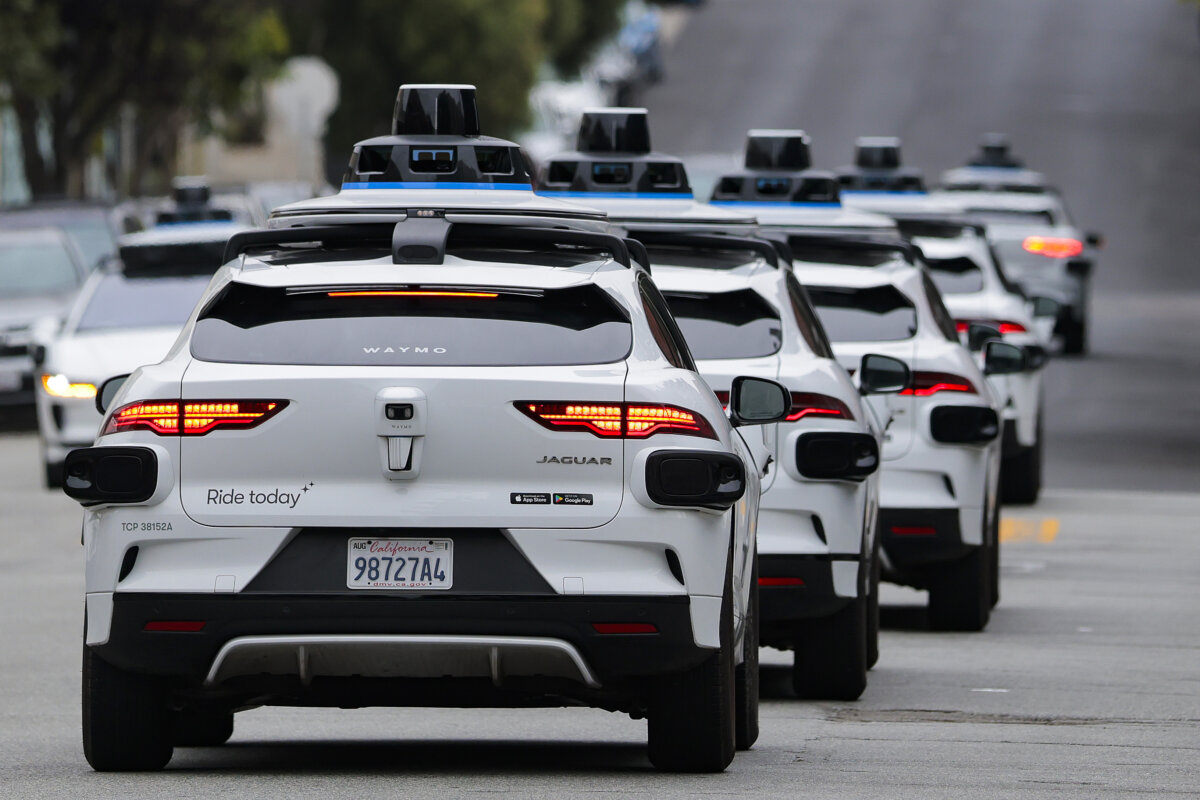
The proposal is the latest step in a broader federal effort to rewrite vehicle safety standards that can create difficulties for purpose-built robotaxis and other autonomous vehicles with unconventional designs.
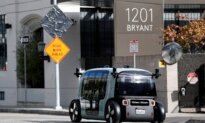
Amazon-owned Zoox, for example, developed a robotaxi without a steering wheel, pedals, mirrors, or a traditional forward-facing driver’s seat. In July, NHTSA granted the company a temporary exemption allowing it to commercially deploy up to 2,500 of the vehicles per year for two years.
Tesla’s Cybercab is another example of the type of vehicle that could benefit from changes to rules written around human drivers.
Deployed in September in Austin, Texas, the two-seat Cybercab has no steering wheel or pedals and is designed to operate without a human driver.
Rather than seeking exemptions from individual federal safety requirements, as Zoox did, Tesla took a different approach by self-certifying that the Cybercab already complies with every applicable federal safety standard.
NHTSA has opened an investigation into Tesla’s self-certification, looking into the technical data and process the company used to reach that conclusion.
NHTSA has said modernizing the underlying rules could eventually spare the manufacturers of self-driving cars from having to clear regulatory hurdles related to human steering.
“If you’re developing a vehicle that is designed never to be driven by a human operator, it doesn’t make any sense to require manual controls,” NHTSA Administrator Jonathan Morrison said in July in an interview with CNBC.