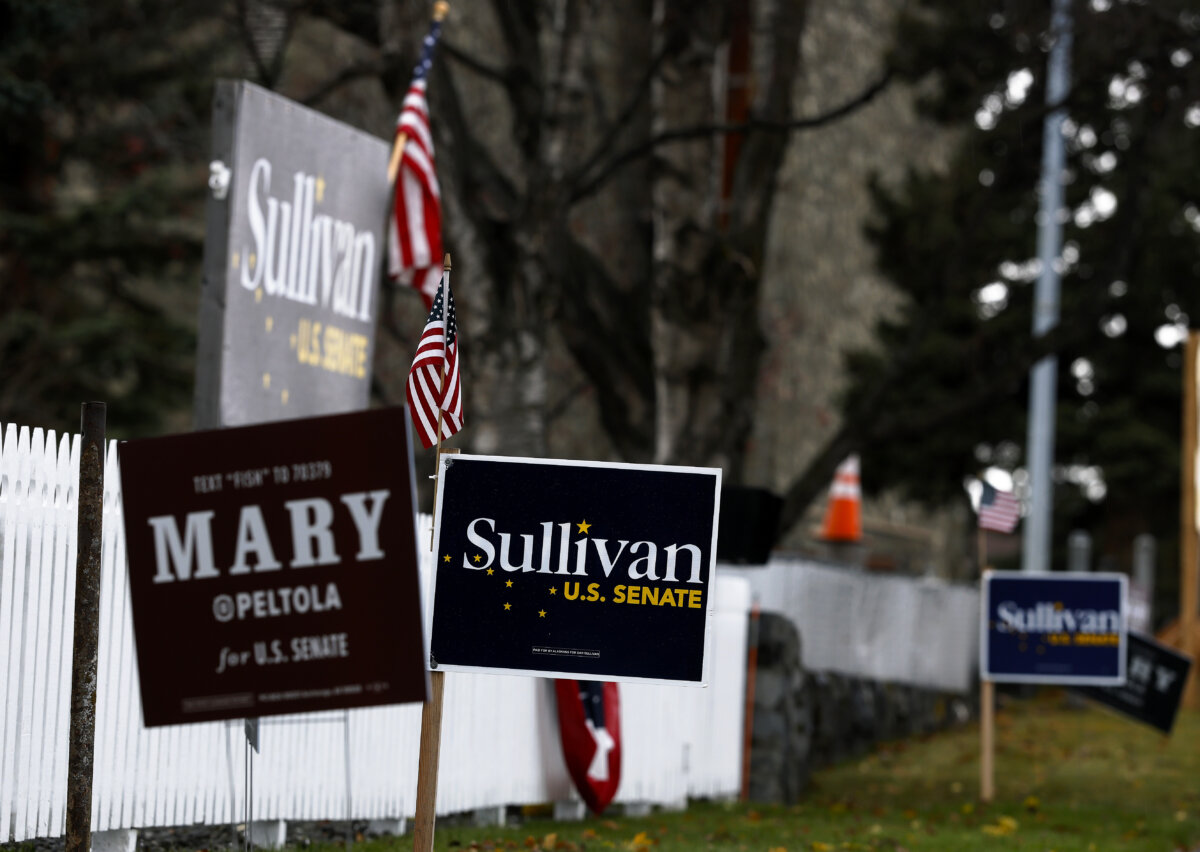

The Department of Justice (DOJ) asked a federal judge on Oct. 30 to block Alaska from certifying its U.S. Senate election if Republican incumbent Sen. Dan Sullivan loses to Democrat Mary Peltola, saying votes cast for another candidate also named Dan Sullivan could alter the outcome.
The new court filing comes as residents of that state are already voting early in the Nov. 3 midterm congressional elections. Republicans currently hold 53 seats in the Senate; Democrats and independents who caucus with them hold 47 seats.
Both state and federal criminal investigations are underway into an alleged scheme to place Daniel J. Sullivan, a retired teacher from Petersburg, Alaska, on the ballot to draw votes away from the incumbent.
The DOJ argues in its lawsuit that Daniel J. Sullivan was brought into the race “to confuse voters,” and that the sole purpose of his candidacy “is to benefit the Peltola campaign by reducing the number of votes for Senator Sullivan.”
On Oct. 29, the DOJ amended its legal complaint in the federal district court in Alaska to incorporate details from an Oct. 28 report in The New York Times. That report alleged that aides to Peltola worked with Democratic Senatorial Campaign Committee (DSCC) staff and others on what was internally called a “Ballot Composition Project” to recruit candidates who could siphon off votes from the incumbent. The newspaper alleged the operation helped bring Daniel J. Sullivan into the race.
Peltola’s campaign, the DSCC, and Daniel J. Sullivan have denied any wrongdoing.
In court papers filed Oct. 30, the DOJ argues that a preliminary injunction should be granted because “monetary damages cannot compensate Alaskans duped into voting for Daniel J. Sullivan.”
“When voters are unable to fairly cast ballots in federal elections, the United States suffers irreparable harm,” the department said.
In June, the Alaska Division of Elections investigated Daniel J. Sullivan’s candidacy and found there were “credible allegations” that he filed to run “with the deliberate intent to confuse Alaska voters.” A state court later allowed the retired educator to stay on the ballot, and the Alaska Supreme Court affirmed that ruling.
In the Oct. 30 filing, the DOJ recounted some of the Division of Elections’ findings.
The DOJ said that the state agency determined that Daniel J. Sullivan asked that the ballot show his name as “Dan S. Sullivan”—even though “S” is not his middle initial—it’s actually the incumbent’s initial.
The Division of Elections also found that Daniel J. Sullivan asked to be designated as a Republican on the ballot, even though he had never before “been affiliated with the Republican Party in Alaska,” the DOJ said. The agency held that Daniel J. Sullivan’s wish to change his party affiliation to match the incumbent’s, along with his desire to use a shortened version of his name that he had not previously used and that matched the incumbent’s name, “strongly suggests an intent to confuse [himself] with the incumbent Senator rather than to distinguish [himself] from him,” the DOJ said.
The DOJ also said that Daniel J. Sullivan “admitted in a July 18, 2026, interview with The New York Times that he voted for Democrats in the last three presidential elections and voted for Peltola when she ran for Congress.”
In its lawsuit, the DOJ is seeking a declaration that certifying any result affected by voter confusion would violate election officials’ duties under the National Voter Registration Act, as well as an injunction blocking certification in the specific scenario in which Sen. Sullivan loses but would have won if votes for Daniel J. Sullivan had been cast for him instead.
Meanwhile, state and federal investigations are underway.
Michael Heyman, the U.S. attorney for Alaska, told reporters on Oct. 30 that a federal criminal investigation has been moving forward for several months, but the Oct. 28 New York Times report on Peltola’s campaign has led to a “significant surge of law enforcement assets to Alaska.”
Alaska Gov. Mike Dunleavy, a Republican, on Oct. 29 ordered state officials to investigate whether aides to Peltola worked with national Democrats to recruit spoiler candidates onto the ballot.
Austin McDaniel, deputy commissioner of the Alaska Department of Public Safety, said Oct. 29 that the Alaska Bureau of Investigation is investigating the alleged conduct outlined in the New York Times report.
“We will work closely with our partners at the Alaska Department of Law to ensure that the facts are thoroughly examined and that anyone found to have violated state law is held accountable,” McDaniel said.
Tom Ozimek, Jack Phillips, and The Associated Press contributed to this report.