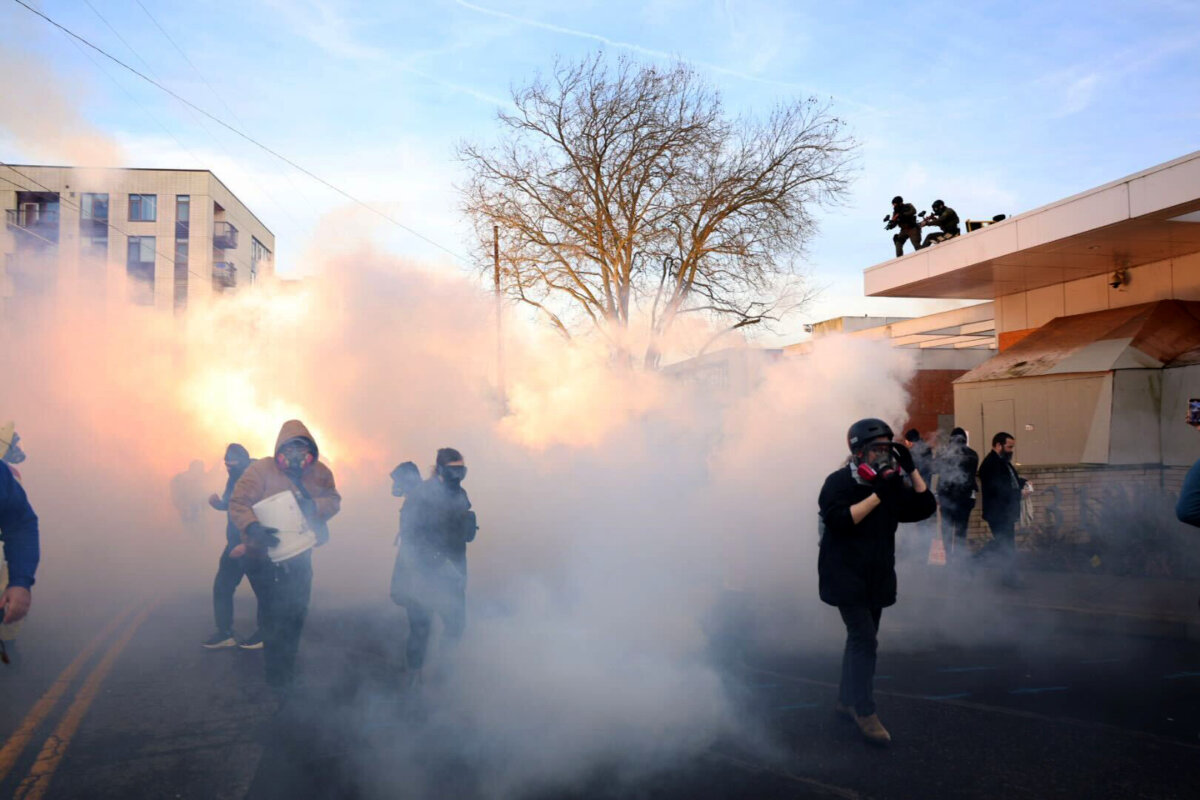

Restrictions on the use by federal officers of tear gas and other measures in Portland, Oregon, were vacated on Nov. 10 by an appeals court.
In two rulings, the U.S. Court of Appeals for the Ninth Circuit overturned lower court orders that limited officers’ use of nonlethal munitions against crowds near the Immigration and Customs Enforcement building in Portland.
“Under our precedent, law enforcement agents may use nonlethal force to clear crowds and restore order—they need not wait until they face ‘an imminent threat of physical harm,’” Circuit Judge Kenneth Kiyul Lee wrote for the majority in one of the decisions.
U.S. District Judge Michael Simon had said in February that federal officers could not use munitions such as tear gas on people around the building unless the target of the munitions “poses an imminent threat of physical harm to a law enforcement officer or other person.”
“The record also does not support the plaintiffs’ claim that federal agents retaliated against them for exercising their First Amendment rights,” Lee said. “Rather, the plaintiffs appear to be unfortunate collateral casualties of federal agents’ efforts to quell an unruly and sometimes violent crowd.”
The plaintiffs in the case are peaceful protesters and freelance journalists who were exposed to tear gas or pepper balls that were deployed by federal officers to control the crowd in Portland in 2025 and 2026.
The other ruling came in an appeal of a similar order that was entered in favor of other people, including individuals who reside in an apartment complex located across the street from the federal building in Portland.
That group of people does not have a Fifth Amendment right not to be exposed to chemicals deployed by the government to control crowds, Circuit Judge Eric Tung wrote for the majority in that decision.
“To succeed on a substantive-due-process challenge to executive action, a plaintiff must show both that the action shocks the conscience and that the action deprives a right that, carefully described, is deeply rooted in our Nation’s history and implicit in the concept of ordered liberty, consistent with the Supreme Court’s teachings,” Tung said.
The majority noted that the use of crowd control devices appeared to come after the crowd barricaded officers inside the facility; destroyed cameras there; hurled rocks, glass, and metal at officers; and shone lasers at officers’ eyes.
When entering a preliminary injunction, a district court judge said that she found “that Plaintiffs have shown a deprivation of their constitutional liberty interest in bodily integrity, and that Defendants’ conduct over the course of the last eight months shocks the conscience such that Plaintiffs have shown a likelihood of success on the merits.”
Circuit Judge Ana de Alba dissented at least in part in both of the new rulings.
De Alba said in a partial dissent and partial concurrence in the case involving protesters and press that portions of the preliminary injunction were overbroad but that she would have maintained the prohibition against officers firing munitions at the head, neck, or torso of a person unless the officer was legally justified in using deadly force.
In the other case, she said that the district court properly held that the tenants in the nearby apartment building met the standard of shocking the conscience, in part because a large quantity of chemical munitions was used.