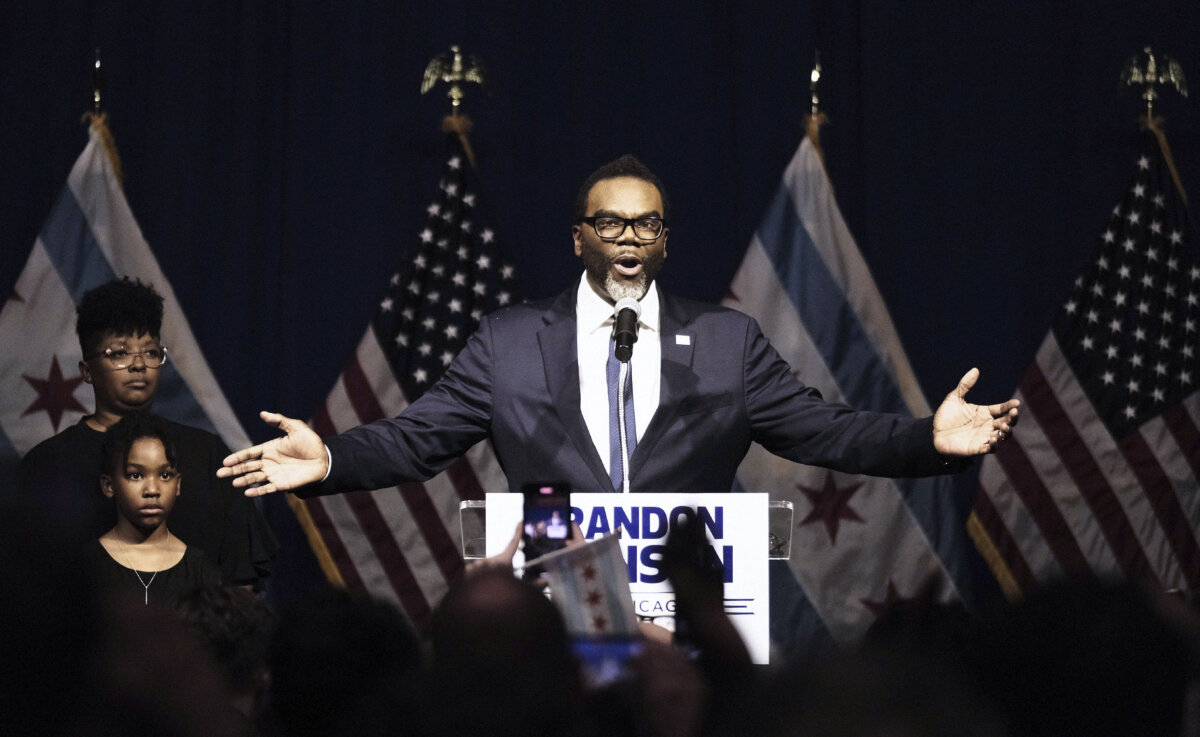

At the bottom of their March 19 primary ballots, Chicago primary voters will see a referendum for which their votes will count—but nearly didn’t.
Ballot Question 1, also known as “Bring Chicago Home,” would cut the tax rate for real estate transactions of less than $1 million by 20 percent, to $3 from $3.75 per $500. But it would raise the transfer tax for the value of transactions greater than $1 million in a graduated way.
Specifically, the price for the portion of transactions between $1 million and $1.5 million would increase by 166.67 percent to $10 per $500. The price for any portion above $1.5 million would rise by 300 percent. That’s an increase to $15 from $3.75 per $500.
According to the language in the referendum, the extra money would go toward “addressing homelessness, including providing permanent affordable housing and the services necessary to obtain and maintain permanent housing in the City of Chicago.”
The Chicago City Council approved the placement of the language on the March ballot in November 2023. The measure has been championed by Chicago Mayor Brandon Johnson, a Democrat.
In late February, after early voting in the primary had started, it seemed like votes on Bring Chicago Home wouldn’t count when Cook County Judge Kathleen Burke ruled that the results of the measure wouldn’t be tallied.
The decision was a victory for the Building Owners and Managers Association (BOMA) Chicago, an industry group that had opposed the ballot measure.
“This referendum would be a backdoor property tax on all Chicagoans, and it is important that our elected officials not mislead voters otherwise,” Farzin Parang of BOMA Chicago said after the decision was handed down.
The City of Chicago’s Law Department swiftly appealed the ruling.
“Make no mistake: the real estate industry would rather have 17,000 homeless children in Chicago than pay their fair share in taxes,” Maxica Williams of the Chicago Coalition for the Homeless said in regard to the decision and the city’s response.
A three-judge panel from the First District Appellate Court reversed the lower court’s ruling, arguing, in part, that the referendum amounts to a portion of the legislative process.
“Courts do not, and cannot, interfere with the legislative process,” Judge Raymond Mitchell wrote in his March 6 opinion.
Just days later, on March 13, the Illinois Supreme Court denied BOMA Chicago’s petition for appeal. The upshot is that Votes on Bring Chicago Home will be counted.
Major supporters of Bring Chicago Home include the Chicago Teachers Union, which cites rampant student homelessness among its motivations.
“The new revenue from that restructuring will provide flexibility to expand our housing inventory, fill gaps in services, and help Chicago work towards eradicating homelessness and housing insecurity,” the union wrote in a December 2023 statement voicing support for the referendum.
Advocates point out that most properties would see a lower real estate transfer tax rate if the referendum passes.
Critics of the so-called mansion tax, including Katherine Loughead of the Tax Foundation, note that commercial properties will be particularly vulnerable to the increase.
“These higher tax burdens would affect not just the owners of various commercial properties, but their customers, employees, and tenants as well,” Ms. Loughead wrote in a March 15 blog entry on the proposal.
The nonpartisan Chicago Civic Federation found that the proposal would likely enlarge the proportion of transfer tax obtained from commercial property transfers.
“The Civic Federation has concerns about the volatility of the proposed graduated real estate transfer tax,” the organization said in its position statement.
“The referendum presents both an opportunity and a risk for Chicago. It is an opportunity to generate a new dedicated revenue stream for the homelessness crisis in Chicago that at the same time presents the risk of negatively impacting the real estate market, especially for a commercial sector already in distress.”







