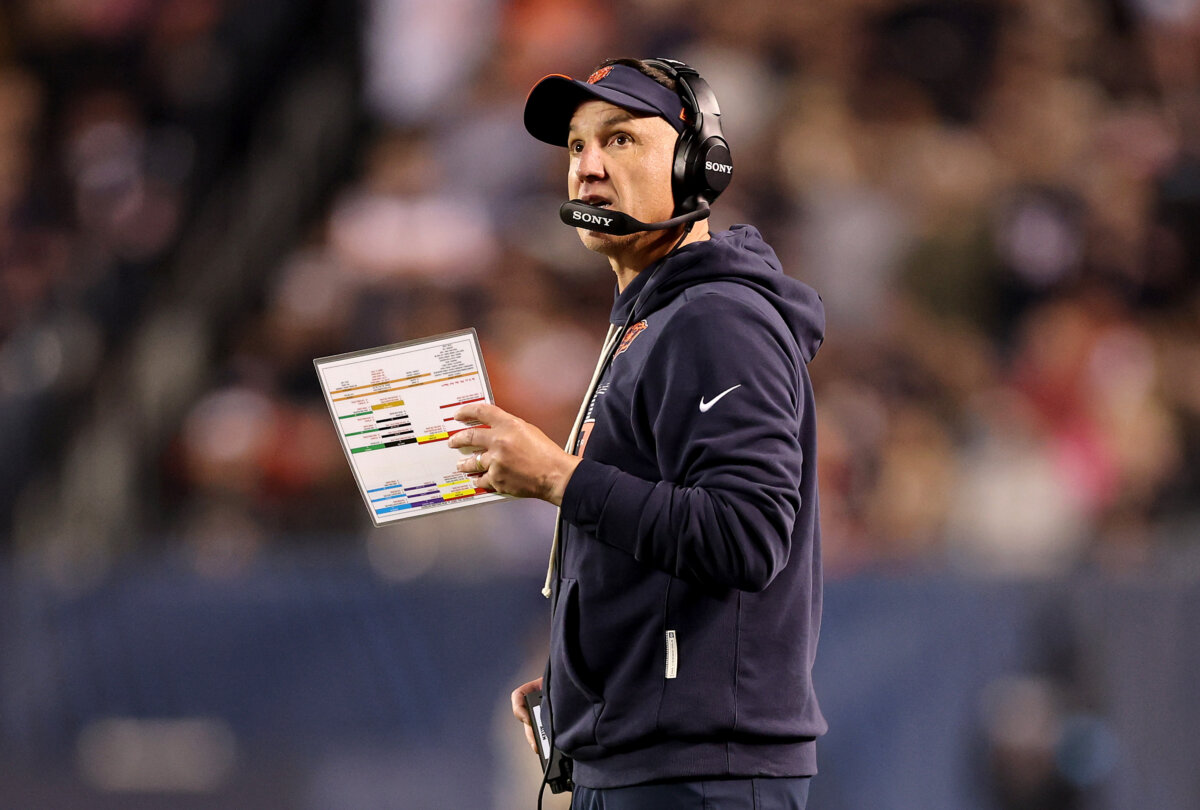
Chicago Bears head coach Ben Johnson shrugged off his failed trick play in Thursday’s win.
During the Bears’ 30–24 win over the New England Patriots on Thursday Night Football, the Bears tried a trick play that used an offensive lineman as the ball carrier. But an illegal forward-handing penalty negated the play.
After the game, Johnson, Caleb Williams, and left guard Joe Thuney (the ball carrier) all expressed mild disappointment and good humor about the play, though they couldn’t say exactly what went wrong.
“[We’ve] got to go look at it,” Thuney said in the locker room after the game. “It was fun, but illegal, I guess.”
Thuney and Williams both said they had been practicing that play for a few weeks. Johnson said the play looked much like how they ran it in practice; it looked clean during the week, so he would have to watch the film to see what went wrong.
Williams didn’t know what went wrong either.
“Joe was supposed to score,” he told reporters. “But I didn’t know that rule. So, I’m going to go back, and we’re going to talk about it, coach and I and the other people that are in charge of that. So, we’ll figure it out, and hopefully we can figure some cool plays out again.”
Halfway through the second quarter, on 2nd and 3 from the New England 8-yard line, the Bears lined up in an offset formation: Thuney and tight end Colston Loveland were the only players on the left side of the offensive line; running back D’Andre Swift was split wide and off the line.
Williams kicked Swift in motion and snapped the ball. Thuney opened up as if he were pulling to the right, but stopped; Williams pitched him the ball while faking a handoff to Swift.
Thuney spun out of a tackle by Patriots edge rusher Gabe Jacas and rumbled for two yards before linebacker Christian Elliss tackled him.
The play was blown dead, and the referees threw a flag for an illegal forward handoff, since Thuney is not an eligible receiver.
Under NFL rules, at least seven offensive players must be on the line of scrimmage on every play.
In a typical formation, five of those seven players are the offensive linemen: the center, left and right guards, and left and right tackles; the other two players are eligible receivers and are able to handle a forward pass, be they a split wide receiver or a tight end, so long as they are lined up on the line.
All other eligible receivers on each side of the line of scrimmage must be off the ball; for example, if both the wide receiver and the tight end are lined up on the line of scrimmage, the tight end is considered “covered up” and ineligible.
A player’s jersey number also determines his eligibility: eligible receivers on offense wear numbers from 1–49 and 80–89. Offensive linemen wear 50–79 and are not eligible unless they explicitly report to the officials that they are lining up as eligible; this also applies to defensive players who wear 50–79 and 90–99 and line up on offense.
The issue was twofold: Thuney—who wears 62—did not report himself as eligible, and Loveland was lined up on the ball, which covered him and made Thuney ineligible.
Thuney echoed Johnson and said he would have to go back and watch the film to find out where he went wrong. From an execution standpoint, he assumed he should have been further behind Williams to make it legal.
But it was a special moment for a player who very rarely, if ever, gets the ball in his hands.
“[We were] working on it here and there, kind of as a ‘who knows?’ play. [I] heard it in the huddle, I was like, ‘All right, let’s go’ … I think I’ve recovered a couple fumbles in my life, but I don’t think I’ve ever carried it.”
After looking at it on film, Johnson confirmed on Friday that it should have been a backward pass. He said that in the initial installation, they faked a fumble to get it to Thuney, and maybe they should have done that. But ultimately he shrugged it off.
“It’s one of those things,” he told reporters. “Shooters shoot. We shot, we missed. So, keep it moving.”