Commentary
The communiqué issued after the Fifth Plenum of the Chinese Communist Party (CCP), which took place between Oct. 26 and Oct. 29, presents Chinese leader Xi Jinping as having solved one of the oldest problems in Chinese political history: the recurring cycle of political rise, decline, and collapse.
In the 1940s, Mao Zedong also claimed to have solved this problem, but his approach ultimately failed.
Why should Xi succeed where Mao did not? In my view, Xi faces essentially the same dilemma as Mao.
Has Xi Really Broken China’s Historical Cycle of Rise and Decline?
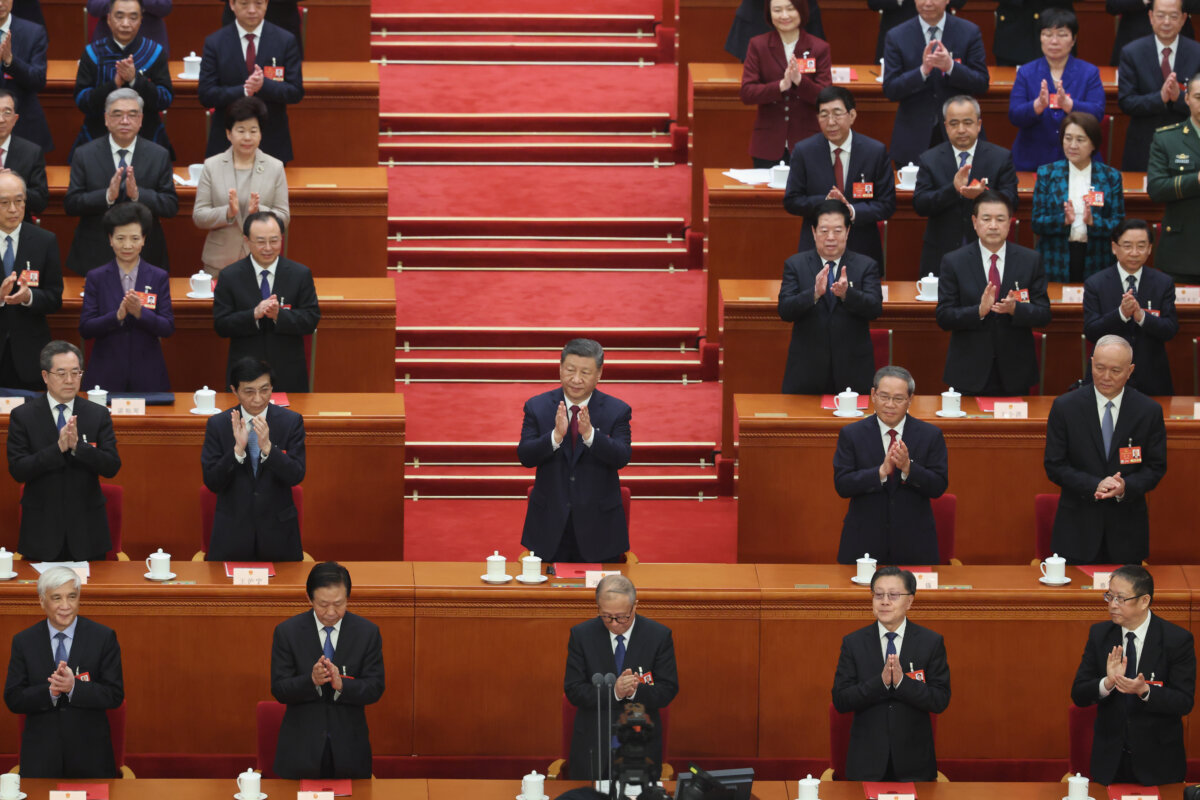
The Fifth Plenum is a closed-door meeting of the CCP’s Central Committee, where senior Party leaders discuss major policy directions, long-term development plans, and issues of Party governance and ideology.
The plenum’s communiqué declares that, since the 18th Party Congress in 2012, the CCP has found two answers to breaking the historical cycle of political rise and decline: letting the people supervise the government and self-purification.
Why does the communiqué specifically mention the 18th Party Congress? Because it presents these achievements as Xi’s rather than those of previous generations of Party leaders. Xi rose to power in 2012, the year the 18th Party Congress convened.
Furthermore, this implicitly criticizes his predecessors and declares that their mistakes needed correction. The communiqué acknowledges that, at one point, the Party’s leadership had become weakened, hollowed out, and diluted; that Party governance and discipline had become lax, superficial, and ineffective; and that some problems within the Party had become deeply alarming.
The idea of breaking the historical cycle dates back to the famous “Cave Dialogue” in 1945 between Mao and Huang Yanpei, which took place when Huang visited Yan’an, the CCP’s wartime headquarters.
Huang, a prominent Chinese educator and political figure who helped establish political organizations outside both the ruling Kuomintang and the CCP, asked Mao if the CCP could find a new way to escape the recurring cycle of dynastic rise and fall that had shaped Chinese history.
Mao’s answer was democracy: people overseeing government.
Yet Mao never put this idea into practice. Instead, he adopted another approach: “continuing revolution,” which took the form of repeated political campaigns during peacetime. This endless revolution peaked during the Cultural Revolution (1966–1976).
After Mao’s death, however, the policy of “continuing revolution” ended abruptly. Further evidence of this failure is that his successors abandoned the approach after his death and reversed his efforts to break the historical cycle. Not only was the political system he had built fundamentally inhumane, but it also depended entirely on Mao himself to survive.
Xi Has Repeated Mao’s Two Failed Approaches
Xi’s first answer, the people’s oversight over government, closely echoes Mao’s 1945 promise.
However, like Mao, Xi has failed to establish any institutional mechanism for public supervision. Functions depend on structures. Without institutions that empower the people to supervise the government, such supervision will not simply appear out of thin air.
The second answer is self-purification. This is essentially a revised version of Mao’s “continuing revolution.” We have witnessed Xi’s anti-corruption campaign and repeated purges: one wave after another, moving from civilian officials to the military, from rival factions to members of his own camp.
Another fundamental problem is that neither answer clearly defines its subject. Who is supposed to let the people supervise the government? Those in power can permit it one day and prohibit it the next. And who is supposed to carry out self-purification? What surgeon in the world can operate on his own internal organs to remove a tumor?
This is why corruption and disloyalty appear to grow more serious with each purge rather than diminish.
All this only demonstrates the ineffectiveness of self-purification. Through the CCP’s extensive propaganda machine, Mao elevated himself to an almost godlike status in the eyes of the Chinese people.
Xi, despite his efforts to build his image and consolidate personal authority, can never command that same level of prestige or popular devotion. If even Mao, with his extraordinary personal authority, failed to break the historical cycle through his “continuing revolution,” what gives Xi the confidence to believe that he can succeed—and that he has already succeeded?
Xi Faces the Same Fundamental Dilemma as Mao
The Fifth Plenum communiqué offers no indication of a designated successor. This is precisely the outcome Xi wants. He may have already purged all potential successors.
If an opposition faction challenged him, one of its most effective weapons would be to force a successor onto the political agenda, effectively imposing a succession arrangement on Xi. In this respect, Xi appears to have held his ground on the succession question.
But while this may be the outcome he wants, it also creates a much deeper problem.
No matter how highly the Fifth Plenum communiqué elevates Xi’s status or portrays his achievements in Party building as historic milestones, the entire political system has been built around his personal will and revolves around him.
The system depends entirely on him for both direction and driving force. It has no independent institutional foundation to sustain itself without his personal authority.
Once he loses power, all his past efforts could be undone overnight, leaving little more than the Fifth Plenum communiqué behind. Perhaps this is precisely why he needs a formal Party “decision” to enshrine his achievements and give them the appearance of lasting institutional significance.
In the end, Xi may have succeeded in concentrating power more completely than any Chinese leader since Mao, but it has left him with the same fundamental dilemma: a political system built around one individual may have no independent life once that individual is gone.
However, an important difference separates Mao from Xi. Mao’s absolute authority ensured that his political legacy would collapse only after his death. Xi may not have that luxury. He could lose power under entirely different circumstances—and while he is still alive.
Views expressed in this article are the opinions of the author and do not necessarily reflect the views of The Epoch Times.