
Commentary
A quiet revolution against the Chinese Communist Party’s baby mandate is underway, and there’s nothing the Party can do about it.
For decades the Chinese Communist Party (CCP) disparaged the traditional family, treating human beings as economic units of the state and blaming marriage and childbearing for China’s poverty and backwardness. Since taking power in 1949, the Party has attacked traditional values and punished those who defied its decrees, stripping the joy from marriage, family, and womanhood itself.
Now Beijing is reaping what it sowed.
China’s population is cratering, and Chinese leader Xi Jinping’s new “pro-family” push to get women marrying and having multiple children is running into a wall: They aren’t buying it. Chinese women are defying the three-child campaign by refusing to marry, choosing childfree lives, and prioritizing careers over state demands.
Why Women Are Saying No
Two generations of Chinese women watched their mothers sacrifice careers and autonomy under the one-child system. Today’s educated, urban women are declining to repeat the pattern. Soaring housing costs are one reason, an unforgiving youth job market another. A third is the sheer financial weight of raising a child—averaging close to $85,000 through age 17, and roughly $96,000 through post-secondary education.
Career hindrance and workplace gender discrimination compound the calculation. The result is a generation opting out of marriage entirely, delaying it indefinitely, or pursuing what state media have begun euphemistically calling “two-sided marriages,” arrangements that split family obligations and abandon the traditional dowry system.
A Renmin University demographer noted that the marriageable-age population itself has shrunk by roughly 64 million people over the past decade. But arithmetic alone doesn’t explain the collapse—attitudes have shifted just as sharply.
The Numbers Behind the Resistance
The scale of this shift can’t be overstated.
Marriage registrations fell by 20.5 percent in 2024 alone, to just 6.1 million pairs from 7.68 million the year before—the steepest single-year decline since Beijing began tracking the data in 1986, and the lowest total in 46 years.
The trend hasn’t reversed: The first quarter of 2025 brought another 8 percent drop from the same period a year earlier, despite cash incentives and relentless state messaging. Compared with 2014, marriage registrations have fallen by more than 50 percent.
The share of adults still unmarried at age 30 more than doubled in a decade, from 14.6 percent in 2013 to nearly 30 percent in 2023. Divorce, meanwhile, is trending in the opposite direction, rising by 1.1 percent in 2024 even as marriage collapsed.
The fertility consequences are severe.
China’s total fertility rate now sits at an estimated 0.93 children per woman, far below the 2.1 needed for a stable population and among the lowest rates recorded anywhere in the world. Births fell by roughly 17 percent between 2024 and 2025 alone—the lowest annual total since 1949, when China was just emerging from civil war.
 Parents looking for partners for their children at a marriage market in Shanghai on May 30, 2015. (Joannes Eisele/AFP via Getty)
The Brutal Legacy of the 1-Child Policy
The worst of it was the one-child policy itself.
For more than three decades, the CCP treated marriage and children as economic levers to switch on and off by decree. Enforced from 1979 to 2015, it imposed heavy financial penalties, mandated sterilizations, and forced abortions on families who defied state quotas.
That system did more than shape a population curve—it embedded, across two generations, the idea that children were burdens to be managed rather than blessings to be welcomed. Now that the Party needs a workforce to sustain its ambitions, it is discovering that decades of treating reproduction as a state utility can’t be undone by a policy reversal. One recent government study warns that China’s labor force could shrink by 200 million people between 2020 and 2050.
 Decades of a one-child policy intensified the nursing problem of the senior population in China. (Getty Images)
Traditional Values Can’t Just Be Switched Back On—or Can They?
Xi has responded with increasingly direct appeals, telling the All-China Women’s Federation that women must “actively cultivate a new culture of marriage and childbearing” and establish a “new trend of family” in service of “national rejuvenation.” Beijing has backed the rhetoric with cash—3,600 yuan (about $537) annually per child younger than age 3, plus childcare subsidies rolled out in more than 20 provinces.
It isn’t working.
Sociologists studying comparable countries aren’t surprised: As one University of California professor put it, monetary incentives have almost no track record of reversing fertility declines once they take hold.
The deeper problem is one the Party created itself.
Genuine reverence for family and life doesn’t switch back on by decree after a state has spent decades degrading the value of children, the women bearing them, and family life generally. Treating reproduction as an instrument of policy rather than a private, sacred choice pushed the value of human life toward relativism.
The CCP’s ongoing suppression of independent religious life—especially underground Christian churches, which teach that every person carries inherent worth apart from state utility—has stripped away much of the moral scaffolding that once made family formation feel meaningful rather than transactional. A society doesn’t casually rebuild a culture of life after two generations of being told that children are liabilities to be rationed.
Ironically, it’s the very faith communities the CCP persecutes and threatens—Christianity chief among them—that are succeeding at prioritizing marriage and family formation in China, doing through spiritual transformation what state decree cannot.
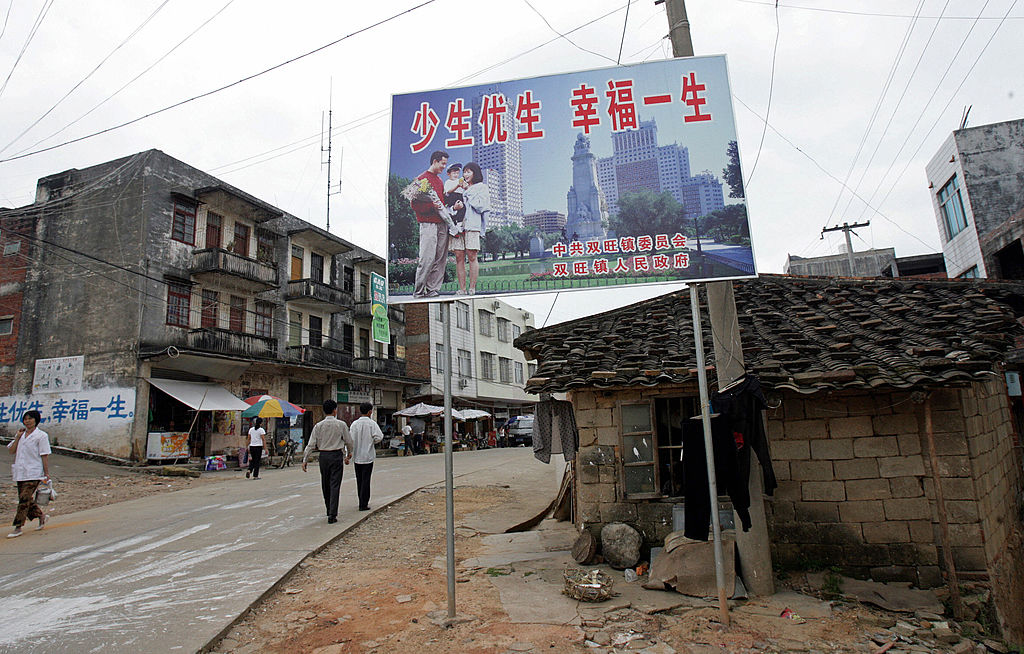 A Chinese “one-child” policy billboard that reads, “have fewer children, have a better life,” greets residents on the main street of Shuangwang, in southern China’s Guangxi region on May 25, 2007. (Goh Chai Hin /AFP via Getty Images)
A Crisis of the Party’s Own Making
Beijing now faces the consequences of a system built to be obeyed, not believed in. The women driving China’s collapsing marriage and birth rates aren’t rejecting family in the abstract—many are rejecting a state that spent 35 years treating their bodies as instruments of economic planning, and are unwilling to treat their futures the same way just because the incentives have flipped.
Having deleted the traditional, intrinsic value once placed on the individual and the family, the Party is discovering that virtue doesn’t return on command. It is reaping, in a genuinely empty cradle, the long-term cost of its own totalitarian overreach.
Views expressed in this article are the opinions of the author and do not necessarily reflect the views of The Epoch Times.