
Commentary
Analysts in Beijing and Taipei must be trying to figure out just how aggressively Democrats will use their new political power with regard to China and Taiwan.
They should be.
The incoming democratic Congress could either strengthen America’s long-term strategy toward China or turn the testy relationship into another arena for domestic political warfare.
It may hold the key to Taiwan’s defense, too.
Taiwan: More Pressure to Deliver Weapons
Taiwan may be the first major test for the new democratic Congress.
For decades, Washington has helped Taiwan defend itself without formally recognizing it as an independent country or abandoning its policy of strategic ambiguity toward a potential Chinese attack.
Will that change?
Probably not. Congress has traditionally supported Taiwan’s defense across party lines.
Still, the Democratic takeover could make U.S. support more assertive. The Taiwan Relations Act requires the United States to make defensive weapons available to Taiwan so it can resist the Chinese regime’s threats.
The immediate issue is a $14 billion arms package to Taiwan. It remains stalled after President Donald Trump described the sale as a negotiating asset after his meeting with Chinese leader Xi Jinping last May. Reuters reporting suggests that the weapons deal could be approved in 2027, potentially in smaller tranches.
Notably, however, the Taiwan Act does not require U.S. forces to defend Taiwan against a Chinese invasion.
Democrats could use defense legislation and other means to pressure the administration to approve the defense package, but it may not have enough votes to override a veto by Trump.
The more likely result is that a Democrat-led Congress will review the administration’s Taiwan policy and pressure the administration to accelerate weapons deliveries to Taiwan.
If the administration resists doing so, it would increase uncertainty in Taipei and perhaps give Beijing an opportunity to test the resolve of a divided United States.
 A U.S.-made F-16V fighter jet with its armaments is on display during an exercise at a military base in Chiayi, southern Taiwan, on Jan. 15, 2020. (Sam Yeh/AFP via Getty Images)
The CCP’s Strategic Calculation
The Chinese Communist Party (CCP) will be watching more than the arms package. It will be assessing whether Washington can maintain a coherent China policy when the executive and legislative branches are controlled by opposing parties.
The CCP could see political conflict in Washington as a domestic political vulnerability and a lack of resolve within the administration for at least the remainder of the Trump presidency.
China’s Options
The CCP has several ways to take advantage of a deeply divided U.S. government. Intensifying military exercises around Taiwan is one option of many, including increasing cyber attacks against Taiwan’s infrastructure and testing the island’s political resilience.
Indeed, these tactics are already part of the CCP’s Taiwan strategy, according to the Congressional Research Service. The challenge would lie with both the administration and Congress to formulate an effective response—or better yet—an effective way to deter Beijing from acting in those capacities in the first place.
That will require Congress and the administration to work with, not against, each other.
Trade and Tariffs: A More Complicated Fight
On the other hand, U.S. trade policy changes are less certain because Democrats are not all committed to free trade. Democrats’ verbal opposition to Trump’s tariffs doesn’t mean opposition to economic pressure on China.
Many Democrats favor protecting American manufacturing, workers, and strategically important industries from Chinese competition. That fact alone makes a Democratic majority unlikely to unwind too much of the administration’s policies toward China.
They may, however, be willing to adjust how tariffs are imposed, whom they benefit, and how much they cost American businesses and consumers.
That said, in February 2026, the Supreme Court ruled that the International Emergency Economic Powers Act did not authorize the president to impose tariffs. The ruling doesn’t eliminate other tariff authorities.
The nuance is that although Congress has constitutional authority over tariffs, it has delegated much of that authority to the executive branch.
Of course, Democrats limit presidential tariff power and increase congressional oversight, but the president may veto such a law, and the Democrats may not be able to override it without some republican support.
The more likely outcome, therefore, will be a narrower trade focus or more targeted measures against China.
Beijing can forget about the free trading days with the United States.
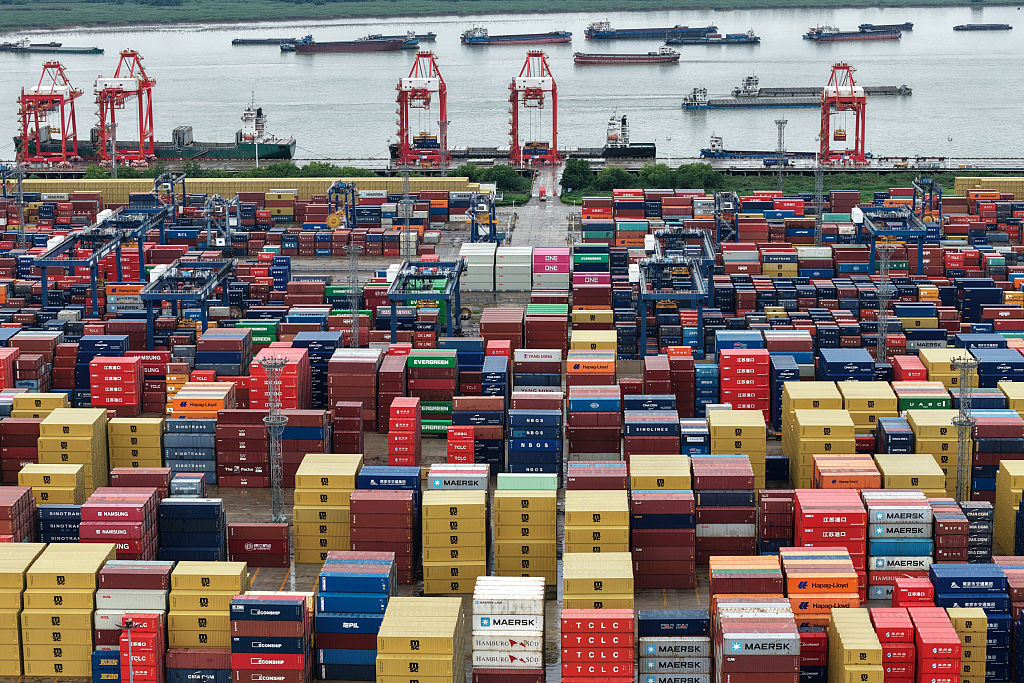 Containers at the port in Nanjing, in China’s eastern Jiangsu Province, on Aug. 12, 2025. (AFP via Getty Images)
Sanctions and Technology Controls Against China: Pressure Could Increase
Sanctions may prove more politically viable with the Democrats than broad tariffs.
The United States now views advanced semiconductors, artificial intelligence, sensitive technologies, and critical supply chains as national-security issues.
Because Democrats and Republicans share concerns about China’s military modernization, intellectual-property practices, and strategic dependence on foreign technology, keeping sanctions in place is an easy and effective solution for both parties.
In fact, a Democratic Congress may actually favor less Chinese access to advanced computing, sensitive investments, and technologies with military applications. It could also outflank Trump with more aggressive enforcement of existing restrictions and stronger coordination with allies.
The same logic applies to sanctions connected to human rights, espionage, and military activity.
But sanctions are not cost-free. Broad restrictions can encourage China to accelerate the development of alternative technologies, retaliate against U.S. companies, and worsen economic relations between the two countries.
The Larger Contest: Strategic Consistency
The Democratic victory shouldn’t mean a softer policy toward China. Nor should it mean a tougher one across every issue.
Rather, the election outcome is a change in the balance of power inside Washington, not so much a change in relations with China or Taiwan.
For Taiwan, the best outcome would be reliable access to defensive weapons and a clearer, more consistent American commitment to deterrence.
For China, trade policy may shift toward fixing security and economic vulnerabilities rather than maintaining blanket tariffs. That’s better than nothing. The same could apply to sanctions, targeting restrictions supported by allies and designed to achieve specific objectives.
Ultimately, the central issue is not whether Democrats or Republicans control Congress. It is whether Washington can distinguish strategic competition from political theater.
Views expressed in this article are the opinions of the author and do not necessarily reflect the views of The Epoch Times.