
Commentary
The true significance of President Donald Trump’s proposed Triumphal Arch in Washington, D.C., seems to be entirely lost on those condemning it—and probably even on those supporting it.
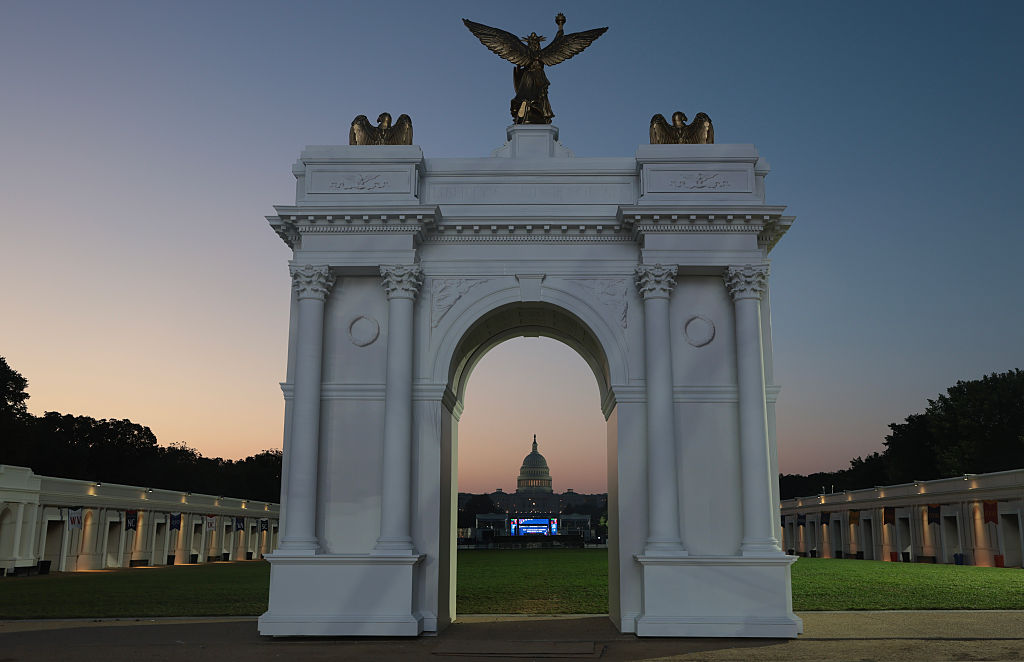
We know the basics: The 250-foot arch would honor the 250th anniversary of America this year with a fittingly larger-than-life monument decked with the phrases “One Nation Under God” and “Liberty and Justice for All,” filling an otherwise empty traffic circle. It would also honor war veterans as does its counterpart, the Arc de Triomphe in Paris. It would provide space for a potential military installation. But these benefits are all in some way superficial and do not do this proposed monument justice.
Simply put, a war is on now for the soul of the nation.
On one side is truly good art. It builds upon the work of those who have come before, resonating through the ages. It inspires the human spirit to achieve the excellence and perfection it exhibits.
This is where the Triumphal Arch stands as a hero among monuments. It draws on the splendid arch of the Romans, who extended their reign to a thousand years and laid the foundation for our legal system, our government, and even the letters of the alphabet we still use to write. Slightly larger than France’s Arc de Triomphe, the Triumphal Arch is a reclaiming of the noble classical styles that France championed through the patronage of Louis XIV and Napoleon Bonaparte, but that have now been lost to modern art—just as France has lost its nerve in suppressing recent riots and confronting the regime in Iran.
The Roman arch can be directly experienced by walking through it, benefiting from the shade and protection from the rain, but also exalting the spirit as does a cathedral’s high ceiling—it is a design both human and divine.
The Triumphal Arch also literally connects with the deepest American cultural traditions by aligning with the Lincoln Memorial, which itself aligns with the Washington Monument and the Capitol building. The arch would also stylistically connect through their shared neoclassical style. On the whole, it would extend and amplify the grandeur of the American spiritual center to new realms.
And then there is the other side of this war. Of course, it’s not nice to criticize our own American monuments, but someone has to say it. In the 20th century, the arts began their turn to nihilism, self-destruction, and juvenile design.
The most egregious example in recent years is the Eisenhower Memorial, which opened in 2020. This monument has some statues that are, though well made, exceedingly boring, and moreover are dwarfed by a giant mesh tapestry that looks like a hot mess of squiggly lines. Another is the National 9/11 Pentagon Memorial, which features 184 weirdly shaped illuminated benches, arranged based on the ages of the victims who died. The benches look like some kind of cool skateboard park for fourth-graders. The Martin Luther King Jr. Memorial from 2011 is primarily a block and sadly looks as if it is unfinished. The Albert Einstein Memorial, created in 1979 outside the National Academy of Sciences, features a hideous, unrefined sculpture of Einstein.
Then there is the brutalist architecture of the Hubert H. Humphrey Building housing the Department of Health and Human Services; the J. Edgar Hoover Building housing the FBI; the mostly vacant Robert C. Weaver Federal Building; and the James V. Forrestal Building housing the U.S. Department of Energy, to name a few. Brutalist designs such as these are monotonous, uninspired, and ruled by rigid, plain geometric shapes. These buildings were all constructed in the 1960s and 1970s, when countercultural ideology supplanted the traditional moral standards and unabashed patriotism that had nurtured the American nation since its founding.
In his book “Classical Architecture and Monuments of Washington, D.C.,” architect Michael Curtis calls them “Brutal Mistakes.” He writes, “After World War II, the progressive hegemony had slowly, silently, irreparably wormed its way into the bowels of government, where it would undermine the founding principles with a burrowing, scientific progressivism. This rejection of our national heritage caused the nation’s capital to be vandalized by intrusive Modernistic buildings.”
The battle lines of the war are illuminated by Mr. Curtis. On one side is our national heritage grounded in the beautiful and good, and on the other is a freakish deviation of the 20th century that is using science and progressivism to push something ugly and corrupt on the nation. The most celebrated American poet of the 19th century, Henry Wadsworth Longfellow, wrote of the value of the beautiful and good and the danger of losing it in his poem “The Builders”:
In the elder days of Art,
Builders wrought with greatest care
Each minute and unseen part;
For the Gods see everywhere.
Let us do our work as well,
Both the unseen and the seen;
Make the house, where Gods may dwell,
Beautiful, entire, and clean.
Else our lives are incomplete,
Standing in these walls of Time,
Broken stairways, where the feet
Stumble as they seek to climb.
Just as Longfellow describes, the Triumphal Arch is a worthy work of art that can stand up to the scrutiny it faces now, but, more importantly, the scrutiny of the future generations who will keep it. It is a work that allows Americans to climb upward physically but also in our civic spirit, approaching what is most beautiful and good. This is what the country is missing.
Views expressed in this article are the opinions of the author and do not necessarily reflect the views of The Epoch Times.