Commentary
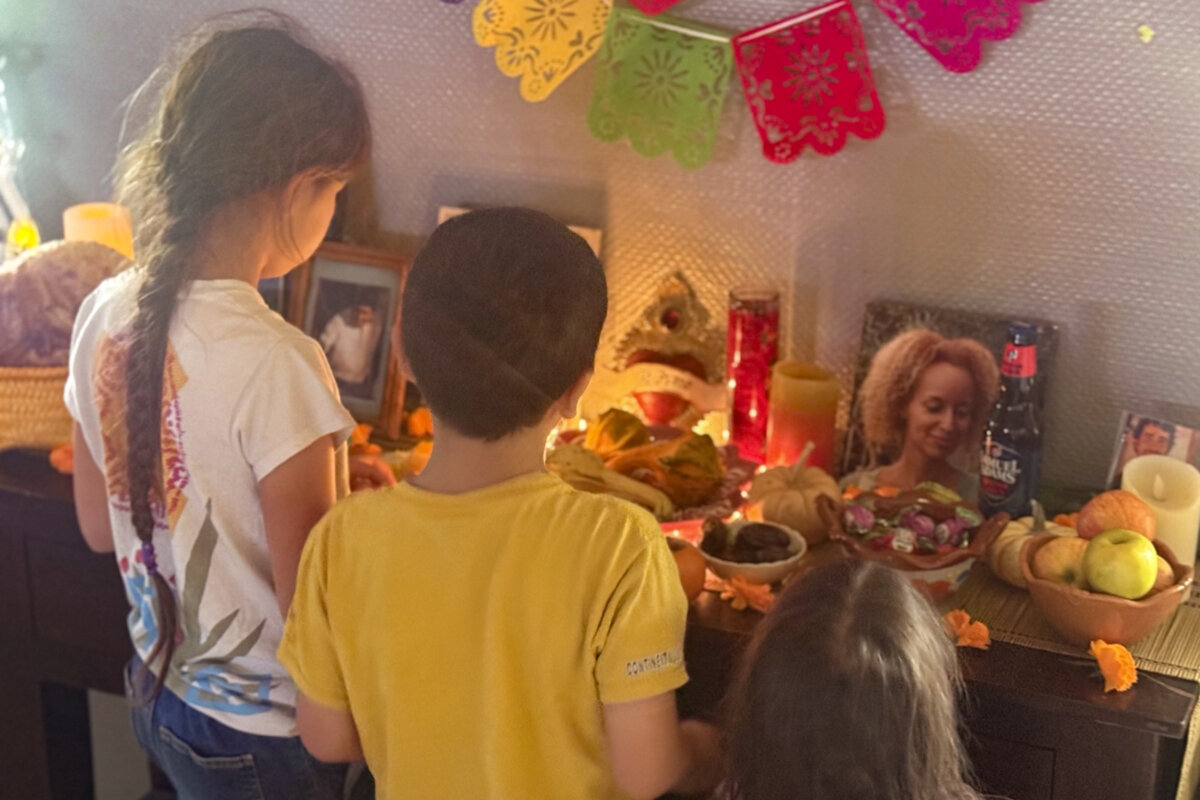
It’s 5:30 in the morning, but because daylight saving time just ended, my body thinks it’s 6:30. I’m pulling out the bins of decorations for Día de los Muertos and getting ready to set up our family’s ofrenda.
I’ve been doing this since 2018, and I still feel like a stranger in this tradition. I don’t know how many years it takes for a tradition to become your own. Maybe eight isn’t enough. Maybe it never happens.
In May 2017, my husband’s brother died. Almost exactly one year later, in May 2018, my best friend Mimi died. By November of that year, we were living in our new farmhouse in Fillmore, California, both carrying the grief of losing someone we loved.
My husband, an Indigenous Oaxacan, asked if we could start celebrating Día de los Muertos as part of our family traditions.
He wanted our children to grow up with traditions from both of our childhoods, but I think the timing mattered. We had both lost people who were deeply important to us, and here was a tradition from his childhood that gave us a way to remember them together. So we began.
Every year since, I’ve pulled out the decorations, arranged the photographs, put out the candles and little dishes. Every year, we buy a few more things. A beautiful bowl, a platter, a candleholder, some little trinket that becomes part of the collection. And every year, the collection of people we have lost grows, too. This year, I’ll be adding my friend Wendy to the ofrenda for the first time.
There is something strange about a tradition that still doesn’t feel mine entirely, holding the photographs of people who were so deeply part of my life.
My husband appreciates the effort I put into it. He loves that our children have this connection to his culture. But he has very little interest in actually setting it up or taking it down. I don’t say that to complain. It’s simply the reality of our marriage, and I think it has to do with how traditions are passed down, particularly in cultures where women have historically carried much of the work of making holidays happen.
My husband remembers these celebrations from his childhood, but he wasn’t necessarily the person preparing everything. He was the child enjoying the food, the family, and the festivities. Now, he is the father who wants to pass those memories down, and I am the mother trying to figure out how to recreate something I never experienced.
Sometimes, that means finding another woman to teach me.
In 2019, I reached out to my friend Andrea, who happens to be the mother of a man I briefly dated years ago. Life is funny that way. Andrea came over with all the ingredients to teach me how to make traditional Mexican Christmas ponche.
I wanted to learn how to make the foods and celebrate the holidays that my husband remembered. He could tell me what he liked, what things tasted like, and what he remembered, but that didn’t necessarily mean he knew how to make them.
Andrea did. She brought the ingredients, showed me what to do, and passed along a little piece of a tradition that wasn’t mine by birth but that she was willing to share through friendship. Last Christmas, I shared that ponche recipe with readers of The Epoch Times.
I think about how many traditions have been passed from woman to woman this way, through kitchens, over cutting boards, while stirring pots and telling stories. Not through textbooks or formal instruction, but through the simple act of one woman showing another how to do something.
Of course, this cultural exchange goes both ways. My husband grew up celebrating Christmas, but Christmas in his childhood looked very different from Christmas in mine. There was special food, tamales or tacos de cabeza, family gatherings, and celebration. But the elaborate Christmas trees, piles of wrapped presents, and decorating that I remember from my childhood weren’t part of his experience.
To me, decorating a Christmas tree is magical. To him, it’s a tremendous amount of work, money, and energy spent on something that will be packed away a few weeks later. And he’s not entirely wrong.
I’ve scaled back some of my holiday celebrations over the years. If I had married a man who was as enthusiastic about Christmas decorating as I am, I probably would have gone completely overboard. But I didn’t. Don’t feel sorry for me.
I still make beautiful Christmas trees with beautifully wrapped presents underneath. Our children have wonderful Christmas mornings. But I’ve learned that I can’t expect my husband to feel nostalgic about a childhood he didn’t have.
Just as he can’t expect me to feel some deep ancestral connection to an ofrenda simply because I’ve been setting one up for eight years. We can appreciate each other’s traditions without feeling the same attachment to them. And somewhere along the way, we’ve created something that belongs to neither of our childhoods but entirely to our children’s.
Our Christmas table might be the best example. We have tamales and cinnamon rolls. Traditional Mexican ponche and Grandpa’s baked eggs. Foods that didn’t grow up together but that now belong together because we do.
Thanksgiving is another holiday that means something different to each of us. Halloween, too. My husband didn’t grow up celebrating Halloween the way I did, and the elaborate American holiday season can seem like an endless series of expensive projects to someone who didn’t grow up with it. And then there are the celebrations from his childhood that I am still learning to navigate.
In a culturally blended marriage, I think there’s an assumption that the two cultures will somehow merge into one harmonious new thing. But that isn’t always what happens.
Sometimes, one person is enthusiastic, and the other is indifferent. Sometimes, one person has all the childhood memories, and the other has to learn everything from scratch. Sometimes, you scale things back. Sometimes, you add something new. Sometimes, you have to call a friend and ask her to come over and teach you how to make ponche.
Marriage doesn’t magically give you your spouse’s childhood. You don’t suddenly inherit the smells, sounds, anticipation, or memories that make a holiday meaningful. Those things were built over decades, long before you ever met.
But what I find fascinating is that our children don’t seem to experience any of this conflict. They feel completely at home in all of it.
The ofrenda belongs to their childhood just as much as the Christmas tree. Tamales belong on the Christmas table right alongside cinnamon rolls. Thanksgiving, Día de los Muertos, Christmas, Halloween—all of it is simply part of their family. They don’t experience these traditions as competing cultures. They don’t see one as foreign and the other as familiar. They belong to all of them.
And that makes me wonder what will happen when they grow up and have families of their own. Will they feel the same attachment to an ofrenda that I feel toward a Christmas tree? Will they be surprised when a future spouse doesn’t understand why Mexican ponche and Grandpa’s baked eggs both belong on the Christmas breakfast table?
Will they insist on keeping traditions that neither of their parents grew up with in quite the same way?
I hope so.
Because what we are creating isn’t simply a compromise between two cultures. It’s a new collection of childhood memories, built from the pieces of both of ours. Perhaps that’s what family traditions have always been. Not something fixed and ancient, but something that changes every time two people from different families decide to build a life together.
This morning, as I pull out the decorations and prepare to add Wendy’s photograph to the ofrenda, I still feel like a stranger in this tradition. I don’t know if that feeling will ever go away.
But I realize that my children don’t need me to feel completely at home in every tradition we celebrate. They need me to make room for the traditions that matter to their father, just as he makes room for the ones that matter to me.
I may always be a stranger in some of my husband’s traditions, and he may always be a stranger in some of mine. But our children are strangers in none of them.
They belong to all of it.
Views expressed in this article are the opinions of the author and do not necessarily reflect the views of The Epoch Times.