
Commentary
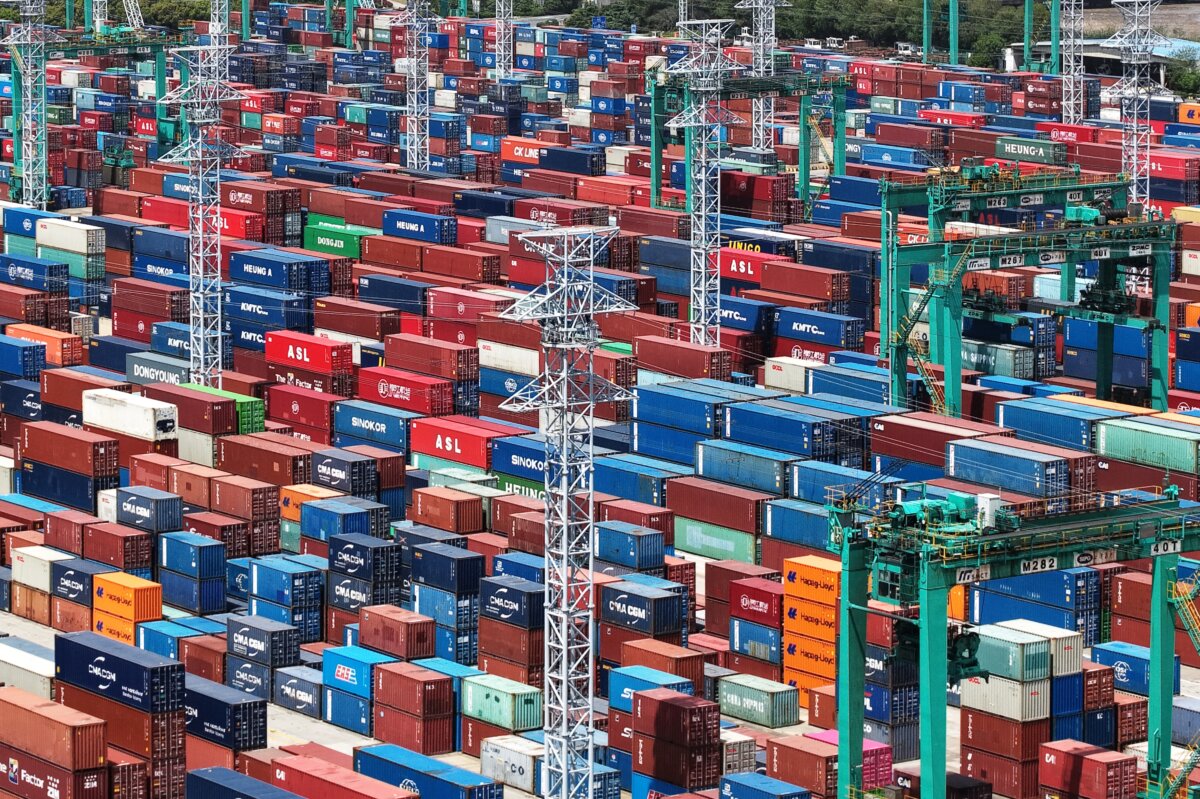
Official Chinese customs data show that China’s trade surplus reached $938.1 billion in the first nine months of 2026, putting the country on track to surpass last year’s record-breaking $1.19 trillion surplus.
The acceleration was particularly striking in September, when exports rose by 36.3 percent year over year, and the monthly trade surplus expanded to $133.5 billion.
On paper, this sustained export surge suggests an economic powerhouse firing on all cylinders. However, behind this facade of mercantilist triumph lies a more precarious reality. In my view, China’s unprecedented trade surplus is not a sign of economic vitality, but a symptom of deep structural pathologies that carry devastating costs.
An Export Boom Built on a Hollowed-Out Home Market
China’s surging exports are driven not by domestic strength, but by chronic internal exhaustion. As I examine Beijing’s economic ledger, the contrast is staggering: Exports surged by double digits, while domestic retail sales grew by a meager 1.1 percent and fixed-asset investment contracted by more than 7 percent. Simply put, domestic consumption has nearly ground to a halt.
Macroeconomists widely agree that China’s internal imbalances have reached a breaking point.
As the International Monetary Fund recently warned when downgrading its growth outlook for China, an export boom cannot indefinitely compensate for a hollowed-out consumer base.
Beijing’s relentless reliance on foreign markets to absorb its excess supply is the economic equivalent of drinking poison to quench a thirst. Rather than pursue systemic reforms that empower households and raise living standards, the Chinese Communist Party (CCP) has doubled down on industrial overcapacity, deepening the macroeconomic distortions that threaten to derail its economy.
China Shock 2.0: Precipitating Global Backlash and Systemic Decoupling
A bilateral imbalance of this magnitude—with China’s trade surplus now exceeding 1 percent of the entire non-Chinese global gross domestic product—is fundamentally intolerable to the international community.
The world is currently experiencing what economists call “China Shock 2.0.” Unlike the initial shock of the early 2000s, which focused on low-cost labor and inexpensive textiles, this new wave involves state-subsidized encroachment on the high-tech, capital-intensive frontiers of advanced economies: electric vehicles, green energy infrastructure, robotics, and precision machinery.
 A worker prepares to load boxes of goods for export onto a container at a logistics hub in Yiwu, Zhejiang Province, China, on April 29, 2025. (Kevin Frayer/Getty Images)
European Commission President Ursula von der Leyen recently warned that the European Union’s trade imbalance with China was structural and unsustainable, calling for substantial and rapid rebalancing.
Western leaders no longer trust the paralyzed mechanisms of the World Trade Organization. Instead, through alliances such as the G7 group of leading industrial nations, democratic powers are building institutional containment walls by closing third-country transshipment loopholes and imposing strict quota ceilings on Chinese hybrid vehicles.
They are also aligning with emerging markets in Latin America and Southeast Asia that have launched their own anti-dumping actions.
In short, Beijing’s export juggernaut is actively accelerating the very economic isolation it sought to evade.
Masking Financial Fragility and a Race to the Bottom
Finally, we must interrogate the genuine economic returns of this multitrillion-dollar export drive, which reveals two glaring internal vulnerabilities.
The first problem is a growing pile of hidden debt that the Chinese regime will eventually have to cover.
China’s massive exports are largely fueled by easy money.
For instance, by the end of the first nine months of 2026, the Export–Import Bank of China had disbursed nearly 1 trillion yuan (about $149.7 billion) in new loans to the foreign trade sector. State banks hand out huge loans to exporters, while a state insurance agency called Sinosure promises to step in if foreign buyers default.
The CCP claims that China’s banks are in great shape, with bad loans sitting at less than 1.5 percent.
In truth, that number is artificially low because banks simply renew troubled loans instead of writing them off as losses, or they let the state insurer pay off the debt behind closed doors. Outside experts believe that the true rate of unpaid loans is actually closer to 5 percent to 10 percent.
This does not make the debt disappear; it just moves it around. When an overseas deal falls apart, the state insurance agency pays the bank, keeping the bank’s books clean. But because that insurer is backed by the Ministry of Finance, the central government ultimately bears the unpaid bills.
Equally troubling is the sheer collapse in China’s terms of trade across most manufacturing sectors.
Outside niche windfalls in high-end semiconductors and artificial intelligence hardware, most Chinese industrial output is trapped in a destructive price-slashing spiral. To penetrate foreign markets ahead of incoming tariffs and domestic tax rebate cuts, Chinese manufacturers of electric vehicles, solar arrays, and consumer appliances are pricing products down to cost—or even below it.
In effect, China is forced to export ever-greater volumes of manufactured goods just to buy the same amount of essential raw commodities such as crude oil and iron ore.
Pyrrhic Victory
What the CCP touts as an export triumph is, in reality, a Pyrrhic victory.
It rests on domestic underconsumption financed through opaque, state-backed debt and achieved by slashing enterprise profit margins.
By forcing the rest of the world to bear the brunt of its domestic structural failures, the CCP has exhausted international goodwill.
In my opinion, this record surplus does not mark the pinnacle of China’s economic ascent but rather the unsustainable crest of a model running on borrowed time.
Views expressed in this article are the opinions of the author and do not necessarily reflect the views of The Epoch Times.