
Commentary
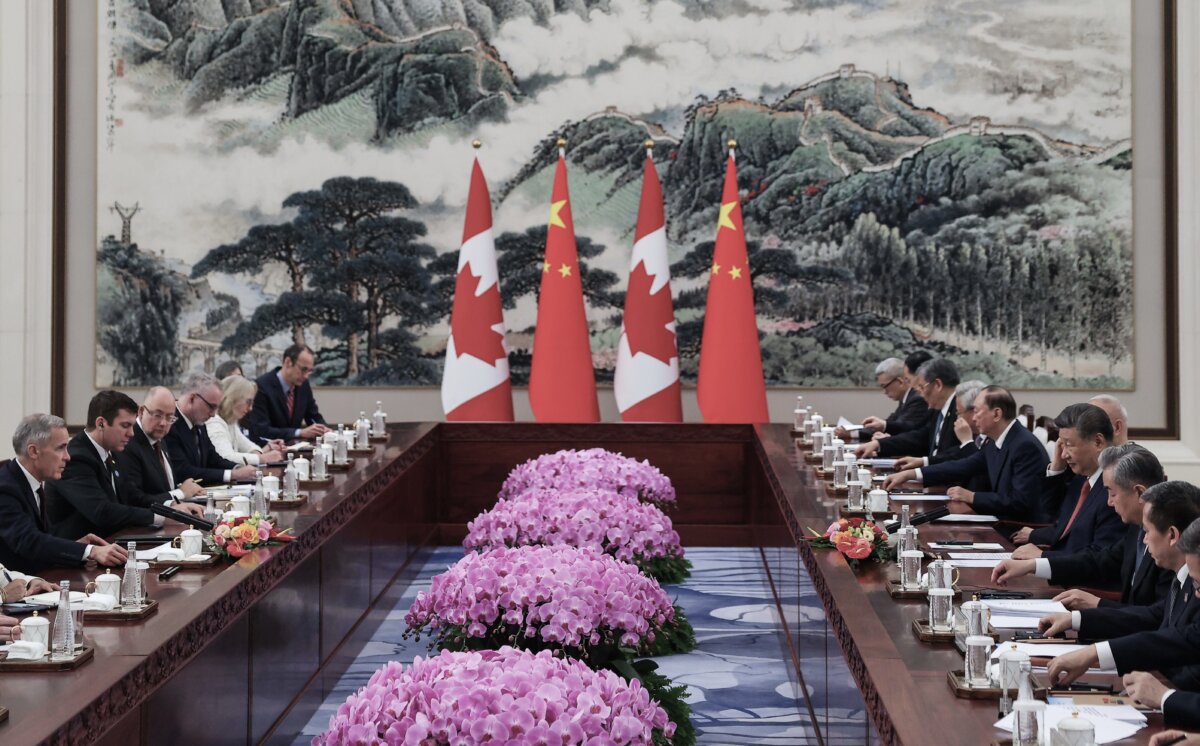
Prime Minister Mark Carney’s meeting with Chinese leader Xi Jinping in Shenzhen on Nov. 17 signals a significant shift in Canada’s economic and strategic direction. Presented as an opportunity to diversify trade and reduce dependence on the United States, the renewed relationship carries implications that extend well beyond tariffs and agricultural exports.
Canada has legitimate reasons to expand international markets. American tariffs have disrupted established industries, while Canadian farmers, manufacturers, and exporters need predictable access to foreign customers. However, closer economic integration with China cannot be assessed through conventional trade calculations alone.
Beijing’s record of foreign interference, cyber espionage, economic coercion, and transnational repression presents risks that Canadian authorities have already documented.
The latest agreements provide approximately $400 million in additional tariff relief for Canadian agricultural and seafood exports. Canada, in return, is extending tariff exemptions on selected Chinese steel and aluminum products. Both governments also intend to deepen cooperation in financial services, energy, education, and commercial investment.
These arrangements may generate economic benefits. They also create additional relationships and potential access points within Canadian institutions and industries already targeted by Chinese state interests. But they come with great strategic risks for Canada.
Canada’s intelligence community has repeatedly identified the People’s Republic of China as a major foreign interference and counterintelligence threat. The Canadian Security Intelligence Service has documented efforts involving intelligence agencies and the Chinese Communist Party’s United Front Work Department to influence institutions, cultivate relationships, and monitor individuals critical of Beijing.
United Front activity deserves particular attention because its methods frequently operate within otherwise legitimate political, commercial, cultural, and community environments. The objective is not necessarily immediate control but the cultivation of relationships and influence that can advance Beijing’s interests over time.
Expanded commercial engagement provides more opportunities for contact. Whether those opportunities become instruments of interference depends on the actors involved and the safeguards Canadian institutions maintain.
The cyber threat is equally significant.
Canada’s Communications Security Establishment identifies China as the country’s most sophisticated and active state-sponsored cyber adversary. Its National Cyber Threat Assessment reported that Chinese actors compromised networks associated with at least 20 federal departments and agencies over several years.
These operations extend beyond intelligence collection. They include intellectual property theft, political influence, and potential positioning within critical infrastructure.
As Canada expands cooperation in technology, financial services, energy, and education, it risks providing indirect access to valuable intellectual property, corporate networks, and strategic infrastructure.
Another concern involves the intersection of transnational organized crime and illicit finance.
Canadian investigations have exposed serious money-laundering vulnerabilities, including criminal networks operating across international jurisdictions. Some Chinese organized-crime groups, including triad-linked networks, have participated in illicit financial activity. Such criminal organizations should not automatically be equated with Chinese intelligence services, but overlapping commercial channels and opaque ownership structures can create opportunities for exploitation.
These concerns also affect Canada’s relationship with Washington.
Canada and the United States share deeply integrated automotive, energy, technology, and financial systems. Canadian manufacturing relies heavily on access to American markets, while U.S. industries depend on Canadian resources, components, and infrastructure.
Carney’s suggestion that Canada could pursue Chinese automotive investment if negotiations with Washington fail introduces another complication.
Canada previously reduced tariffs on a limited number of Chinese electric vehicles, initially permitting 49,000 annually at a 6.1 percent tariff. Additional Chinese manufacturing investment could provide employment opportunities, but it would also raise questions about subsidies, ownership, technology transfer, and compliance with the Canada-United States-Mexico Agreement.
Washington is unlikely to assess these developments solely as commercial competition. American concerns about Chinese industrial policy, strategic technology acquisition, and supply-chain security are central to its economic-security priorities. Greater Chinese involvement in Canadian manufacturing could consequently intensify U.S. scrutiny of Canadian exports.
The broader strategic issue is whether Canada can diversify its economic relationships without weakening the trust underpinning integration with the United States.
Canada’s vulnerability lies in treating each commercial agreement, investment proposal, cyber incident, or influence operation as an isolated matter rather than examining how their collective effects could be and how Beijing may use them in its overall strategy.
Views expressed in this article are the opinions of the author and do not necessarily reflect the views of The Epoch Times.