
Commentary
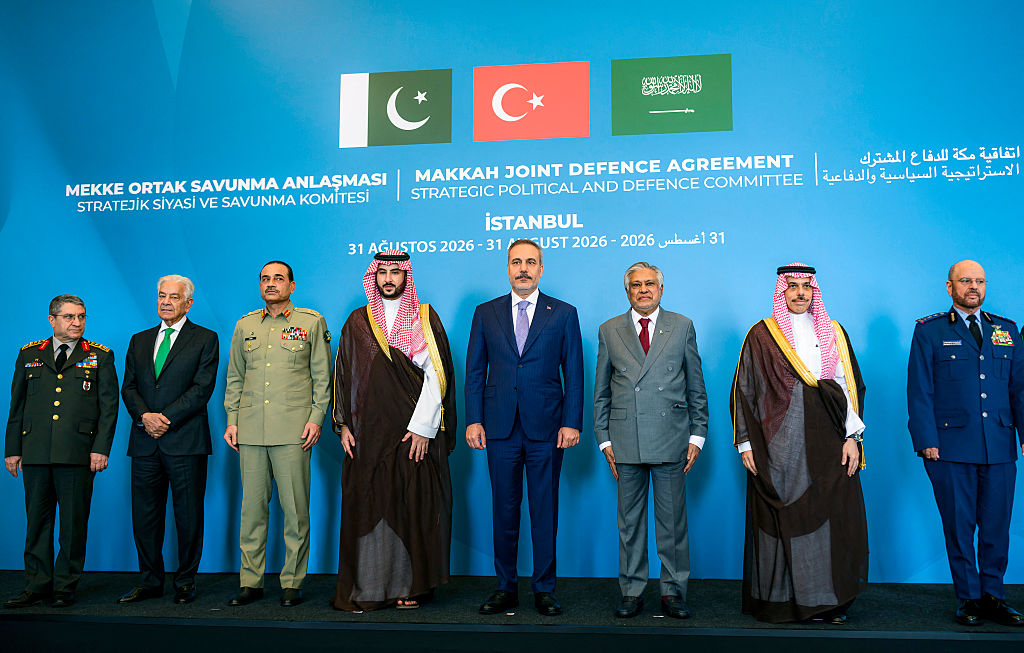
The activation of the Mecca Joint Defense Agreement is a clear-cut indicator that Iran’s regional influence has been severely degraded. Tehran spent years counting on Pakistani restraint and Turkish distance to keep a Gulf war from becoming a wider Muslim alignment against itself and its partners. But on Oct. 5, 2026, the world changed for the better as both Turkey and Pakistan activated the pact.
Before the war, about 20 million barrels of oil per day passed through the Strait of Hormuz. Iran declared the strait closed in early March, yet as of today, 10 million to 13 million barrels of oil are flowing through the strait daily, with another 7 million to 10 million barrels that used to flow through the strait taking alternate routes. In other words, 92 percent or so of the oil flow affected by Iranian efforts to shut down the strait has been restored. And much of that restored oil flow is coming via the Red Sea.
With Iran’s own ports under a U.S. blockade since mid-July, and its ability to seal Hormuz declining daily, the remaining way to restore a risk premium to oil and exploit market volatility was to threaten oil flows elsewhere. Enter the Red Sea and the Houthi terrorist group, which Iran encouraged to ramp up attacks on Red Sea shipping as well as to attack Saudi territory critical to oil flows. In September, the Houthis seized Mocha, the Red Sea coast, and Perim in the Bab el-Mandeb Strait.
The Saudi response exposed the huge decline in influence Iran has suffered over the course of the war. In a move that would likely never have occurred if Iran had not been so greatly damaged by the war, Saudi Arabia, Pakistan, and Turkey signed the Mecca pact in August, treating an attack on one as an attack on all. After Houthi strikes on Saudi territory, the three activated the newly signed pact on Oct. 5, with Turkey and Pakistan agreeing to rapidly deploy forces to Saudi Arabia for the purpose of beefing up its defenses.
As of now, it looks like Turkish and Pakistani personnel will be supplying reconnaissance, technical support, additional air defenses, and drone operators, freeing up more of Saudi Arabia’s forces to take the offensive. Oct. 5 also saw the internationally recognized Yemeni government open Operation Dawn of Yemen under Saudi air cover. Coalition statements described about 100 Saudi aircraft striking several hundred Houthi targets, with naval action around Hodeidah.
Even just a few years ago, such a pact would have been unlikely. Historically, even as Pakistan took Saudi money, it would avoid pitting itself against an Iranian partner or proxy. Turkey competed with Iran without joining a Gulf war. Both kept a channel open with Iran. Publicly aligning with Riyadh against Iran’s most important regional ally would not have happened without the Iran war and its subsequent loss of military power and economic clout. For Ankara and Islamabad, the risk of a regional energy collapse now outweighs the benefit of diplomatic neutrality.
With Pakistani and Turkish forces helping Saudi Arabia to defend its territory, more Saudi aircraft and interceptors can stay on the offensive in Yemen. Retaking the Bab el-Mandeb will restore oil flows. Striking Hodeidah hits the ports and the fuel trade that is funding Houthis to the tune of roughly $2.5 billion to $4 billion per year—a majority of the funding the Houthis count on to fund military operations. All of this reduces the Houthis’ ability to threaten Red Sea shipping, and helps mitigate the oil supply instability that Iran is counting on to pressure Western economies and the Trump administration.
This is a major strategic win for the Trump administration as it demonstrates that far from being a quagmire, the Iran war has delivered a self-funding, locally manned security architecture with regional powers doing the heavy lifting to counter terrorism that threatens the United States and the world.
Sure, the United States is still involved, but it is only supplying intelligence, targeting help, advisers, and tanker aircraft. Two states Iran counted on to stay neutral have effectively joined the effort to degrade Iranian power. The activated pact is concrete evidence of Iran’s diminishment and demonstrates the benefits of disrupting a terrible status quo that, among other bad things, seemed likely to allow Iran to succeed in creating nuclear weapons capable of destroying cities as big and important as San Diego and Los Angeles.
Views expressed in this article are the opinions of the author and do not necessarily reflect the views of The Epoch Times.







