
Commentary
One of the things I love most about regenerative agriculture is that I don’t have to wait 15 years to find out if I’m doing something good for the environment.
I don’t have to rely on a computer model, a carbon calculator, or some hypothetical future in which the resources I consumed today might eventually be offset by the resources I saved tomorrow.
I can walk out into my pasture and see it.
Take an electric vehicle, for example. How much energy went into mining the materials, manufacturing the batteries, and building the car? How long will the batteries last? And where is the electricity coming from? Coal? Natural gas? Solar? Over its lifetime, that vehicle may have a smaller environmental footprint than my Ford F-150. Maybe it won’t. So much depends on what happens over the lifetime of that vehicle.
Regenerative agriculture is different. I can stand in a field I’ve been managing for just a few years and see the changes with my own eyes.
So when I read that Interior Secretary Doug Burgum signed an order to expand grazing opportunities on federal lands, restore suspended grazing allotments, and recognize well-managed grazing as a tool to improve rangeland health and reduce wildfire risk, I couldn’t help but smile.
For decades, cattle have been portrayed as part of the environmental problem. Now, the federal government is acknowledging that they can also be part of the solution.
And I know this because I’ve watched it happen.
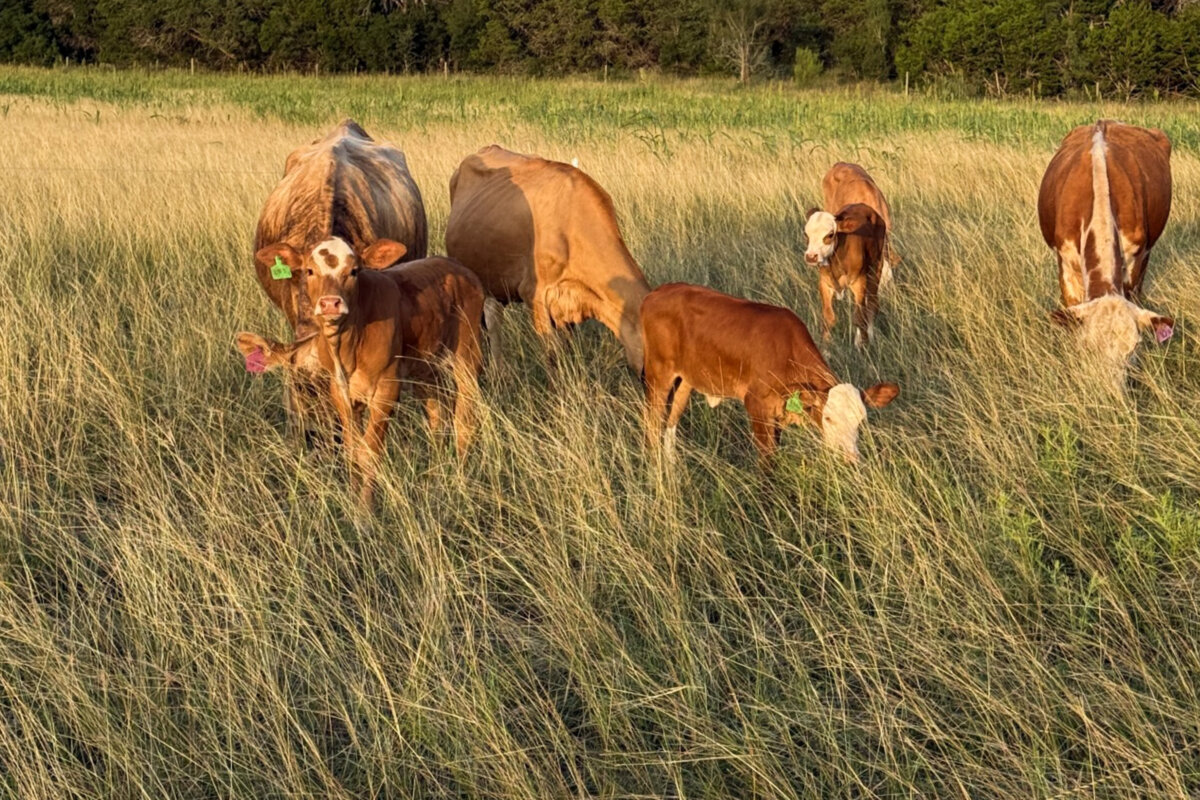
Even in a drought year, the spaces between the grasses begin to fill in. The soil becomes darker. The variety of native plants increases. Birds fly through the pasture picking insects out of cow manure. They land on the cows’ heads, their horns, and their backs. Dragonflies buzz through the air. Dung beetles roll little balls of manure across the ground, burying nutrients and organic matter in the soil.
Beneath my feet, an entire world of microorganisms is working, breaking things down and building things up. The land is more alive than it was the year before.
And all of this is happening because of cows.
Not cows standing in the same field for months, eating everything down to the ground. Cows moving. Cows grazing and then leaving. Cows depositing manure and urine, pressing organic matter into the soil with their hooves, stimulating plant growth, and giving that land time to recover before they return.
Some call it mob grazing. Others call it holistic planned grazing, adaptive multi-paddock grazing, rotational grazing, or regenerative grazing. There are a hundred names and endless arguments about the differences.
But the basic idea is remarkably simple. Move the animals. Let the plants recover. Pay attention to what the land is telling you.
Allan Savory has spent decades challenging the assumption that livestock are inherently destructive to grasslands. His work in holistic management helped inspire generations of ranchers to think differently about grazing.
Bobby Gill of the Savory Institute even gave a TEDx talk in 2020 titled “It’s Not the Cow, It’s the How.” It’s a saying that has become something of a mantra in regenerative agriculture, and it captures a truth that took me years to understand.
For years, I was a vegan chef in Los Angeles. I believed that animal agriculture was one of the great environmental problems of our time. I thought removing animals from our food system was essential to saving the planet.
Then I bought a farm in California.
I became a farmer because I was trying to solve a problem in my restaurants. We were producing enormous amounts of food waste, and I wanted to understand how to turn that waste into something useful. I wanted to close the loop.
What I found was an entirely different understanding of how life works.
Nature doesn’t operate in separate departments. There isn’t a department for plants, another for animals, another for insects, and another for soil. Everything is connected. The cow eats the grass. The cow feeds the soil. The soil feeds the grass. The insects feed the birds. All of it happens together, whether we understand it or not.
I began to realize that I had spent years viewing the cow as an isolated environmental problem instead of as part of a living system.
According to the Congressional Research Service, livestock grazing on Bureau of Land Management lands declined by more than 50 percent between 1954 and 2016.
For decades, reducing grazing pressure was often presented as a way to protect public lands. And certainly, overgrazing can destroy landscapes. But after all those decades of reducing grazing, did we actually make the land healthier?
The research is mixed. Some landscapes improved when livestock were removed. Others showed little difference between moderate grazing and complete exclusion. In some places, invasive grasses expanded after grazing stopped.
There is no simple equation in which fewer cows automatically equals healthier land.
That is what I hope this new federal initiative begins to recognize. Simply opening more land to grazing isn’t necessarily regenerative. The opportunity is not just to put more cows on the land. It’s to manage them in ways that improve the land.
I have witnessed this on my farm in California and on our ranch in Texas. I’ve watched it happen on friends’ farms, on my father’s land, and on my mother’s land. Different climates, different soils, different challenges, but the same fundamental relationship between animals, plants, and the earth.
And what I find so extraordinary is that the improvement doesn’t have to be some distant promise for my grandchildren or great-grandchildren.
I can see changes from one year to the next.
We’ve experienced brutal droughts in Texas. I’ve watched plants die, water disappear, and the land struggle under temperatures that seemed almost impossible. Farming has a way of humbling anyone who thinks they’ve figured nature out.
But even through those challenges, I can walk into pastures where our management has improved the soil and see the difference. More ground covered. More life moving through the grass. More diversity in the plants. Darker soil beneath the surface.
We spend so much time talking about carbon as though it were the enemy. But carbon is one of the fundamental building blocks of life. It’s in our bodies, plants, animals, and soil. Plants pull carbon dioxide from the atmosphere through photosynthesis, and some of that carbon moves belowground through roots and into the soil food web.
I don’t need to calculate every cow’s carbon footprint to appreciate the life returning to a pasture.
I can watch the dung beetles.
And something remarkable is happening in Washington.
I have been disappointed by plenty of decisions this administration has made. Some things I hoped would change haven’t, and others haven’t gone the way I wanted. But as a regenerative farmer, I have seen more positive recognition and support for regenerative agriculture from this administration than from any other in my lifetime.
President Donald Trump signed an executive order in June advancing regenerative agriculture.
The Department of Agriculture launched a $700 million regenerative agriculture pilot program and has since announced an expansion to $1 billion for fiscal year 2027.
Robert F. Kennedy Jr. has been talking about nutrient density, soil health, and the connection between how we grow our food and the health of the people eating it.
Agriculture Secretary Brooke Rollins regularly uses the language of regenerative agriculture, and now the Interior Department is recognizing managed grazing as a tool for restoring landscapes.
These are not small things, and I’m grateful for them.
But I’m even more grateful for the farmers.
The farmers who have spent decades doing this work, when nobody in Washington was talking about regenerative agriculture.
The farmers who moved fences every day, watched their grass, studied their soil, made mistakes, changed their management, and tried again.
The farmers who invited their neighbors over to see what was happening on their land, who shared what they learned, and who kept going even when conventional wisdom told them they were wrong.
Because permission to regenerate our land doesn’t come from the federal government.
The government is responding to something farmers have been demonstrating for decades. The change started in pastures, not in Washington. It started with ordinary people paying attention to the land beneath their feet and having the courage to do things differently.
One farmer inspires a neighbor. One rancher shows another what is possible. One piece of land begins to heal, and someone driving down the road notices that the grass looks different on the other side of the fence.
Eventually, even Washington notices.
I spent years believing that saving the environment meant removing animals from agriculture. Now, I spend my days moving animals across the landscape, trying to leave the land better than I found it.
The cow hasn’t changed. My understanding of its place in nature has.
It’s not the cow. It’s the how.
Views expressed in this article are the opinions of the author and do not necessarily reflect the views of The Epoch Times.