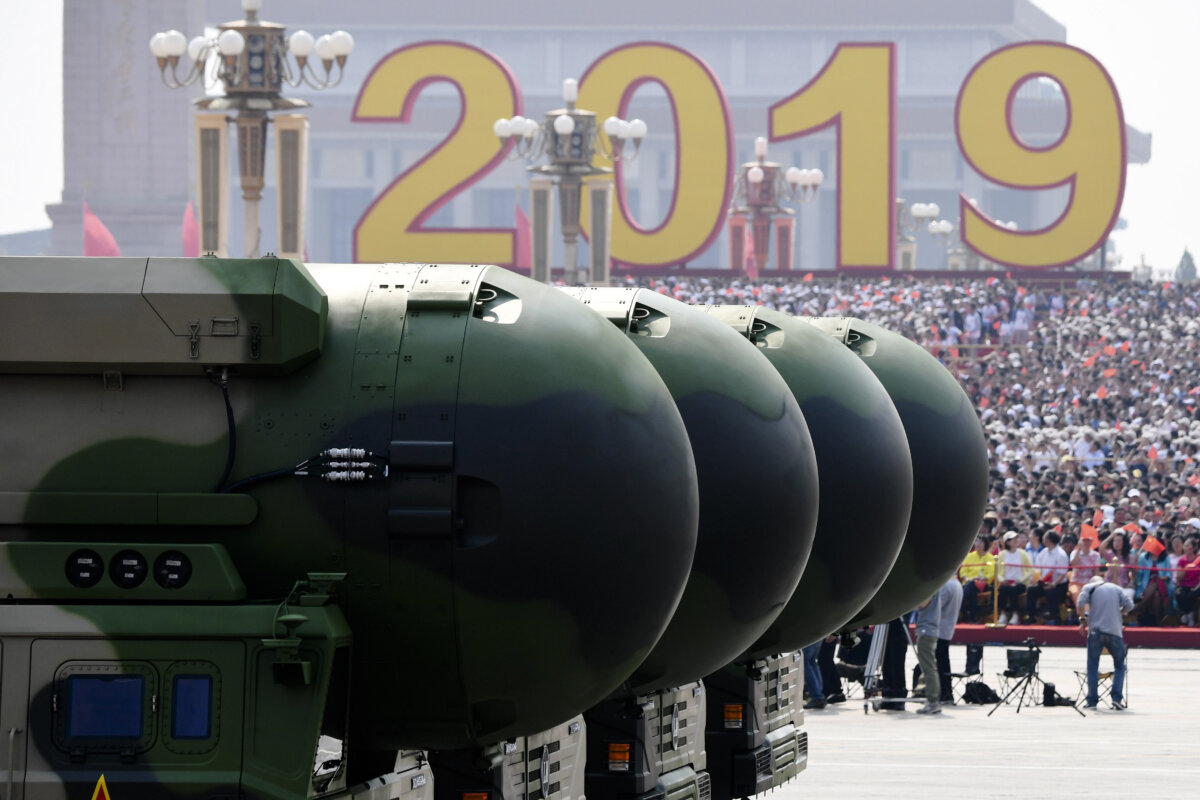

Despite Red China’s oft-repeated and soothingly expressed policy of “no first use of nuclear weapons,” the growth of the People’s Liberation Army’s (PLA) nuclear arsenal continues apace, as noted in “The 2025 Pentagon Assessment of Chinese Nuclear Weapons Capabilities.” While China’s stockpile of nuclear warheads remained in the low 600s through 2024, reflecting a slower rate of production compared to previous years, the PLA remains on track to have over 1,000 warheads by 2030.
In parallel with this ongoing expansion and modernization initiative, Beijing runs a consistent, multi-channel messaging campaign whose core claims can be checked against the real documentary of evidence of China’s nuclear buildup. The deluge of words cannot mask the concrete actions taken in expanding the Chinese arsenal.
Let us examine Red China’s cognitive warfare campaign to deflect international attention—especially from America—from that buildup.
What Is Cognitive Warfare?
China’s three warfares doctrine—public opinion warfare, psychological warfare, and legal warfare (lawfare)—was approved by the CCP Central Committee and Central Military Commission in December 2003 to guide PLA political and information operations and set forth in the amended Political Work Regulations of the PLA. It’s explicitly a war-winning doctrine, not a communications strategy, that China expert Laura Jackson describes as aiming at “undermining international institutions, changing borders, and subverting global media, all without firing a shot.”
Since the late 2010s, the PLA has folded this into a broader, more ambitious concept: cognitive domain operations, which fall under the PLA’s concept of information operations and are inspired partly by the U.S. military’s own emphasis on the cognitive domain, alongside CCP leaders’ belief that the U.S. government has already been waging this kind of warfare against China.
Examples of Chinese cognitive warfare operations include COVID-19 narrative control, South China Sea and maritime gray-zone information warfare, and ongoing TikTok influence operations through algorithmic manipulation.
Core Chinese Messaging Themes Related to Their Nuclear Arsenal
Beijing has been conducting a cognitive warfare campaign aimed at confusing Western observers about China’s intentions with respect to its nuclear buildup. Here are some of the messaging themes in that campaign as regularly stated by Chinese officials and state media.
-
“Minimum deterrence, no-first-use, defensive-only” framing. This theme is regularly restated without qualification even as delivery-system and silo-loading data contradict a static “minimum” force. Chinese Ministry of National Defense spokesperson Zhang Xiaogang stated in February that China adheres to no-first-use, upholds a nuclear strategy of self-defense, consistently maintains capabilities at the minimum level required for national security, denies any nuclear arms race, and will strictly honor its testing moratorium, asserting it has never violated the Comprehensive Nuclear-Test-Ban Treaty (CTBT).
-
Inversion of the “who is destabilizing” narrative. This theme casts the United States, not China, as the primary threat to global nuclear order. According to state mouthpiece People’s Daily, Zhang said in March that “the U.S. remarks are completely unfounded and untenable” and that, in contrast, the United States possesses the world’s largest arsenal, maintains a first-use policy, has invested heavily in its nuclear triad, and has even claimed it will resume testing. The article’s headline itself frames the United States, not China, as “the greatest source of uncertainty for the international nuclear order.”
-
Dismissal of covert-testing evidence via the CTBT Organization’s own caveat, deployed rhetorically rather than technically. A February editorial in state media China Daily states that remarks made by the United States on nuclear testing “are nothing but lies,” and cites CTBTO Secretary Floyd’s statement that the International Monitoring System detected no event consistent with a nuclear test. The article also cited a Foreign Ministry spokesperson labeling the U.S. claims “political manipulation” designed to let Washington “evade its own nuclear disarmament responsibilities.” Note this argument leverages a real technical limitation (the seismic network’s detection threshold) to imply full exoneration, when Floyd’s actual statement was narrower—that the available data could not confirm the cause, not that no explosion occurred.
-
“Pretext” framing for U.S. domestic testing decisions. Chinese state-linked commentary (via Hu Xijin) posted in February on X explicitly frames the secret Chinese nuclear testing disclosure as manufactured: “Trump is eager to resume nuclear testing and needs a plausible reason, and accusing China of conducting nuclear tests is the perfect pretext… Washington’s motives for spreading these rumors are too clear; they can’t even be bothered to feign it.”
-
Numerical minimization by comparison rather than trajectory. Chinese state-media commentary consistently cites the current gap with U.S. and Russian stockpiles (approximately 5,500 each versus China’s 600 or so) while omitting the rate of Chinese growth (tripling-to-quintupling by 2030–2035) that is the actual point of U.S. concern. A China Daily editorial published in February explicitly deploys this framing: “the U.S. and Russia possess the largest nuclear arsenals … with China maintaining a significantly smaller stockpile,” calling U.S. “nuclear parity” rhetoric “only a smokescreen.”
-
Dismissing U.S. official disclosures as “hype” and pretext for U.S. military spending. Per a Chinese Foreign Ministry spokesperson response to the Reuters silo-loading report in December 2025: “we’ve been hearing the same story told and retold by the U.S. to create pretext for speeding up the upgrade of U.S. nuclear power and disrupting global strategic stability,” and that the disparity in scale between China’s and the U.S. and Russian arsenals makes it “unfair and unreasonable” to demand Chinese participation in arms control.
-
“Special and primary responsibility” deflection. The scripted formula (verbatim across multiple briefings months apart) converts any U.S. disclosure into a demand for unilateral U.S. cuts, without engaging the disclosure’s substance. This also underlies Beijing’s formal position that it’s “not fair” to fold China into a trilateral arms-control framework after the expiration of the New Strategic Arms Reduction Treaty in February.
-
No-first-use as reputational leverage, paired with “vilification” framing. Beijing markets its no-first-use pledge (one of only two nuclear states with one) as inherent proof of restraint, then flips U.S. skepticism about that restraint into the actual bad-faith act—for example, Foreign Ministry spokesperson Mao Ning’s line from a February presser that “shirking arms control obligations by vilification harms the U.S.’s own reputation” is a fairly explicit example of that inversion.
-
Joint China–Russia strategic-stability framing. A May 2025 joint statement recruits Russia’s own arms-control grievances (chiefly opposition to U.S. missile defense) to build an implicit “two responsible powers versus one destabilizer” narrative.
Concluding Thoughts
Here is why this ongoing cognitive warfare campaign matters as a distinct threat vector (and not just messaging noise). National Institute for Public Policy analyst Mark Schneider argues the pattern in the U.S. government’s own reporting, including repeated multi-year non-updates of 2035 projections, the incoherent assessment of massive expansion amid slower production, omission of known systems (nuclear-capable cruise missiles, MRBMs, nuclear artillery) from recent Pentagon reports, may itself reflect successful Chinese influence on the U.S. assessment process, not merely public messaging aimed at foreign audiences.
Schneider cites former Pacific Fleet intelligence officer CAPT James Fanell’s characterization of a generational U.S. intelligence-community pattern of “threat deflation” on China and raises the possibility that Chinese disinformation reaching U.S. analysts through compromised or deceived channels could be a contributing factor. This is a far more serious allegation than ordinary propaganda.
In the end, it is much safer to disbelieve anything that Chinese communists say, no matter how often they repeat it!
Views expressed in this article are the opinions of the author and do not necessarily reflect the views of The Epoch Times.