Commentary
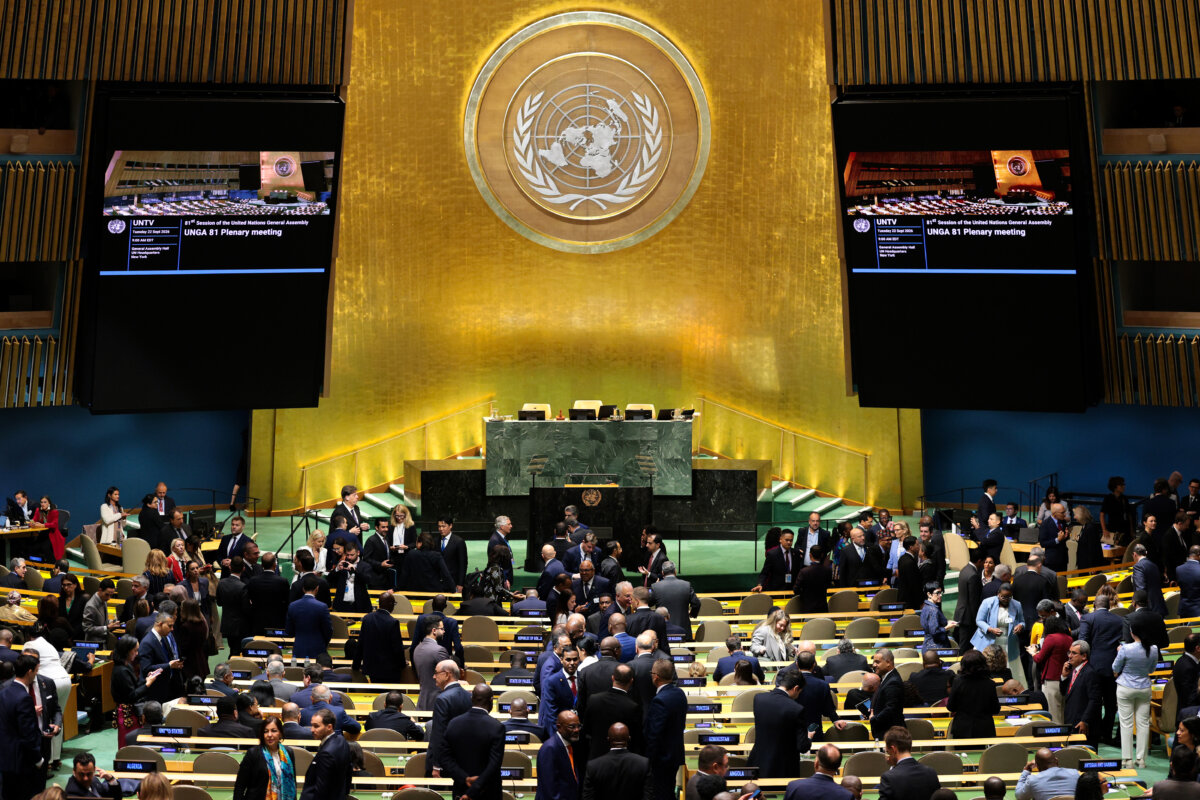
This year’s meeting of the U.N. General Assembly was more interesting than they usually are, as it occurred at a critical moment in a number of important international events.
The president of the United States and the president of Iran both commented on the present sporadic conflict between them in vastly different terms. President Trump, though a nationalist, is far from an isolationist, and his influence can be felt and asserted everywhere in the world. He gave a somewhat upbeat summary of the outlook for the Ukraine war, which has been churning up about 25,000 casualties per month for over four years. The assembly session occurred just before the arrival of Chinese leader Xi Jinping in the United States for an official visit with a full agenda.
The U.S. president again subjected the world to his almost compulsive oscillation between the promise of Iran achieving a level of greatness and prosperity unprecedented in the 3,500 years of Persian history, and the alternative: to “annihilate” the Islamic Republic. This is a refrain that has long since worn thin and his countrymen and the whole world have tired of it.
Presumably no one is more tired of it than the Iranian president, Masoud Pezeshkian, who said he had altered his remarks to the General Assembly after hearing Trump’s speech. In those remarks, and in interviews with the American media, Pezeshkian stuck to the now drearily familiar technique of the Islamic regime of offering a tissue of lies from A to Z, claiming that Iran had never committed any aggression, does not sponsor terrorism, and has no ambition to develop a nuclear weapon. His uncompromising mendacity affirmed President Trump in the wisdom of his view that there was no point negotiating with Iran, since it only used negotiations to relieve the pressure on itself while its offensive conduct continued unabated.
The Iranians were in a particularly conciliatory mood, which surely reflects the (for them) inconvenient fact that the U.S. Navy is now successfully escorting almost the full amount of oil that normally departs the Persian Gulf through the Strait of Hormuz: about 15 million barrels, plus about 5 million barrels by pipeline. This fact made the Iranian offer to “open” the Strait superfluous. At the same time, Iranian oil exports have been reduced by the American blockade by more than 85 percent, and this includes the elimination of most of the oil supply of the People’s Republic of China.
Estimates are that Iran’s floating oil reserve—large well-filled tankers on the high seas ready to deliver oil—are now down to about 15 ships. These are vulnerable to American interception, and unless the U.S. blockade is eased, which Trump has pledged not to do without serious concessions eliminating Iran’s military nuclear program and assistance to international terrorism, the Islamic Republic will run completely out of money.
Pezeshkian’s remarks at the United Nations confirmed that there is a schism between what might be called Iran’s civilian government and the Revolutionary Guard, which includes the Iraqi terror squads that are specifically assigned responsibility for suppressing civilian discontent. There are now acute shortages of oil and gasoline throughout Iran, and private automobile use has been substantially discouraged. The inflation rate is around 300 percent and rising steadily, and the Iranian currency is practically without value. All the Arab powers, including Qatar, which has notoriously shuffled its loyalties in all directions for many years, have taken their distance from Iran. Tehran, meanwhile, seems to have abandoned its policy of firing heavy missile attacks at the Arab oil producers to provoke them to beseech the United States to relax its blockade of Iran.
President Trump is adhering to his pledges to avoid a land invasion in the Middle East, to prevent Iran from developing a nuclear weapon, and to avoid participation in a “forever war.” He appears to have settled on a correct policy option, and has clearly indicated that he will not be moved from it by concerns about the outcome of the U.S. midterm congressional elections in November. The United States is accomplishing its objectives in the conflict, and has only lost 18 servicemen.
It is far from clear that Trump’s party will lose these elections, but if it does, that is not alarming. The last two-term president of either party—except for the invincible FDR, who was not facing a hostile Congress between his sixth and eighth years in office—was Theodore Roosevelt, who retired in 1909. If the Democrats revert to spurious attempts to impeach Trump, it will assist him in demonstrating to the public how unworthy of election to the presidency the Democrats will be in 2028. And while no House of Representatives impeachment will have any chance of being adopted by the Senate, the president can respond by ensuring that the attorney general indicts all the Democrats on his hate list, a formidable congeries of unprepossessing officeholders and seekers.
Differing accounts of the Ukraine war from both sides were delivered at the U.N. General Assembly, but it was President Trump’s view that the war can be ended relatively soon that had the most impact, since he effectively controls the spigots of offensive and defensive weapons by which Ukraine can escalate the cost of this already failed aggressive war launched by the Kremlin. When Mr. Trump announced that Cuba was a failed state and implied that the regime is about to be changed, the representatives of the beleaguered detritus of the Castro despotism straggled in protest from the meeting hall.
So did a variety of delegations when Israeli Prime Minister Netanyahu took the podium. He was addressing his countrymen, now just over four weeks from a general election, and gave a brilliant Demosthenean attack on terrorists. He recalled the horrible barbarism of Oct. 7, 2023, and, without putting it quite so explicitly, made it clear that when the survivors of the Nazi pogroms—which massacred half the Jewish population of the world—said “never again,” they did not speak idly. Any attempt to destroy the Jewish people again, by a maximum assault on the State of Israel, will elicit a thermonuclear response of unheard-of destructiveness.
Because of the gravity of some of the current crises in the world and the uncommon strength and determination of several of the leaders who addressed the General Assembly, the United Nations rose briefly above its usual status as a talking shop of hypocrites mainly representing failed regimes. The world watched and listened as high drama unfolded.
Views expressed in this article are the opinions of the author and do not necessarily reflect the views of The Epoch Times.