
Commentary
China’s World Artificial Intelligence Cooperation Organization (WAICO) now has 37 members.
Beijing is growing the organization by providing partner countries, such as Russia and Iran, with free open-weight models and funding for AI centers at international organizations, including BRICS, the Shanghai Cooperation Organization, the Association of Southeast Asian Nations, the League of Arab States, the African Union, and the Community of Latin American and Caribbean States.
Despite the seeming openness of WAICO, the Chinese Communist Party (CCP) wants to keep tight control over the best of its AI. The regime proposed AI export controls on its strategic AI systems on Oct. 16.
The benefits of WAICO are, therefore, fewer than described, and the costs greater. WAICO includes risks such as technological dependency on China, espionage by the regime’s military and intelligence operatives that threaten the data sovereignty of member states, and the AI-enabling of unprecedented levels of civil liberties violations on an international scale.
The CCP wields WAICO to weaken democratic diplomatic initiatives on AI norms. The U.S. version of WAICO is Pax Silica, which promotes stable AI hardware supply chains by giving members preferential access to minerals, computer chips, and AI infrastructure. This approach integrates and protects democratic supply chains that are reliable and support responsible AI.
Conversely, WAICO promotes Chinese AI companies and models, including DeepSeek, Qwen, Kimi, GLM, and MiniMax. These models are typically open-weight, which lack strong guardrails and so risk the increasing use of AI for hacking, weapons of mass destruction proliferation, and the empowerment of authoritarian regimes. The CCP accepts these risks and embraces AI’s use for authoritarian purposes as part and parcel of its own global expansion in the AI space.
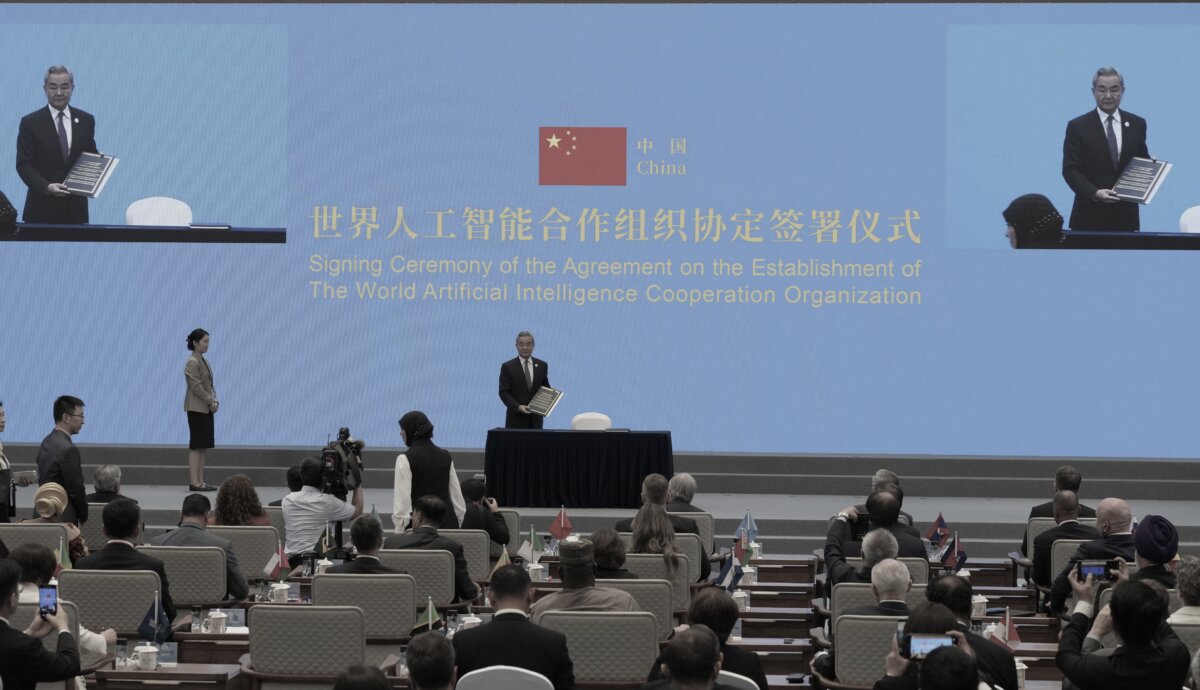
As noted previously, WAICO was founded in July and is headquartered in Shanghai. U.N. Secretary-General António Guterres and officials from several “founding members,” including Russia, Pakistan, Indonesia, Kazakhstan, and Laos, attended the ceremony.
CCP leader Xi Jinping delivered a keynote speech the next day at the “2026 World AI Conference.” He called for “true multilateralism,” which analysts interpret as a justification for a parallel global order led by Beijing.
That new AI-empowered global order would likely deprioritize American values such as democracy, human rights, and civil liberties in the same way that the CCP already suppresses these values in China.
According to Alex Krasodomski at Chatham House in the UK, China’s play is competitive: “Its vision for WAICO is to counterbalance the US in shaping global AI norms.”
That will lead the CCP to use WAICO to counter the U.S. attempt to keep AI aligned with democracy and human rights and to advance Beijing’s approach, which lets authoritarian regimes worldwide use AI to increase their power at the expense of civil liberties.
Several Philippine analysts at the International Development and Security Cooperation, a think tank, have warned their country against joining WAICO, which they call a “Trojan horse” with “digital traps.”
They write that WAICO “creates a structural dependency on Chinese technology while normalizing surveillance tools that directly violate Philippine civil liberties,” and “forces the premature surrender of sovereign data custody” before the Philippines’ own domestic tech ecosystem “even gets off the ground.”
The analysts note that it is unclear whether the Philippines was even invited to join WAICO.
“This silence reveals WAICO’s objectives as a selective coalition-building exercise designed to build political alliances under the guise of technology,” they write.
Kazakhstan is the only country that signed on to both Pax Silica and WAICO. The country’s AI authorities are acting independently and seem to be choosing their own path between superpower approaches, including that of the European Union.
Simultaneously, Kazakhstan is receiving massive foreign direct investment from China, including a record $2.8 billion last year. This could influence its decisions on AI and WAICO, which appears to be winning on civil liberties.
Kazakhstan passed a new AI law last year, which came into force in January, before the country joined WAICO and the Pax Silica. The law takes its lead from the European Union AI Act. Unlike the EU Act, however, and consistent with what would become WAICO, Kazakhstan’s AI law does not forbid high-risk applications such as the use of AI for mass biometric surveillance and predictive policing.
Kazakhstan is rich in uranium and tungsten deposits and has cheap energy. These resources will be important to AI buildouts worldwide and fit Pax Silica’s drive for supply chain independence, which, along with Kazakhstan’s early-mover advantage, likely gave the country enough influence to join both organizations.
Indonesia also has resources, such as nickel and copper, that are critical to AI development. Indonesia is also a WAICO member and wants the freedom to join both organizations.
However, the United States increasingly resists joint memberships. A draft State Department letter reported by Reuters in August states, “To be part of everything is to be part of nothing.” It was meant to go to the 35 signatories of a U.S. statement on AI, but it was apparently leaked instead.
Reuters reported at the time, “By pressing countries to choose sides the U.S. hopes to starve China of resources in a race to make the most sophisticated AI, which could be used for military or economic dominance.”
To achieve the necessary pressure, the United States will likely extend the Pax Silica’s full preferential treatment only to countries that have not joined WAICO. Dual members will likely be seen as inconsistent supporters of American values and distant from the organization’s core.
The State Department noted in a report on Oct. 26, “Countries can’t be trusted partners in Pax Silica while substantively engaging in initiatives that advance a competing vision for super intelligence.”
WAICO and the Pax Silica are in competition because they both seek to harness the power of AI to influence the future of world politics. The former is led by, and therefore supports, a totalitarian political party, while the latter promotes the opposite: democratic freedoms rather than dependence on the CCP. The stakes could not be higher.
Views expressed in this article are the opinions of the author and do not necessarily reflect the views of The Epoch Times.