Commentary
China is helping sustain Russia’s war in Ukraine while its military studies lessons from the conflict, including tactics that the People’s Liberation Army (PLA) could apply to a blockade of Taiwan.
Moscow has expanded its attacks on the infrastructure that supplies Ukraine with electricity, food, and fuel, striking petrol stations, supermarket warehouses, ports, commercial shipping, and power facilities.
In early October, Russian drones hit Kyiv, Ukraine’s Southern Bridge and Northern Bridge, marking the war’s first strikes on the capital’s Dnipro crossings, vital routes for moving people and supplies across the city. The damage forced full or partial closures, disrupting road and rail traffic across the river. Officials warned that further strikes could close the bridges for extended periods.
Russia’s campaign against Ukraine’s power, fuel, and transport links shows how China could approach Taiwan, where the chokepoints are ports and energy terminals rather than bridges.
A July Modern War Institute analysis states that China could use massed missile strikes to cripple Taiwan’s “highly centralized and vulnerable power grid.” Unlike Ukraine, which can import electricity through Europe’s grid, Taiwan has no connection to an external grid and must generate its electricity locally.
Taiwan imported about 96 percent of its energy in 2024, according to the Taiwanese Energy Administration, leaving it dependent on imported fuels to keep its power plants running.
Natural gas and coal generated about 43 percent and 40 percent of Taiwan’s electricity in 2024, respectively, according to the U.S. Energy Information Administration. Its three liquefied natural gas terminals—at Yung-An, Taichung, and Taoyuan—all sit on the west coast. The Taiwanese Ministry of Economic Affairs requires enough natural gas in reserve to cover at least 11 days of use, rising to 14 days in 2027.
China has already rehearsed attacks and blockades near Taiwan’s ports. During the PLA’s Justice Mission 2025 drills on Dec. 29–30, 2025, the Eastern Theater Command listed “blockading key ports” among its aims, and PLA rockets landed in exercise zones near Taiwanese port cities Keelung and Kaohsiung. The exercise used naval and coast guard assets to practice enforcing a blockade, according to the Institute for the Study of War and the American Enterprise Institute.
China is also training alongside Russian forces in exercises informed by combat experience in Ukraine. The PLA joined Russia and other foreign militaries for Tsentr-2026, held from Sept. 28 to Oct. 3 in Russia’s Chelyabinsk region, near the Kazakh border.
The exercise involved more than 47,000 military personnel from countries including China, Belarus, Kyrgyzstan, Mongolia, and Pakistan. Russian Defense Minister Andrey Belousov said preparations drew on Russia’s “unique experience” from the war.
The Chinese contingent came from the PLA’s Central Theater Command and included troops from the 82nd Group Army. Participating forces included a combined-arms brigade. The drills covered intelligence and reconnaissance, command and control, fire strikes, and logistical support.
Photos released by China Military Bugle, the PLA’s official media account, show Type 99A main battle tanks firing. The tanks trained alongside drones and unmanned ground vehicles. Drone swarms supplied target data to Chinese ground units, while tactical drones, attack helicopters, and unmanned ground vehicles coordinated strikes on simulated front-line targets. Russia and Ukraine have used drones to locate targets and direct strikes since 2022.
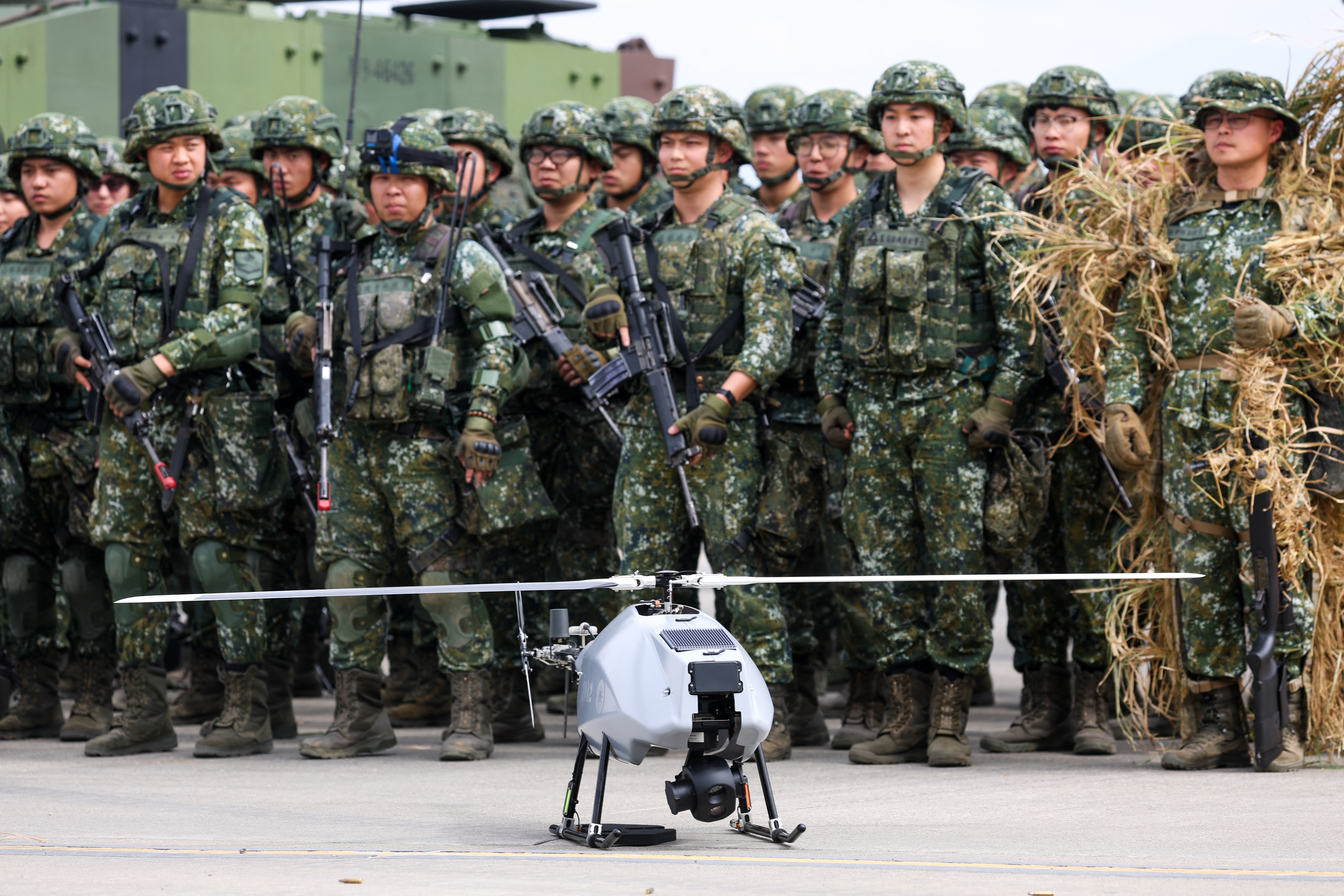 Soldiers stand next to a military unmanned aerial vehicle in Taichung, Taiwan, on Jan. 27, 2026. (I-Hwa Cheng/AFP via Getty Images)
A February report by the Center for a New American Security proposed an “asymmetric hellscape” of thousands of drones arranged in layered zones extending about 50 miles off Taiwan’s coast. The PLA is preparing to counter such defenses. In January, a PLA naval unit used ship-launched missiles and interception systems against a simulated swarm of low-flying suicide drones.
A Center for Strategic and International Studies (CSIS) analysis published on Oct. 7 found that Chinese analysts are studying the war from Russia’s perspective as the target of Ukrainian drone attacks. Chinese designers of air and harbor defenses view attacks on Russian ships and airfields as previews of possible strikes on China. CSIS also found that counter-drone lessons have been incorporated into PLA hardware faster than other lessons from the war.
The PLA has had no large-scale combat experience in decades. Access to Russian battlefield experience offers an opportunity to improve its tactics and readiness, particularly in drone warfare and urban combat, according to an August report by the U.S.-China Economic and Security Review Commission (USCC).
The commission stated that Russia may share data on Western weapons, while Chinese military journals show interest in U.S. systems used by Taiwan, including the High Mobility Artillery Rocket System (HIMARS). During Justice Mission 2025, PLA and China Coast Guard media depicted forces stopping and boarding vessels carrying HIMARS to Taiwan, and a PLA video shows the launchers as simulated targets.
Beyond joint exercises, Beijing helps sustain Moscow through energy purchases, supplies of goods with civilian and military applications, and diplomatic backing, the USCC reported. It also cited reports of Chinese drone engines, training for Russian drone operators, and satellite imagery supporting Russian targeting. Washington has sanctioned Chinese companies involved in producing Russia’s Garpiya attack drones.
China is studying how to overcome the defenses demonstrated in Ukraine, while Washington and Taipei seek to adapt them to deter an attack.
Views expressed in this article are the opinions of the author and do not necessarily reflect the views of The Epoch Times.