
Commentary
Recently, we examined China’s deep reach into America’s telecom networks. But Beijing’s reach into America’s critical infrastructure doesn’t stop at technological penetration. It also extends into the U.S. food processing industry and even America’s food supply, in a very big way.
Over the past several decades, Chinese companies have established positions in strategically important parts of America’s agricultural system, from pork processing and agricultural chemicals to farmland, livestock-feed inputs, and food ingredients.
Now, let’s be clear; China doesn’t control the entire U.S. food supply or own America’s food system. But that misses the larger issue. Beijing does have some leverage over U.S. food production. In a geopolitical confrontation, leverage over food is power.
A Deal Changed the Equation
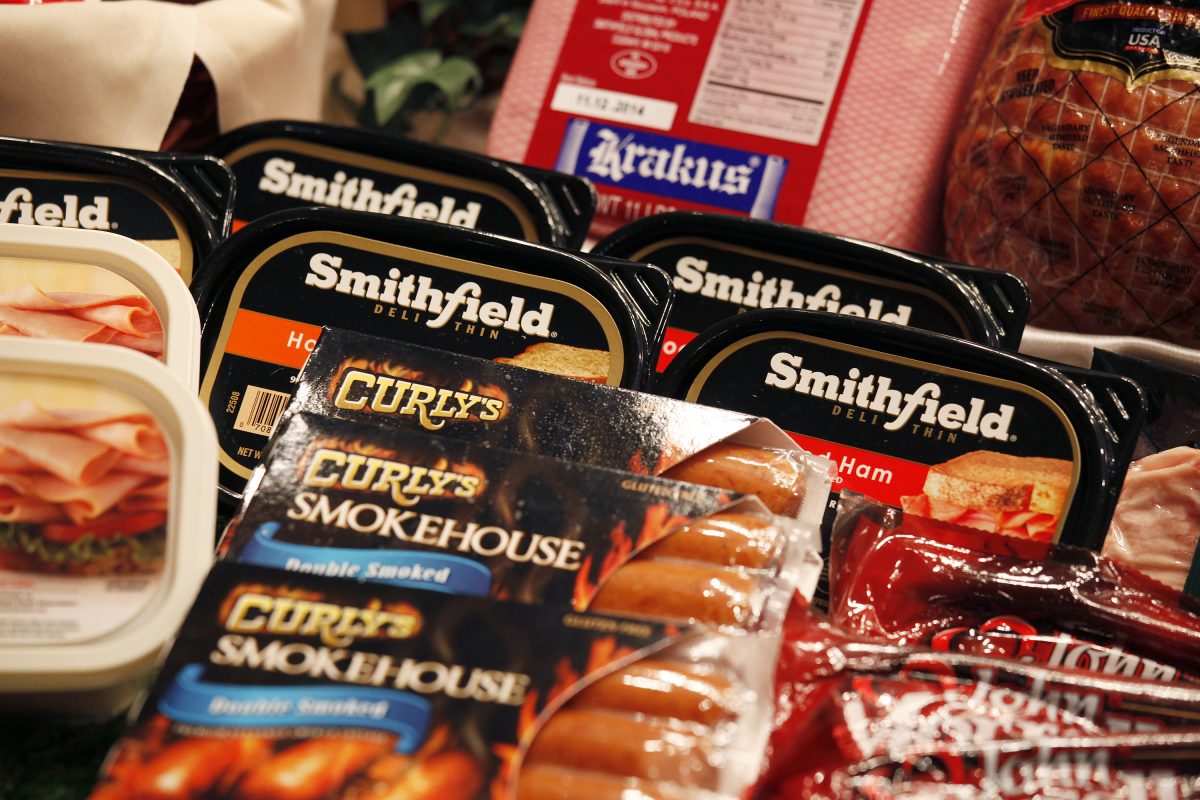
The clearest example is Smithfield Foods.
In 2013, China’s Shuanghui International, now part of Hong Kong-based WH Group, acquired Smithfield for about $7.1 billion. At the time, Smithfield was America’s largest pork producer and processor.
This acquisition gave its Chinese parent access to U.S. hog production, processing plants, farms, distribution networks, and valuable production expertise. Today, Smithfield remains controlled by WH Group, which owned about 87 percent of Smithfield’s outstanding shares as of March 2026.
Smithfield is not simply another food brand. It’s a significant part of America’s food production infrastructure. The company employs tens of thousands of Americans and operates across fresh pork, packaged meats, and hog production. Much of what it produces is consumed inside the United States.
That doesn’t mean Beijing can simply order Smithfield to stop feeding Americans. U.S. law, service contracts, markets, and corporate governance have significant control in that area.
But foreign ownership of critical food infrastructure creates strategic options for China and unnecessary vulnerabilities for the United States. That’s an unnecessary weakness that U.S. national security planners are worrying about right now.
It Goes Beyond Pork
Of course, China’s reach into U.S. agriculture is broader than Smithfield.
In 2017, state-owned China National Chemical Corp., or ChemChina, completed its acquisition of Swiss agricultural giant Syngenta, one of the world’s largest agricultural-input companies.
Syngenta’s business includes seeds and crop-protection products used by farmers around the world, including in the United States. The transaction received U.S. regulatory scrutiny. But food-security concerns were not the central issue in the review.
The two countries approach the same resource from very different strategic perspectives. The United States has traditionally treated agriculture primarily as an economic sector, whereas China treats food security as a strategic priority. Its food-security laws emphasize national control over food production, processing, and supply.
The Chinese regime’s 2023 Food Security Law explicitly seeks “absolute self-sufficiency” in staple grains and greater domestic production and processing of food.
The difference in mindset is important.
Inputs May Matter More
The greatest vulnerability may not be the food sitting on supermarket shelves. It may be what American farmers need to produce that food.
China has enormous positions in the global production of agricultural chemicals and certain vitamins and amino acids used in livestock feed. The American Foreign Policy Council has specifically warned that these dependencies can give Beijing leverage over U.S. agriculture.
A farmer does not need to buy a Chinese-owned farm to become dependent on China. He can own every acre himself and still depend on foreign-controlled inputs such as feed additives, agricultural chemicals, seeds, processing equipment, components, and data that are controlled by Chinese firms.
If a critical input suddenly becomes unavailable, the farm can remain 100 percent American-owned while its production capacity is constrained from abroad.
That’s the strategic vulnerability.
China’s Footprint
The numbers require perspective.
China doesn’t own anything close to a significant share of U.S. farmland. On Dec. 31, 2024, the U.S. Department of Agriculture (USDA) reported that Chinese investors held approximately 247,659 acres of U.S. agricultural land. That’s less than 1 percent of all foreign-held U.S. agricultural and non-agricultural land.
But Chinese ownership is concentrated. Texas accounted for roughly 123,700 acres of Chinese-reported holdings, North Carolina about 44,300 acres, and Missouri about 42,900 acres. Five companies accounted for approximately 92 percent of reported Chinese holdings.
The issue, therefore, is where strategically significant foreign-owned assets are located and what infrastructure surrounds them. Farmland near military installations, transportation hubs, and other sensitive infrastructure has become a national security concern.
Paying Attention
Washington has not been completely asleep. Congress has begun expanding scrutiny of foreign investment in American agriculture.
Recent legislation and congressional proposals have sought to give the Agriculture Department a greater role in the Committee on Foreign Investment in the United States when foreign transactions involve agricultural land, biotechnology, food processing, and other agricultural assets.
Other proposals would restrict agricultural land purchases by entities connected with China, Russia, Iran, and North Korea.
The direction is clear. The old assumption that foreign investment is simply a matter of economics is changing.
What Is the Trump Administration Doing About It?
The Trump administration has explicitly identified agriculture and food supplies as national security issues.
Its 2025 America First Investment Policy directed the government to use the Committee on Foreign Investment in the United States and other legal authorities to restrict Chinese investment in strategic U.S. sectors, including agriculture, food supplies, farmland, energy, and critical infrastructure.
In December 2025, President Donald Trump also ordered the Justice Department and Federal Trade Commission to establish Food Supply Chain Security Task Forces to investigate anti-competitive behavior and determine whether foreign control of food-related industries creates economic or national-security risks.
The USDA has also strengthened its system for tracking foreign ownership of agricultural land.
These are all significant steps. But screening transactions after the fact is not enough. The larger goal should be resilience. The United States should encourage and expand domestic production of critical feed additives and agricultural chemicals, as well as tighter scrutiny of Chinese acquisitions and tracking beneficial ownership.
Protecting agricultural data and recognizing that food-processing plants, transportation networks, ports, and agricultural technology are strategic infrastructure assets, not merely businesses.
Views expressed in this article are the opinions of the author and do not necessarily reflect the views of The Epoch Times.