
Commentary
Those of us who have worked with Artificial Intelligence have news that is both thrilling and terrifying. The tools are getting smarter and better. I’ve seen processes that used to take months and years now reduced to days or even hours. I’ve seen a level of expertise that no human working alone can match.
If you are a tradesman—baker, brewer, butcher, builder—AI is only going to help you keep track of the routines that are not your specialization. On the other hand, if you are a “knowledge worker,” as they say, look out. You need to learn as soon as possible how to make friends with AI and become its master before the reverse happens.
Based on what I’ve seen, I would estimate that half or more of professional-level jobs are under profound threat. This is in most if not all sectors: health, education, law, accounting, project management, management of anything, financial planning, portfolio management, and even design and music. You could say that you know someone who is better and that’s probably correct but that someone also takes vastly longer and costs thousands of times more.
At this point, we all need to get clear on what precisely human beings bring to the table. The moment requires we get this straight. If every routine that deals with digits especially is better done by a machine, what is there left for us? Answering this requires a serious inventory of our work routines and talents.
This is because so much of what we do in life is a mixture of what we do well and what the new machines do better. It is up to us to figure this out because anything in our workflow that consists of using a predictable skill is going to be eaten away and finally wiped out by technology.
Here is the advantage that humans have and always will have.
First, we have the capacity for intuition, which is discerning what is true with extremely limited clues based on experience or an understanding of cause and effect. That allows us to know things that are not obvious from given data or evidence. Intuition is a superpower that no machine can recreate. It’s what gives us profound insight into what might be possible, what is likely true, what may or may not work, and so on.
Second, we have the capacity for creativity. There are profound mysteries associated with that word. Does creativity consist of the discovery of something that already exists or is it imagining something entirely new into existence? I don’t know but I do know that there was a Bach, a Beethoven, a Rembrandt, a Leonardo, a Steve Jobs, a Thomas Cole, among millions of other creative people who showed humanity something they had never seen before.
The creative spark exists in all of us. Theologians would say it is a feature of human life granted as a reflection of the ultimate power of God to create out of nothing. We have this to a limited degree, which is what makes us a little lower than the angels. No machine has creativity of this sort. We deploy it constantly to see and act on better ways to live from the tiniest to the largest decisions. We are all creators all day every day.
Kids call it imagination. Cultivating that is not optional; it is a feature of what makes us human.
Third, we have a moral sense from training and from what is written on our hearts. We know right from wrong. What is right makes us happy and what is wrong makes us miserable in the long term. We all struggle with making the right choices. Machines face no such struggle, which is why they can be so dangerous. It’s up to us to exercise that moral sense in all that we do from professional to private life, however imperfectly.
With this brief toolkit, we can speculate on what the future of work looks like. Anything routine will be managed by machines and humans who manage those machines. The human work we need is that which depends on intuition, creativity, and ethics. That leaves a huge space in which people can excel.
Now to the problems we face. We are massively disadvantaged by how much we cost. It’s not only the price of labor, which is high enough. We have created huge systems that impose a gigantic tax on being human. Our systems of liability make every person a legal risk to employ. In contrast, machines cannot sue us for discrimination, harassment, hostility, or injury. They leave us completely alone.
In addition, human hiring comes with all sorts of mandates. There is the demand for vacation time, paid family leave, unemployment insurance, super expensive health insurance, retirement benefits, weekly limits on hours worked, and demands for weekends and holidays. Machines ask for none of those benefits.
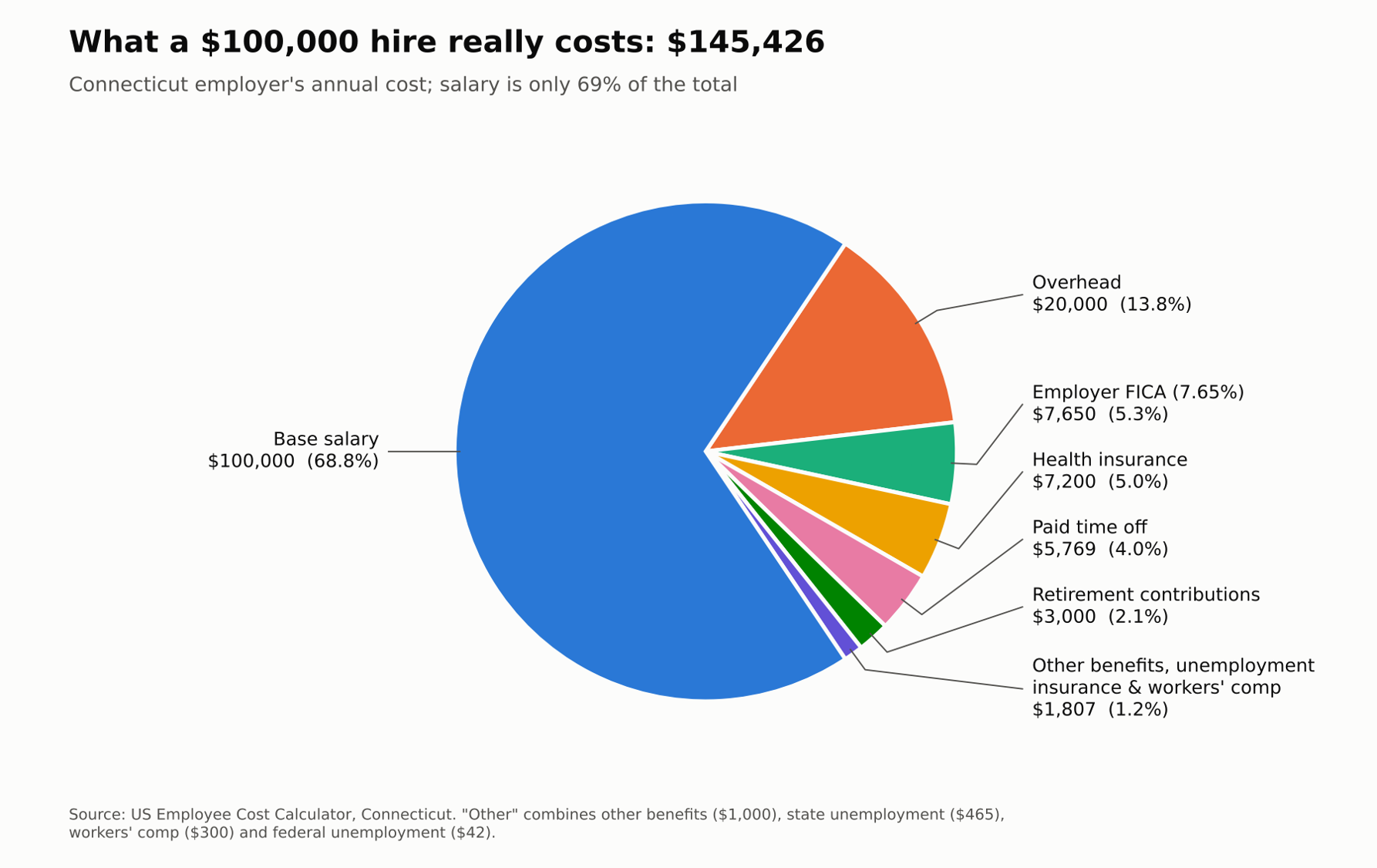
Let’s look at the data when it comes to hiring a person at $100K a year. How much of that is wages and how much of that consists of an added layer of cost? There is a nice tool that reveals much of this. It’s called the US Employee Cost Calculator.
I’m looking at what it costs to hire a person at $100K a year in Connecticut. The results are shocking. The employer will pay 45 percent more than the salary just to have a warm body around. Here is how it breaks down.
Base Annual Salary: $100,000
Employer FICA (7.65 percent): $7,650
Federal Unemployment Tax: $42
State Unemployment Insurance: $465
Workers’ Compensation: $300
Health Insurance: $7,200
Retirement Contributions: $3,000
Paid Time Off Cost: $5,769
Other Benefits: $1,000
Overhead Costs: $20,000
Total Annual Employee Cost: $145,426
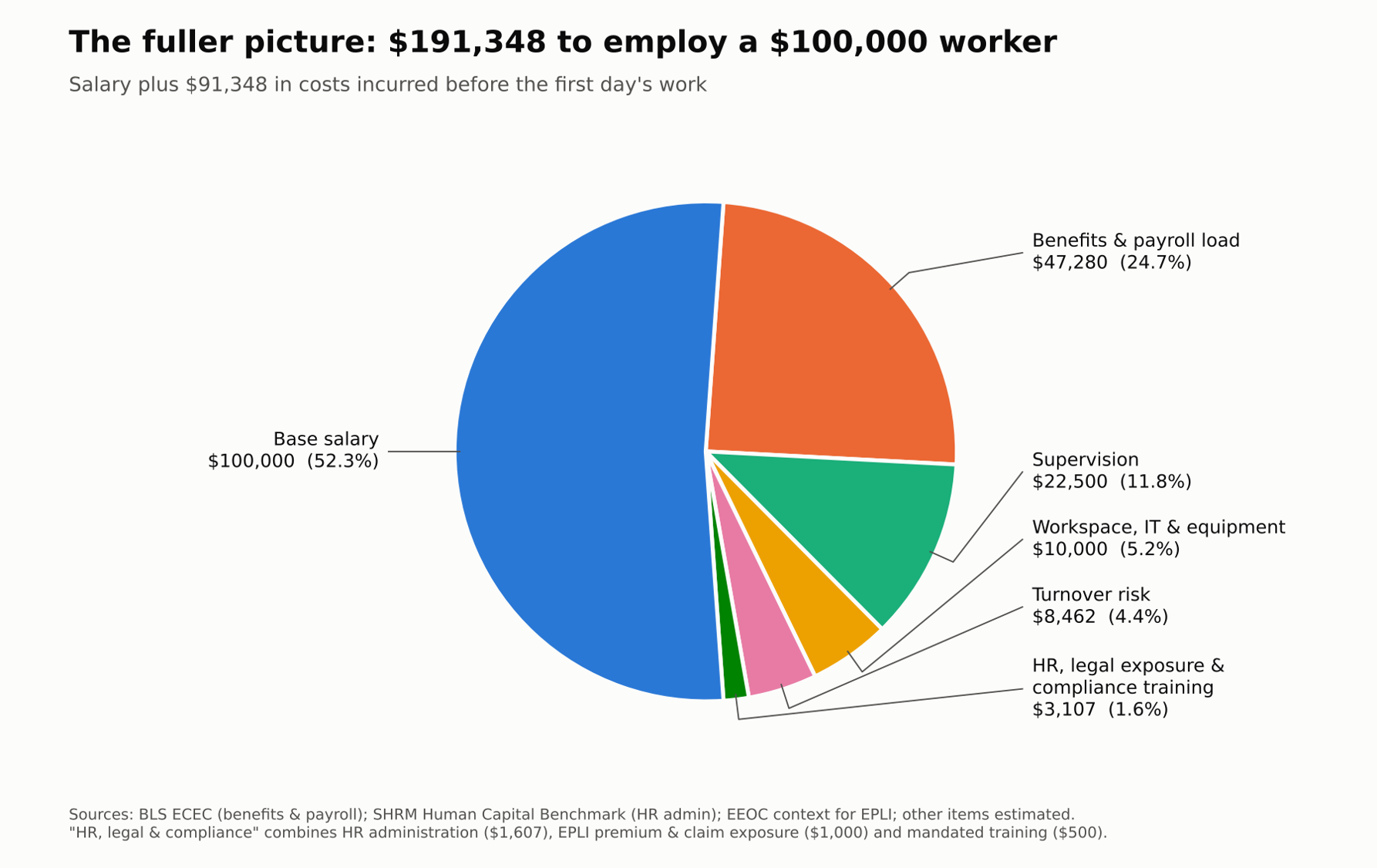
The truth is even worse than just what I listed above. An AI engine also wants to add these costs.
Benefits and payroll load: $47,280 (source: BLS ECEC)
Turnover risk: $8,448 (calculated as 33 percent of salary × 25.6 percent annual separation rate)
Workspace, IT, software, and equipment: $10,000 (mid-range estimate)
Supervision: $22,500 (0.15 FTE of a fully loaded $150,000 manager; derived)
HR administration: $1,607 (based on 1.7 HR staff per 100 employees; source: SHRM Human Capital Benchmark)
EPLI premium + expected claim exposure: $1,000 (context: EEOC average recovery of $37,330 per charge)
Mandated compliance training (EEO, safety, I-9, ADA): $500 (estimate)
Total additional costs: $91,348
In other words, our labor system has artificially disadvantaged employing people over machines in ways that make people prohibitively out of range. There are ways to deal with this.
We need a dramatic overhaul of all the systems and rules immediately before it is too late. The blue sections in the charts above should be as much of the whole as possible so that humans can capture their full value.
I say that because it will be too late once the mass firings start. We’ll look back with profound regret and wonder why we did not prepare in time.
Humans can outcompete AI for now. But in order to maintain that advantage, the extra layers that tax human labor need to be trimmed or eliminated as soon as possible. Are our politicians up to the task? I doubt it.
Views expressed in this article are the opinions of the author and do not necessarily reflect the views of The Epoch Times.