
Commentary
On June 14, 1999, a decommissioned, unmanned Australian frigate, the HMAS Torrens, was sitting in the Indian Ocean off Western Australia when a Collins-class submarine, the HMAS Farncomb, launched a Mark 48 advanced capability torpedo at the Torrens, detonating under the Torrens’s midship. The attack was devastating, with video showing the center of the ship rising, slamming back down, and then breaking clean in half.
The video clip launched a thousand comment threads. Watching it, the lesson seems obvious: A modern heavyweight torpedo executing an under-the-keel attack will snap a warship in half. Using this video plus basic explanations of how the gas bubble damages a ship has led internet “experts” to assert that one Mark 48 will snap the keel of an aircraft carrier or an Iowa-class battleship, causing it to break in half, or at least knock it out of the fight.
Here is an excerpted quote from the internet:
“The explosion creates a steam cavity that first forces the midship keel upward. When the cavity subsequently contracts, the keel is forced downward. The bending moments on the keel during this brief process will break the keel. While the carrier may not ‘sink’, it’s very likely going to put it out of operation.”
But is this really true?
And even if it’s not true, what does it really matter?
Let’s answer the second question first. It matters because this narrative perpetuates a flawed, deeply embedded mindset that has dominated naval procurement since World War II. For decades, the service has systematically devalued shipboard staying power, the physical resilience required not just to survive a weapon strike, but to absorb the damage, control the flooding, and stay in the fight.
By unthinkingly equating a tiny, 2,700-ton frigate with a 100,000-ton supercarrier or an armored battleship, the popular internet narrative implies that structural toughness is entirely obsolete. If a single torpedo can magically snap the backbone of any hull regardless of its size, then spending money on defensive armor, triple bottoms, and structural redundancy is framed as a waste of resources.
This dangerous logic encourages a procurement strategy focused exclusively on packing ultra-expensive, fragile electronics into modern warships under the assumption that they can simply avoid ever getting hit. It reduces the entire survival equation to the increasingly unrealistic assumption that our ships’ technological superiority, coupled with superior situational awareness, will guarantee our ships’ safety. It ignores the fact that superior staying power provides very cost-effective increases in both offensive and defensive power.
Regarding the first question—the answer is a big no!
The Devil Is in the Details
The HMAS Torrens, a River-class escort, displaced about 2,700 tons—essentially a smallish, lightly built frigate not at all designed to survive a direct hit by a heavy torpedo. For a ship its size, the explosion in the video was a ship-sized event, creating a gas bubble wider than the vessel itself. First, the expanding bubble violently pushed the middle of the ship upward while the bow and stern lagged, creating a bending motion known as “hogging.” Then, the bubble collapsed, and the water vanished, causing the center section of the ship to plunge into an empty void while the ends stayed elevated, commonly referred to as “sagging.” This rapid shifting caused “whipping”—a violent, rapid flexing of the hull. Together, these forces snapped the ship’s keel/spine. With its backbone broken and very little structural strength left, the ship split clean in half. But uncritically extrapolating these effects to other ships is a mistake.
It’s Not About Magic, It’s About Energy
The internet narrative treats the under-the-keel burst as a magic trick that uses a clever mechanism to do far more damage than an “old-fashioned” side contact detonation. For a small escort, any kind of heavy torpedo attack is going to be a ship-ending event. But for a carrier or battleship, it is a very different story, as the bubble cavity created by the torpedo attack relative to the size of the ship is small, affecting only a small portion of these ships’ massive bottoms. Further, a large capital ship is designed to elegantly handle the greater hogging and sagging forces created by rough seas.
Going into a bit more detail, at the distance beneath the ship’s bottom needed to form a full under-keel bubble, some 30 to 40 feet, almost all of the torpedo warhead’s energy never reaches the ship. Roughly half goes into a spherical shock wave, with only a small cap of that wave striking the ship’s bottom, and then for only a few milliseconds. It can jolt the hull, but on a large, sturdy ship it will likely produce minor damage at best. The other half goes into forming the gas cavity. After heat, mixing, and expansion losses, and after most of the accelerated water misses the hull entirely, only a small portion of the original energy is coupled or transmitted into the ship’s steel bottom, typically less than 1 percent. This small remnant is not concentrated on a small area; instead, it ends up being spread out over hundreds of square feet on the Torrens and thousands of square feet on a battleship or carrier, meaning the impact per square foot is only a small fraction of what a direct contact attack would generate.
If the burst is close enough, collapse against the hull may or may not throw a brief water jet a few meters in diameter into the ship’s hull. That jet carries only a small fraction of the original yield and, although it may dish the outer plating of a carrier or battleship, it has less than a zero chance of breaking the keel or even dealing major structural damage.
In other words, the bubble effects on a 58,000-ton, 890-foot battleship or a 100,000-ton, 1,000-foot carrier with their massive, extremely strong hulls are not at all that dramatic, and the under-keel explosion in question will only produce minor hogging and sagging effects and, in some cases, minor dishing. It should also be noted that these ships were designed to routinely take enormous shocks such as 16-inch broadsides, catapult launches, etc. Further, they have layered bottoms that dissipate and dampen the blast energy before it reaches the interior, which means damage potential is further mitigated. This all adds up to the conclusion that the bubble-jet under-the-keel attack that is so lethal for small, lightly constructed ships does only minor damage at best to large, rugged ships such as carriers and battleships. Those interested in a much more detailed energy accounting can find it in my Substack.
Maximizing Damage on Large Ships
Hence, although the video showing the destruction of the Torrens is real, extrapolating that damage to a large capital ship is an unjustified leap that defies basic physics and fluid dynamics. If the goal is to maximize damage on a large capital ship, the vastly more effective attack mode for a torpedo is a direct strike on the hull, which provides for maximum possible transmission of destructive energy into the ship’s hull and then interior. An Iowa’s side torpedo defense system (TDS) was designed to protect its interior spaces from torpedoes carrying up to 700 pounds of TNT. Hence, a Mark 48 at 1,200 pounds TNT equivalent is definitely going to breach the Iowa’s TDS and will likely cause significant, but not ship-threatening, interior flooding. However, there will be far less interior flooding and far less damage to the ship’s interior than if the TDS did not absorb the vast majority of the energy. Although the exact details of the TDS of a U.S. supercarrier are not public knowledge, it has the extra size to allow for a deeper TDS than that of an Iowa, potentially providing enough depth to protect its interior spaces from suffering flooding after being attacked by a single Mark 48 torpedo.
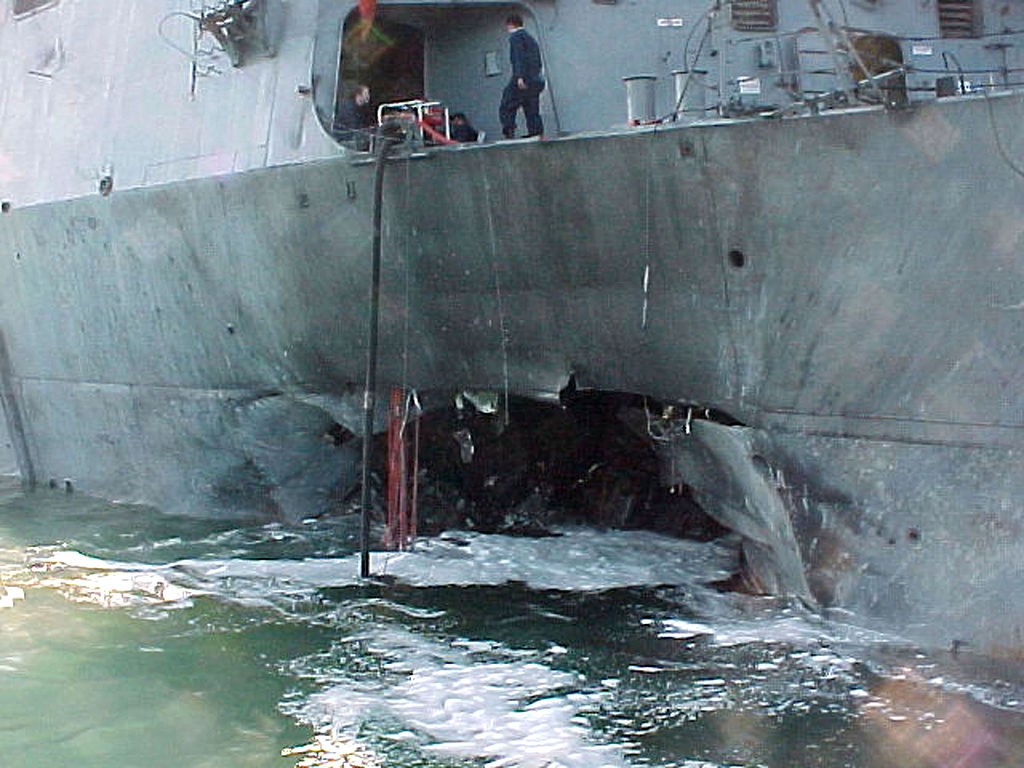
None of this should be construed to imply that a Mark 48 torpedo is anything less than lethal, as most modern warships would be lucky to survive a single hit. For comparison, when the 9,000-ton Arleigh Burke-class destroyer USS Cole was attacked in October 2000, a point-blank surface explosion of roughly 600 to 700 pounds of explosives tore a massive 40-by-40-foot gash into its thin steel side hull. In comparison, a strike by a single Mark 48 torpedo, carrying nearly double the explosive power for underwater detonations, would be vastly more devastating, and such a direct side impact would have likely sunk the ship. If the Cole had suffered the same kind of attack suffered by the Torrens, its much greater size, combined with its much stronger Level 3 construction, would have resulted in significantly less damage.
The above analysis shows that the standoff under-the-keel bubble pulse/mode is not the way to go when attacking an Iowa or a carrier, or perhaps even a large destroyer. Instead, a contact attack, whether slamming directly into the side or detonating at point-blank or near point-blank distances under the ship’s bottom, will do far more damage. Finally, equating a 2,700-ton escort to a battleship or a carrier is bound to result in faulty narratives that help perpetuate our navy’s unwillingness to incorporate more staying power into our warships.
Views expressed in this article are the opinions of the author and do not necessarily reflect the views of The Epoch Times.