
Commentary
As Bougainville gauges the choices made by the Cook Islands and the consequences that followed, its own challenge is coming into sharper focus: ensuring that political independence does not produce a new form of economic dependence.
As it builds the institutions of a future state, the critical task will be to establish procurement rules, transparency requirements, and strategic oversight strong enough to shape the behavior of external partners before those relationships become entrenched.
A New State Watches an Old Pattern Unfold
The Cook Islands offers a useful warning. When it signed a comprehensive strategic partnership with China in February 2025, the agreement was framed around development and diversification, including infrastructure, fisheries, education, trade and seabed mining. Security cooperation was explicitly excluded.
But the strategic consequences came quickly. New Zealand, which maintains a free-association relationship with the Cook Islands, objected that it had not been adequately consulted. Wellington later suspended NZ$18.2 million in budget support, citing damage to the high-trust relationship. By April 2026, the two governments had signed a new Defense and Security Declaration requiring closer consultation on maritime security, border protection, cybersecurity, and critical infrastructure.
The lesson for Bougainville is straightforward: define the rules before outside powers begin defining the relationships. Independence will provide sovereignty on paper. Strong institutions will determine how much of it Bougainville can actually exercise.
Why Bougainville’s Moment Is Different
Bougainville’s political instincts were forged in conflict. The Bougainville Civil War was driven in part by outside extraction and local exclusion, leaving a legacy that still shapes how leaders think about sovereignty.
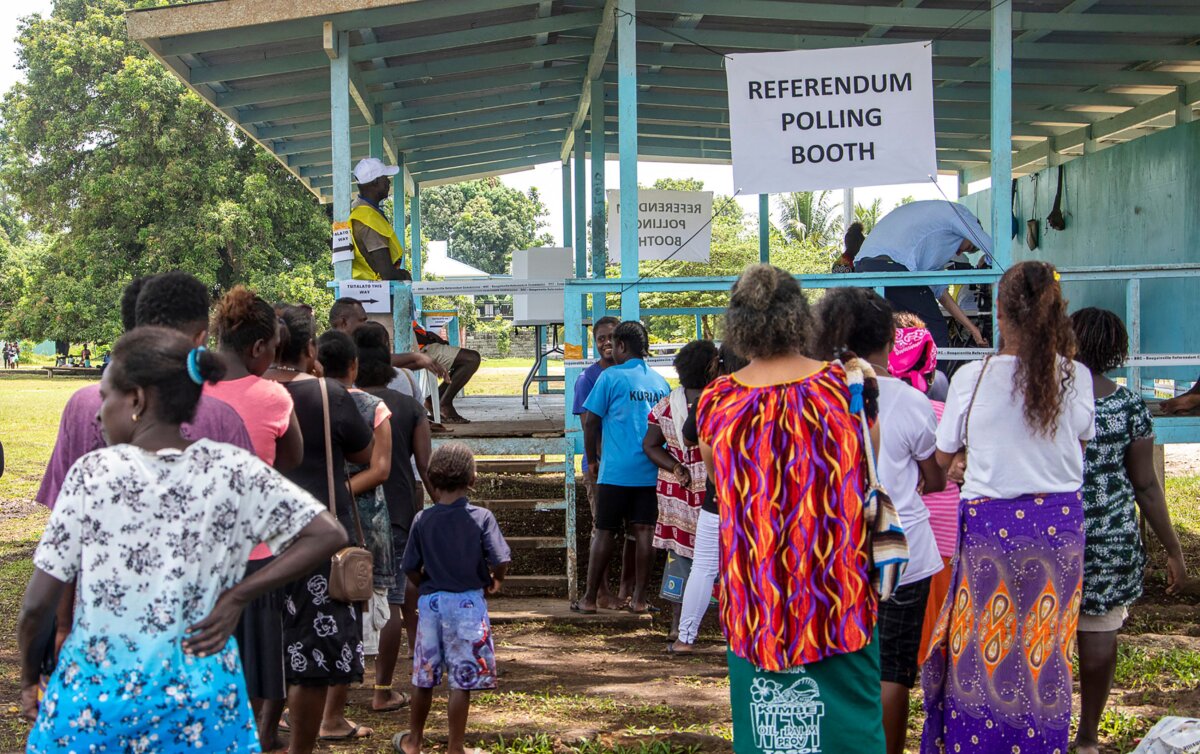
The 2001 Bougainville Peace Agreement forged a route to autonomy, and the 2019 referendum delivered an overwhelming vote for independence.
For Bougainville, sovereignty is not theoretical. It is something that can be taken quietly, contractually, and permanently. Of course, it will need foreign capital, technical expertise, infrastructure, market access, and security support.
The question is whether Bougainville can build a state before outside actors build the terms around it.
Panguna: The Prize That Attracts Pressure
The Panguna mine is Bougainville’s economic foundation and its political warning. Once one of the world’s major copper and gold mines, Panguna helped finance Papua New Guinea while leaving many Bougainvilleans with environmental damage, social fracture, and a sense that outsiders had extracted wealth without consent. That history has not faded and remains at the center of Bougainville’s independence debate.
Panguna is also the asset that makes Bougainville strategically visible. Reopening the mine could help fund a future state. It could also lock that state into dependency before its institutions are strong enough to manage the consequences.
Chinese leader Xi Jinping understands this, and China’s interest is not incidental. It is strategic.
Across the Pacific and beyond, Beijing’s model is familiar: secure access to critical resources, finance the infrastructure around them, and embed long-term influence through contracts, debt exposure, technical dependence, construction standards, and political access. All create structured leverage.
Bougainville Pushes Back
In early 2026, Bougainville rejected a proposed partnership with Chinese mining company CMOC to help reopen Panguna and instead directed Bougainville Copper Limited toward India’s Lloyds Metals and Energy.
Reuters reported that Bougainville sees Panguna as essential to funding independence and that the autonomous government still generates only a small share of its own budget internally.
The first major deal often defines the terms of those that follow. Accepting opaque financing, accelerated timelines, and asymmetrical contracts at the outset does not merely solve a short-term problem. It locks in long-term constraints and consequences.
The Lloyds pathway remains unsettled. Bougainville Copper later announced a non-binding cooperation agreement with Lloyds, giving the Indian company a 90-day exclusivity period for technical, commercial, financial, environmental, and social due diligence. Local reporting has also reflected continuing landowner concerns and political friction around Panguna’s future.
That distinction matters. While Bougainville has not solved the Panguna problem, it has bought itself time to test alternatives without defaulting to Beijing.
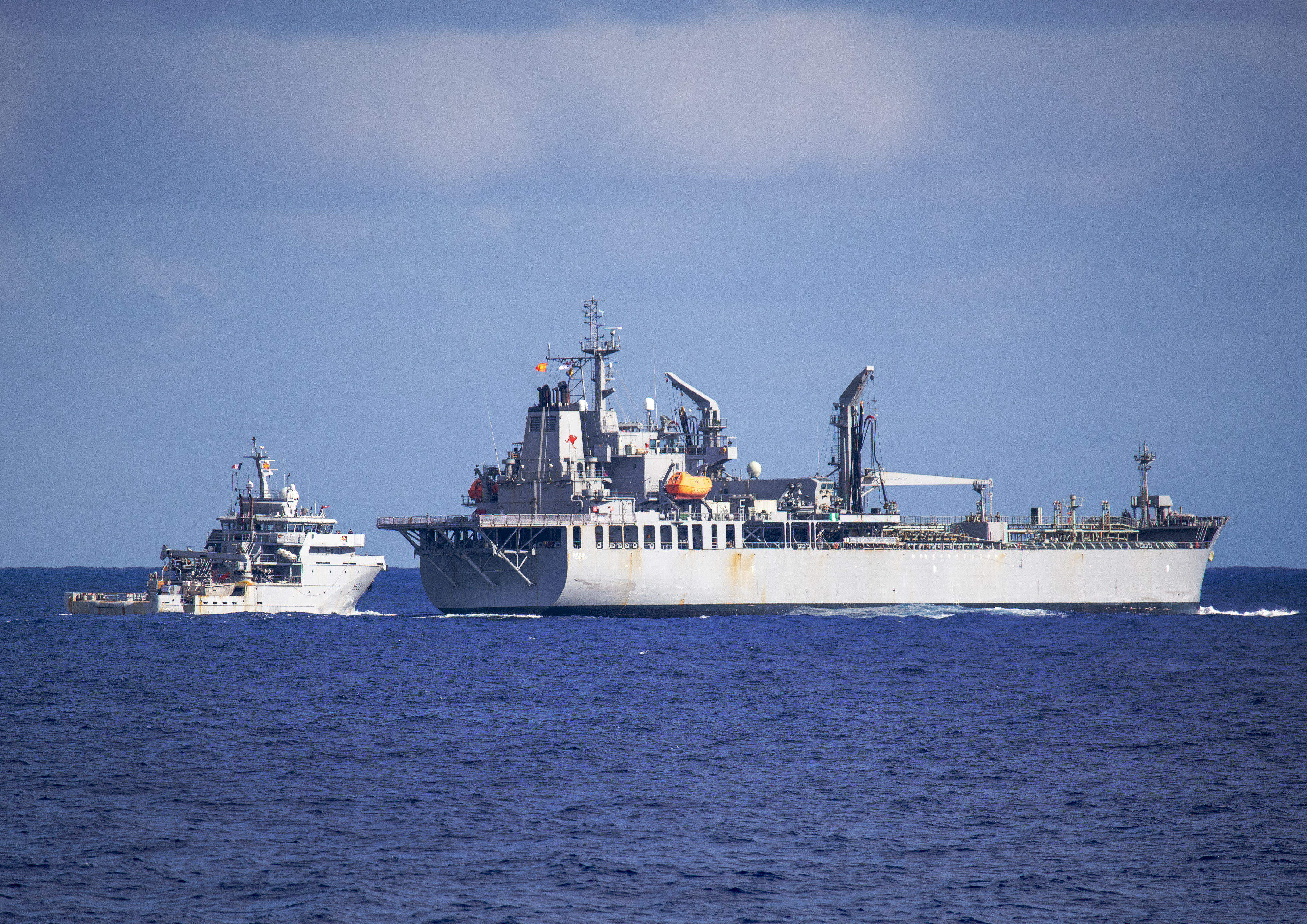 HMAS Sirius conducts a Replenishment at Sea Approach (RASAP) exercise with FS Bougainville as they sail in company through the southern waters of Hawaii during Exercise RIMPAC 2020 on Aug. 17, 2020. (Australian Department of Defence)
The lesson from the Cook Islands is not simply “avoid China.” It is that small states lose leverage when major decisions move faster than their institutions can absorb.
Seeing the System Clearly
Beijing’s approach in the Pacific is often described as a partnership. In practice, it operates as a system that converts economic entry points into strategic positioning. It’s not a partnership when one can veto the other’s interests.
The Cook Islands example matters because it was not formally a security pact. It did not need to be. The agreement touched sectors that carry strategic weight, including ocean resources, infrastructure, education, and deep-sea mining.
The value was not only in what the agreement said. It was in the ambiguity it created, and the Chinese communist regime has mastered operating in ambiguity.
The Solomon Islands offers another warning. Chinese policing assistance there has moved beyond training to internal security influence. Reuters reported that Chinese police piloted the “Fengqiao” model, associated with grassroots surveillance, household registration, and social monitoring.
That matters for Bougainville because the first partner to build infrastructure often becomes the one asked to secure, monitor, finance, and defend it politically.
Bougainville appears to understand the system. It is not evaluating one deal. It is evaluating the chain reaction that one deal can start.
Where Australia and the United States Fit
If China’s model is built on speed and scale, the Western alternative must be built on durability, transparency, and delivery. Australia has an immediate role.
Bougainville’s fisheries are vulnerable to exploitation, particularly from distant-water fleets. Without enforcement capacity, sovereignty becomes a legal fiction. The Pacific Islands Forum Fisheries Agency has long emphasized regional surveillance and enforcement as essential to protecting Pacific maritime resources.
Australia is also beginning to provide infrastructure that matters. In late 2025, Reuters reported that Google would build high-capacity subsea cables in Papua New Guinea as part of a $120 million Australia-funded project, including connectivity to Bougainville.
The United States has also reasserted its presence in the region, including reopening its embassy in the Solomon Islands in 2023. But presence alone is not enough. Washington has to offer governance support, maritime capacity, transparent financing, and infrastructure that does not convert into leverage.
Conclusion
Bougainville’s choices are unfolding in a Pacific that has become more militarized. China’s July missile test into the Pacific sharpened regional concern and undercut the idea that the region can be insulated from major-power rivalry.
For small states, the danger is not only foreign bases but also the gradual loss of control over how waters, ports, data links, police cooperation, and mineral infrastructure are used in a crisis.
Bougainville stands at a rare strategic moment—on the edge of statehood without overwhelming debt entanglement, without binding infrastructure obligations, and without external actors already shaping its policy space.
Views expressed in this article are the opinions of the author and do not necessarily reflect the views of The Epoch Times.