
Commentary
A new generation of young Chinese is refusing to work the same long hours at the same kind of work that their parents and grandparents did.
Beijing’s answer is not to persuade them, but to replace them.
The Generation That Has Opted Out
In 2021, an online manifesto against overwork and the unfulfilment of factory work and other mundane occupations became a quiet national rebellion among China’s young generation.
“Lying flat,” or tang ping, is what many young Chinese are choosing to do instead of hustling into the job market. It’s hard to know how many would-be workers are lying flat because censors scrub posts on the topic.
But the peripheral indicators are telling.
Official unemployment among 16-to-24-year-olds not in school hit 16.9 percent in March, and the figure excludes students and ignores those who have stopped looking. A Peking University scholar earlier noted that the official rate undercounts roughly 16 million young people who are neither working, studying nor seeking work.
Although the accuracy of the last statistic is not up to date, Beijing’s reaction is revealing.
First, it points a finger at outsiders for the malaise of its young people. China’s Ministry of State Security blamed foreign forces for brainwashing young people into rejecting work, marriage, and homeownership.
Of course, taking responsibility would mean the China’s state-capitalist economic model has lost its appeal.
But not all young Chinese are choosing the lying flat trend; some are simply being shut out of the workforce. A record 12.7 million graduates entered the market this year, chasing white-collar jobs that don’t exist. Meanwhile, many shun factory work even as those roles go unfilled.
Ironically, millions of young people are out of work, while factories can’t find people to perform the work.
A Stretched Labor Force
Demographics are a big factor, too.
China’s population fell for a fourth straight year in 2025, by 3.39 million. The core working-age group, ages 16 to 59, shrank by about 6.6 million to 851 million. Projections show the 15-to-64 age group falling from 990 million to about 745 million by 2050.
That means the shortage is structural—permanent for the foreseeable future. The rural migrant workers who built the export machine are now, on average, in their 40s, and their children won’t take their places on the assembly line.
Those two factors alone are making Chinese Communist Party (CCP) planners shudder. China is growing old before it grows rich, and the Party knows it.
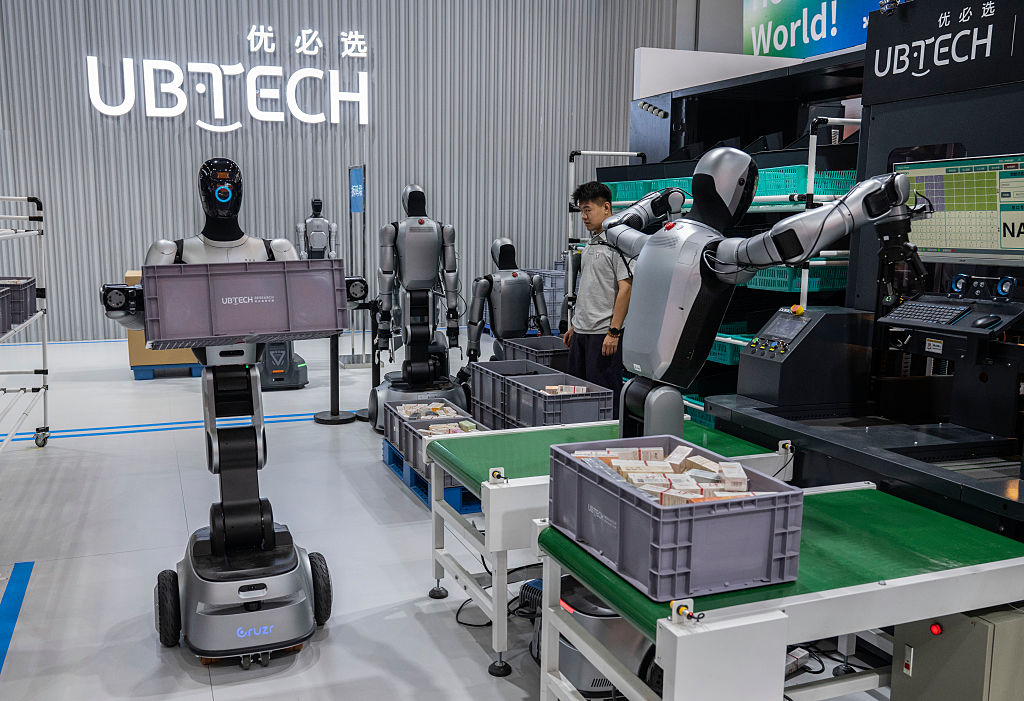 A technician watches over humanoid robots from Chinese company UBTECH as they demonstrate working skills in a mock factory-warehouse environment at the World Robot Conference in Beijing on Aug. 20, 2026. (Kevin Frayer/Getty Images)
Enter the Machines
Beijing’s solution is automation on a scale no other nation on the planet is attempting.
China already runs more than 2 million industrial robots and installs more than half the world’s new units each year. But now, CCP planners are ramping up humanoid robot production even more.
A national program targets 10,000 humanoid robots in commercial use by the end of 2026, and local governments and state companies face strong pressure to meet that goal. Morgan Stanley has nearly doubled its forecast twice, expecting 50,000 shipments this year. Basic units now cost about 100,000 yuan, roughly $14,000—a fraction of 2023 prices.
The stakes are huge. Barclays Research estimates that robotics could offset as much as 60 percent of China’s population-driven labor shortage by 2035. The Financial Times reports a growing consensus that China must embed robots in as many tasks as possible.
Hype Versus Reality
Some skepticism, however, is in order.
Industry data suggest fewer than 5 percent of the humanoids built actually reach production lines. Most are used for research and to showcase their capabilities.
Plus, several glitches still need ironing out. Perception errors, safety standards, and multi-year payback periods are all factors inhibiting mass market adoption.
Nonetheless, the trend is clear.
Conventional industrial robots already do the heavy lifting, and humanoids are the next layer, aimed at logistics, inspection, and assembly.
Within a few years, the factory floor that once demanded millions of young migrants will need only a fraction of them. The young person who has chosen to lie flat will not be missed by the machine.
At that time, Beijing will face the question of what to do with a generation it no longer needs and that no longer believes in the system.
A Robot Army?
Of course, the same technology that can work in a factory can also have military uses.
A Reuters investigation of more than 100 procurement notices, papers, and patents found that the Chinese military is accelerating research into humanoids for battlefield use. Reuters found no evidence that an armed humanoid has joined an operational People’s Liberation Army unit, so any claim of a robot army today would be premature.
The direction, though, is clear.
A 2025 PLA Daily article argued that humanoid roles could evolve from supporting combat toward primary combat. Military researchers have modeled urban assault teams that mix soldiers with six combat robots, including humanoids, robot dogs, and unmanned vehicles.
Military use cases aren’t hard to find, either.
The PLA’s Eastern Theater Command released an AI-generated montage of robots overwhelming Taiwan’s defenses. Chinese companies made roughly 95 percent of global humanoid shipments in 2025, giving the PLA a commercial base no rival can match.
Again, a few technical obstacles remain.
Battery life and reliability, for example, remain real limits. Some estimates put deployment five to ten years out.
But Beijing may want and need them sooner. Consider what the shrinking labor pool means for the military. The one-child generation produces fewer soldiers, and those it does produce are less willing to sacrifice.
Militarized humanoid robots can fill a great need. A regime like the CCP that fears its own young people has every reason to want an army that doesn’t question orders.
What Comes Next?
Beijing is betting that machines can solve problems that its young people won’t. It may indeed work for production and economic output, but it does nothing for the deeper problem: a generation that doesn’t trust the system, a falling birth rate, and an economy that can’t convert growth into hope.
A robot workforce can build goods, but it cannot spend wages, buy homes, or raise children. And an army of machines answering only to the CCP is a prospect that should concern every nation, not just those near China’s borders.
Views expressed in this article are the opinions of the author and do not necessarily reflect the views of The Epoch Times.