
Commentary
For nearly five decades, U.S. policy toward Taiwan has depended on a carefully constructed uncertainty.
Washington does not formally recognize Taiwan as an independent country. It maintains diplomatic relations with Beijing under the “One China” framework while providing Taiwan with weapons and other support for its self-defense.
But the United States has deliberately refused to say whether American forces would fight China if Beijing attacked Taiwan.
That’s strategic ambiguity. The question now is whether it still works and whether it still exists in practice.
Officially Intact
The legal foundation remains intact.
The Taiwan Relations Act requires the United States to provide Taiwan with defensive articles and services and maintain the capacity to resist coercion that would threaten Taiwan’s security or social and economic system. Congress has also established U.S. policy to maintain the capacity to prevent a Chinese military fait accompli against Taiwan.
That’s significant, but what’s also significant is that the law does not guarantee that American forces will automatically go to war with China to defend Taiwan.
That ambiguity is intentional.
Washington wants Beijing to believe an attack could trigger an American military response, while denying Beijing certainty about when, where and how the United States would respond.
The policy, therefore, remains intact on paper, but increasingly, the problem is what’s credible with respect to U.S. military intentions and capabilities in the region.
Trump Has Made Ambiguity More Visible
President Donald Trump has been unusually transactional about Taiwan.
After his May summit with Chinese leader Xi Jinping, Trump said he had discussed Taiwan arms sales with Xi and described the proposed weapons package as a potentially useful “negotiating chip.” He also declined to say whether the United States would defend Taiwan in a conflict.
Both are significant departures in tone and policy from prior administrations and imply that Taiwan policy could become part of a broader U.S.-China negotiation.
That gives Beijing an incentive to believe that pressure on Washington might produce concessions.
That’s precisely what worries Taipei.
The concern is no longer simply whether America can or will defend Taiwan, but whether Beijing believes America’s commitment can be negotiated away before a conflict begins.
Summit Raises Stakes
Trump and Xi are expected to meet at the White House on Sept. 24, and Taiwan will almost certainly be part of the strategic conversation. The meeting follows the May summit, during which Xi warned Trump that mishandling Taiwan could lead to conflict between the two countries.
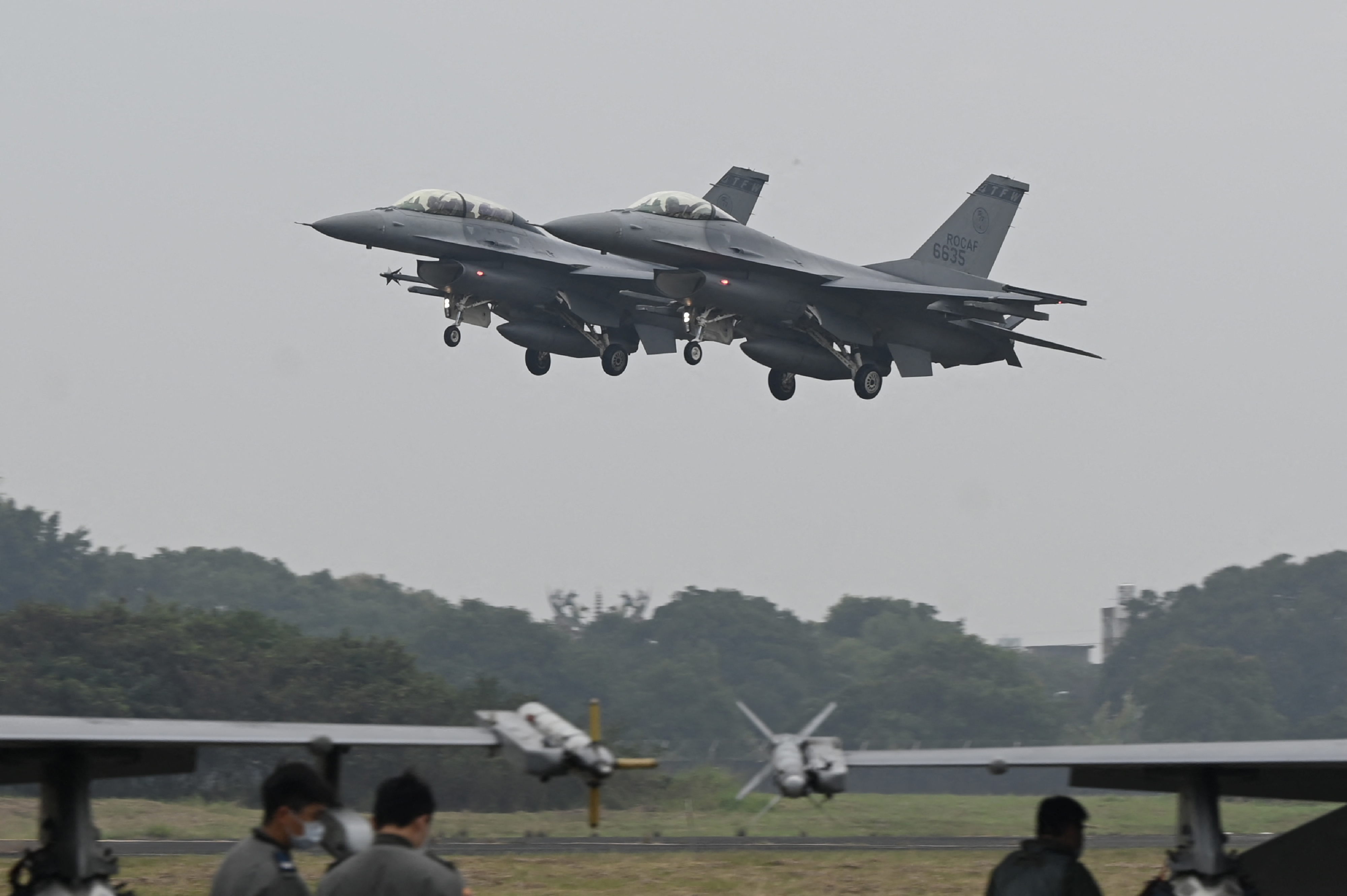 Two armed U.S.-made F-16V fighters fly over at an air force base in Chiayi, southern Taiwan, on Jan. 5, 2022. (Sam Yeh/AFP via Getty Images)
Beijing may think that Taiwan can be separated from the broader U.S.-China relationship.
If that’s the case, if the United States allows that to be a serious point of discussion, strategic ambiguity is all but dead already.
Ambiguity Still Makes Sense
But there’s a strong argument for keeping the policy. If Washington explicitly promised to fight for Taiwan under all circumstances, Beijing would know exactly what it was facing.
That could reduce China’s uncertainty but increase the risk of miscalculation. It could also encourage Taiwan to believe that American forces would automatically rescue it, potentially weakening incentives for Taipei to invest sufficiently in its own defense.
Strategic ambiguity avoids both problems.
It keeps Beijing uncertain, keeps Taipei responsible for its own survival, and preserves presidential flexibility during a crisis.
That flexibility may be more valuable today than ever.
Testing the Limits
The problem is that China’s military capabilities have changed dramatically.
The Pentagon’s 2025 China military report says the People’s Liberation Army is focused heavily on the First Island Chain, which includes Japan, Taiwan, and the Philippines. Beijing is developing the capabilities required to challenge American power throughout that region.
China’s strategy is not necessarily to defeat the United States in a traditional naval war, but rather to make American intervention expensive, difficult, and uncertain.
Today, Chinese long-range missiles, aircraft, submarines, cyber capabilities, satellites, and other systems can threaten U.S. forces and bases across the Western Pacific.
More Than Rhetoric
Here, Washington’s actions remain significant.
The Pentagon’s 2026 National Defense Strategy explicitly calls for a strong “denial defense” along the First Island Chain and says the United States will work with allies and partners to prevent China from dominating the Indo-Pacific.
That’s not the language of an America preparing to abandon Taiwan. At the same time, the United States is also strengthening its forward military posture. That includes mobile anti-ship missile capabilities with Philippine forces near the Luzon Strait and upgrading the U.S. Forces Japan headquarters.
Those developments matter because geography is everything in a Taiwan conflict, with consequences for Japan to the north and the Philippines to the south.
Taiwan More Responsible for Defense
But Taiwan is also taking responsibility for its security.
Taipei has increased defense spending, extended conscription to one year, and worked to strengthen reserve forces and military resilience. It knows that it must make an invasion prohibitively difficult.
The objective isn’t to defeat China outright, but to make victory so costly and uncertain that Beijing decides not to try.
Is Strategic Ambiguity Dead?
Not yet, but it is changing.
The legal policy remains ambiguous even as U.S. military posture improves but political uncertainty grows.
Washington is increasingly building the military architecture necessary to deter China, while President Trump is simultaneously emphasizing negotiation and transactional diplomacy.
Those approaches are not necessarily contradictory, but can be complementary. Diplomacy works better when backed by credible military power. But is Taiwan a security pillar or a negotiating chip?
That’s the question going into the September summit, and indeed, after it.
What Happens After?
A $14 billion Taiwan package remains under consideration, and U.S. officials have said the pending sale does not depend on negotiations with China.
If Washington continues supplying Taiwan while strengthening its military position along the First Island Chain, strategic ambiguity may remain credible.
If arms deliveries are delayed because Beijing objects, ambiguity could begin to look like accommodation.
Either outcome will send a message far beyond Taipei.
The purpose of strategic ambiguity was never to guarantee war, but to prevent it. Beijing must believe that the consequences of attacking Taiwan could be catastrophic.
Views expressed in this article are the opinions of the author and do not necessarily reflect the views of The Epoch Times.