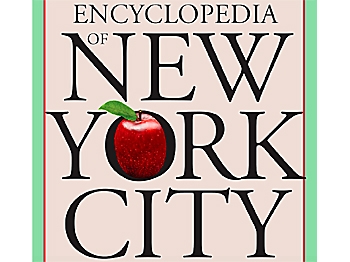
Michael Bloomberg, bodegas, broken windows policy, Brooklyn cyclones, Chelsea Piers, Joe DiMaggio, graffiti, Harlem Renaissance, jaywalking, Bernard Madoff, MetroCard, Marilyn Monroe, parking—a few of the 2 million words in the nine-pound tome that squeezes all the complexities and intricacies of New York City between two covers.
“New York City has never been a static entity, and neither is ‘The Encyclopedia of New York City,’” writes Jackson in the preface.
The first edition was published in 1995. Jackson, the editor-in-chief, added 800 entries to his latest edition. With a total of more than 5,000 entries from about 800 contributors—experts on a vast array of topics—the book brings together the city’s multifaceted history in a way Google never could, says Jackson.
“Although third-graders may know how to use an Internet browser, browsing a book is a very different experience,” writes Jackson, “There is a joy in leafing through the pages to make unexpected discoveries about topics in which you did not think you had an interest.”
Just flipping through the “M” section to get to Marilyn Monroe, one is taken through the early days of a thriving marine economy up to the subsuming of Merrill Lynch by Bank of America in 2008. In between lie all sorts of interesting tidbits and the many stories that have formed this city’s history.
During World War II, the government secretly developed a nuclear weapon in a lab at 270 Broadway. The operation is known as the “Manhattan Project.”
“At one point the Columbia football team was recruited to move thousands of pounds of uranium for experiments that resulted in the first nuclear reactor,” writes Richard Rhodes, author of the encyclopedia entry and of "The Making of the Atomic Bomb."
“Marine pollution” chronicles the history of the harbor. “It’s hard to believe that this was once an oyster city,” says Jackson. The first study of harbor pollution in 1907 deemed the mollusks unfit to eat. The water was described as “almost a thick black oil.” The city poured its sewage into the harbor from the time of the first Dutch settlers to Mayor Fiorello La Guardia’s reign in the 1930s. In 2009, the sludge boat, Red Hook, collected sewage to use as fertilizer, and volunteer groups began opening new oyster beds.
Continuing to flip through the pages, one comes across “Maybelline New York.” In 1915, chemist T.L. Williams observed his sister, Maybel, mixing Vaseline and coal dust to darken her lashes; a cosmetics empire was born.
Under mental health, one learns that convicts from the city prison once staffed the city’s poorly run asylums. The “Mercury Theater” entry tells the story of a broadcast that had many Americans believing Martians were invading. On Halloween, 1938, the theater produced a rendition of H.G. Wells’s "The War of the Worlds" that aired on the radio and was mistaken by some as a news broadcast.