Chinese leader Xi Jinping faces growing political challenges ahead of the 2027 National Congress, with ongoing military purges, economic difficulties, and internal instability raising questions about his ability to secure another term, according to Taiwanese experts.
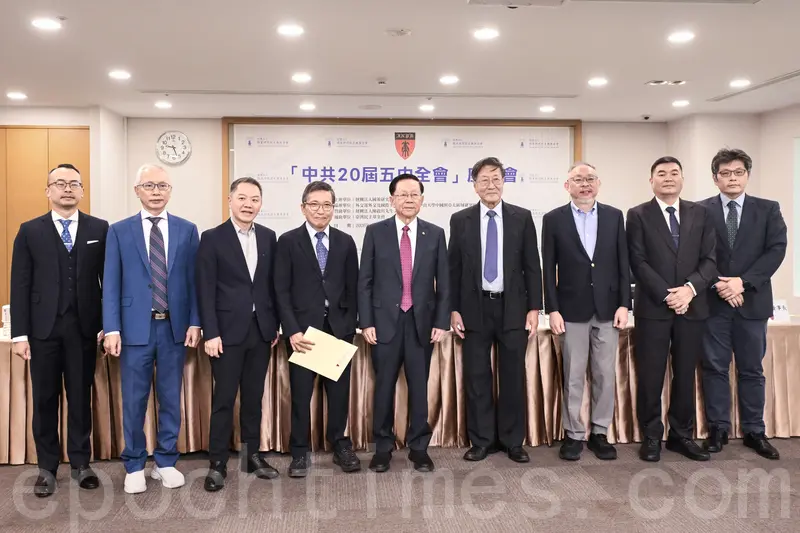
At a forum hosted by Taiwan’s National Policy Foundation on Oct. 30, experts described the Fifth Plenum of the Chinese Communist Party (CCP), which concluded the day before, as a preparatory meeting for the next National Congress. They said Xi was emphasizing political discipline and personnel control to consolidate his leadership.
The experts warned that Beijing could combine military pressure with political influence operations against Taiwan, urging the island nation to guard against CCP infiltration efforts.
China has experienced increasing economic and social difficulties, said Tien Hung-mao, president of the National Policy Foundation, including a property market collapse, rising government debt, foreign capital withdrawals, high youth unemployment, and an aging population.
These pressures have contributed to social instability, prompting the regime to intensify efforts to maintain control, Tien said. Meanwhile, successive anti-corruption campaigns and the removal of senior military officers have created uncertainty among officials.
It was unusual that the CCP’s most recent plenum focused on strict Party discipline, said Chang Wu-ueh, director of the Center for Cross-Strait Relations at Taiwan’s Tamkang University, rather than leadership appointments or succession arrangements.
Zhang Shengmin was added to the Politburo, restoring military representation to the Party’s top decision-making body, he noted. However, 18 full Central Committee members and 15 alternate members remained absent from their positions, suggesting that military purges were continuing.
Also, only 11 of 97 vacant positions had been filled at the meeting, reflecting what he described as dysfunction in the party’s personnel system, according to Tung Li-wen, executive director of Taiwan’s Foundation on Asia-Pacific Peace Studies.
Tung also noted contradictions in the plenum’s communique, including references to public supervision of the government and “self-revolution.” He said the acknowledgment that Party governance had been inadequate appeared to contradict claims that Xi had fully consolidated his authority.
Xi’s 2027 Leadership Bid
The Fifth Plenum was intended to prepare for the 2027 National Congress and ensure that Xi could secure another term, said Ming Chu-cheng, an emeritus professor of political science at National Taiwan University.
“The fact that he needs to consolidate his leadership shows that there are problems with Xi Jinping’s reelection at the 21st National Congress,” he said.
Ninety-seven Central Committee members were absent from the plenum, accounting for more than one-quarter of those expected to attend, Ming said. The absentees included officials already purged, those awaiting investigation, and others who feared becoming targets.
Ming also cited extensive military purges since the 20th National Congress, and the resulting vacancies had weakened military leadership and undermined trust within the armed forces.
Xi had previously presented resolving the Taiwan issue as a major achievement of his leadership, but had made little progress, Ming said. He suggested that Xi might seek to justify another term through improved U.S.–China relations and progress on Taiwan.
“Beijing is pursuing both military and nonmilitary approaches toward Taiwan,” he said, warning that Taiwan needed to guard against internal collaborators.
Hung Yao-nan, an assistant professor in international relations at Tamkang University in Taiwan, identified several indicators to watch before the 2027 congress, including whether the military leadership returns to collective decision-making, whether political language increasingly replaces conventional corruption charges in official announcements, and whether newly appointed provincial leaders emerge as candidates for the next Central Committee.
Fan Shih-ping, a professor of Asian studies at National Taiwan Normal University, said the plenum’s communique offered little new direction on cross-strait relations, broadly repeating previous calls to manage Taiwan, Hong Kong, and Macao affairs.
He said Beijing was particularly interested in Taiwan’s local elections in November due to their potential impact on the 2028 presidential election. Fan highlighted the political rise of Puma Shen, the pro-Taiwanese sovereignty candidate for Taipei mayor, as a sign of a new generation of political figures that could influence Taiwan’s politics for years.
China’s Economic Outlook
The plenum’s communique offered little emphasis on economic development despite China’s mounting challenges, said Tsai Ming-fang, an economics professor at Tamkang University.
He said Beijing had attempted to offset weak domestic demand by expanding exports, prompting countermeasures from the European Union and other trading partners.
As international manufacturers relocate production and supply chains to comply with U.S. policies, China’s share of global manufacturing and exports to the United States could decline, Tsai said.
With domestic demand remaining weak and production costs rising, Chinese companies would face shrinking profits and mounting employment pressures. Tsai said Beijing should encourage foreign investment rather than rely on export expansion and economic pressure.
Concluding the forum, Tien urged Taiwan to strengthen its resilience against Beijing’s influence operations and pressure, protect its role in global supply chains, and deepen intelligence and strategic cooperation with the United States, Japan, and other partners.
Chun Yuan contributed to this report.