
A prolonged delay in a proposed $14 billion U.S. arms sale to Taiwan risks emboldening Beijing, weakening the island’s defenses, and undermining Washington’s credibility with its Indo-Pacific allies, according to two U.S. foreign policy experts who are urging the Trump administration to resume the arms sales notification process.
The White House has yet to formally notify Congress of the proposed sale, which lawmakers pre-approved in January 2026. The delay means Taiwan could face a lengthy wait before receiving the weapons, some of which are considered critical to strengthening its air defenses.
The Trump administration indicated that it must prioritize U.S. military requirements in other regions, according to the experts. However, the continued suspension of arms sales notifications carries strategic costs that could outweigh any diplomatic or military benefits, the experts warned.
In an article published on Nov. 9 by the public policy think tank German Marshall Fund of the United States (GMF), Bonnie Glaser, managing director of GMF’s Indo-Pacific Program, and Noah Munk, an international relations researcher at Johns Hopkins University’s School of Advanced International Studies, outlined four consequences of the delay.
The article, titled “A Holdup of U.S. Arms for Taiwan,” said the current interruption marks the fourth major disruption to U.S. arms sales to Taiwan in 21 years. Previous interruptions occurred in 2005–2006, 2007–2008, and 2011–2015.
The authors said concerns in Washington that supporting Taiwan could jeopardize cooperation with China have repeatedly contributed to such delays.
Four Strategic Costs
One of the major concerns is that Beijing could gain greater influence over U.S. arms sales.
The authors warned that Beijing could interpret the delay as evidence that it can influence the timing of U.S. weapons sales to Taiwan, potentially approaching an effective veto over them.
The longer Washington holds up the notification, the stronger Beijing’s reaction could be when the sales eventually proceed, they said. The delay could also reinforce China’s confidence in using so-called gray-zone tactics—incremental actions that gradually change the status quo without triggering a major confrontation, they added.
Another concern is that Taiwan’s defense buildup could fall further behind.
The proposed package includes nine National Advanced Surface-to-Air Missile System (NASAMS) batteries, hundreds of PAC-3 Missile Segment Enhancement (MSE) interceptors, and components of the Integrated Battle Command System (IBCS).
The systems are important elements of Taiwanese President Lai Ching-te’s planned multilayered air defense network, known as T-Dome.
NASAMS would strengthen Taiwan’s defenses against aircraft, drones, and cruise missiles, while PAC-3 MSE interceptors would help counter ballistic and cruise missiles. IBCS would integrate the different systems into a coordinated defense network.
The authors warned that delays in congressional notification could push Taiwan further back in manufacturers’ production schedules. A six-month notification delay could result in a delivery delay of a year or more, they said.
The hold could also intensify political disputes over Taiwan’s defense spending.
Opposition parties control Taiwan’s legislature, which has already reduced Lai’s proposed special defense budget. Funding earmarked for the stalled arms package cannot yet be spent, giving pro-China opposition parties further grounds to argue that U.S. weapons supplies are unreliable and that the spending is being wasted.
The authors worry that Beijing could conclude that delaying arms sales is an effective strategy.
Previous interruptions have taught Beijing that political pressure and high-level diplomacy can influence the timing of U.S. weapons sales, the authors said.
President Donald Trump sees arms sales as a good negotiating tool, which could reinforce the perception that Beijing expects concessions in return for future approvals, according to the authors.
This risks changing the nature of U.S. arms sales from a routine process under the Taiwan Relations Act into a bargaining exercise in which each approval is treated as a diplomatic concession to Beijing, they said.
Another concern is that U.S. credibility with Indo-Pacific allies could suffer.
The delay could also raise concerns among regional partners, including Japan and South Korea, about Washington’s willingness to honor its security commitments, according to the authors.
The implications extend beyond regional security. Taiwan accounts for roughly two-thirds of global advanced-node semiconductor production, making the island critical to supply chains relied upon by economies worldwide.
If Washington appears willing to compromise Taiwan’s defense to maintain smoother relations with Beijing, countries dependent on Taiwan’s semiconductor industry could lose confidence in both the security of those supply chains and the reliability of U.S. commitments, the authors warned.
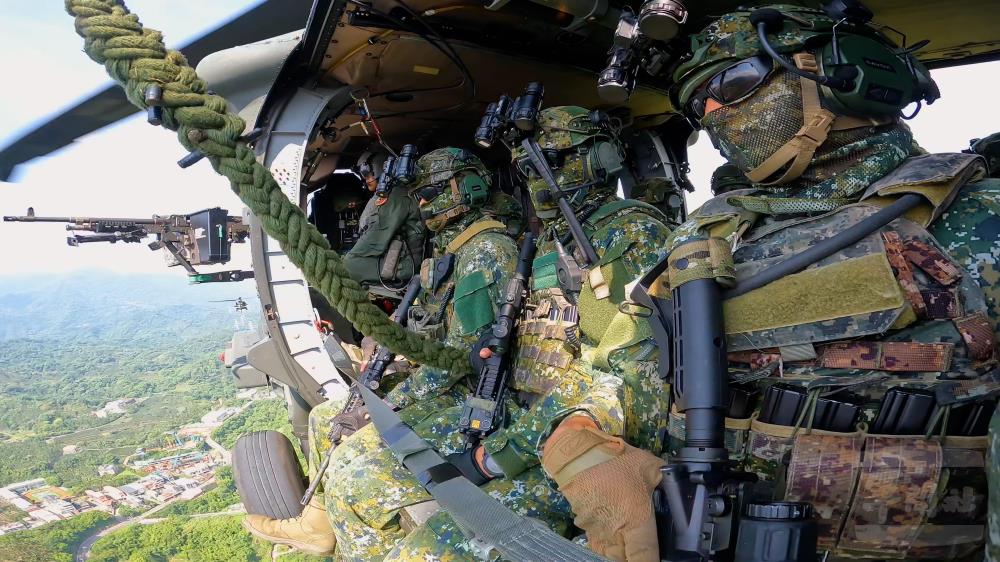 Taiwanese special operations troops take part in an air-infiltration drill during the Han Kuang 42 military exercises in Taoyuan, Taiwan, on Aug. 12, 2026. (Courtesy of Taiwan Ministry of National Defense)
Calls to Resume Arms Sales
To address the risks, Glaser and Munk urged the Trump administration to resume formal congressional notifications without further delay.
They recommended that Washington begin by notifying Congress of a smaller initial package, prioritizing PAC-3 MSE interceptors, IBCS components, and counter-drone systems that urgently need to secure positions in manufacturers’ production schedules.
The authors also called for a return to regular, case-by-case reviews of Taiwan’s arms requests, rather than grouping sales into large packages that could be subject to prolonged political delays.
Congress, they said, should use its oversight authority and legislation to improve transparency and restore a predictable notification process.
They pointed to two pending legislative proposals—the PORCUPINE Act, which would give Taiwan NATO Plus treatment and shorten the congressional notification period from 30 days to 15 days, and the Six Assurances to Taiwan Act, which would codify the U.S. commitment not to consult Beijing on arms sales to the island.
The authors argued that the strategic risks of continuing the suspension now outweigh the potential costs of resuming the sales. They urged Washington to restore regular arms sales notifications rather than allow Beijing to gain greater influence over U.S. decisions.
Wu Min-chou contributed to this report.