
American aerospace giants transferred technology and expertise to Chinese military-linked companies, often with U.S. government approval, helping develop capabilities that could strengthen China’s armed forces, according to a House panel’s report released Nov. 19 that calls for a crackdown on the practice.
The 65-page report, released by House Select Committee on China Chairman John Moolenaar (R-Mich.), identifies Honeywell Aerospace, GE Aerospace, and Collins Aerospace as major U.S. defense suppliers that worked with Chinese companies tied to military aircraft development.
The committee found that U.S. authorities continued approving sensitive technology exports even after Washington identified some of the Chinese partners as military end users.
“American and European companies transferred technology to China that could be used against our brave men and women in uniform,” Moolenaar said in a statement.
The investigation centers on the Chinese Communist Party’s (CCP’s) military-civil fusion strategy, which seeks to make civilian technology, manufacturing expertise, and research available to the People’s Liberation Army (PLA).
The committee said Chinese companies gained advanced capabilities through commercial partnerships that were often entirely legal.
American Technology, Chinese Fighter-Jet Developers
One example involves Honeywell Aerospace, whose technologies are used in American military aircraft, including the F-22 and F-35 fighter jets.
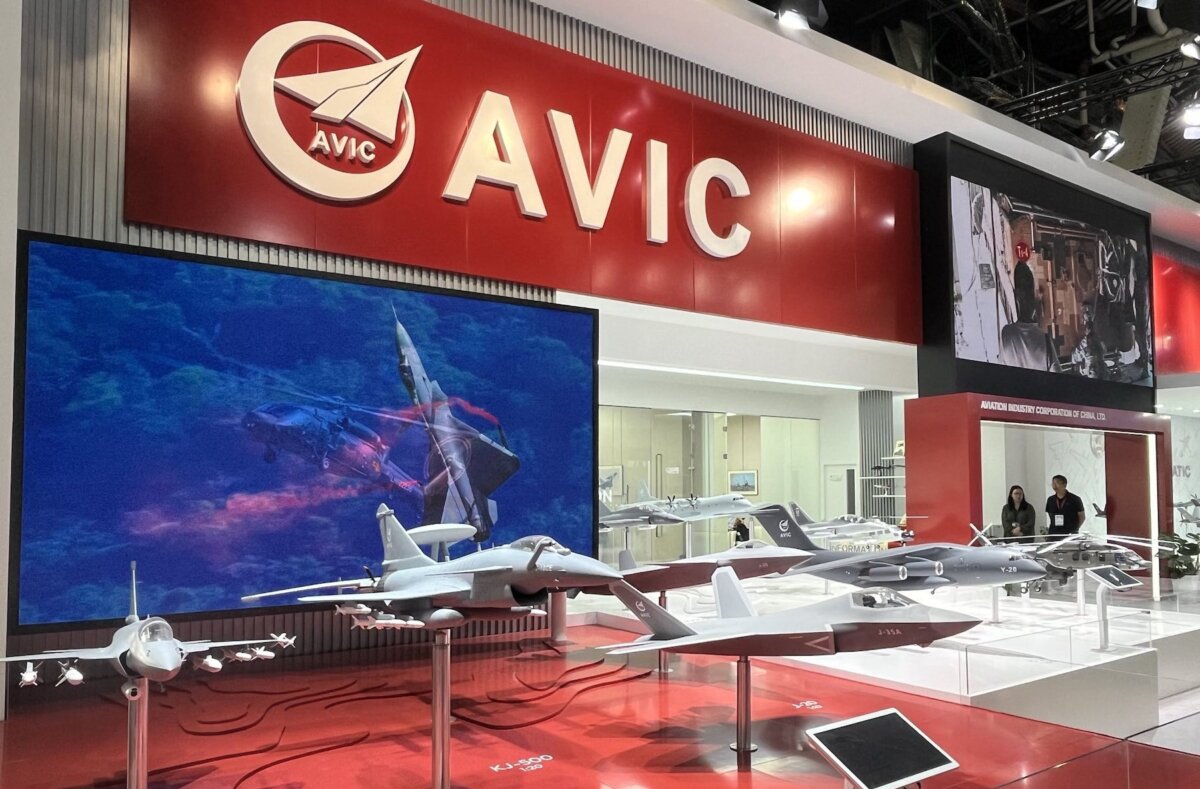
In 2013, Honeywell established a joint venture to develop flight-control systems for China’s C919 passenger jet with an institute belonging to the Aviation Industry Corporation of China (AVIC), the state-owned conglomerate behind many of China’s combat aircraft.
That Chinese partner, known as the 618 Institute, also develops flight-control technology for Chinese fighter jets, including the J-10, J-11, J-15, and J-16.
The United States designated the institute a military end user in 2020.
Honeywell told congressional investigators that the joint venture primarily handled logistics and did not conduct new product engineering.
But contracts obtained by the committee described a broader arrangement, giving the venture rights to use certain Honeywell technologies for developing, testing, and manufacturing flight-control systems.
Investigators also found that employees of the venture developed and patented a drone-related package-delivery mechanism in China.
Honeywell said the drone technology had since been quarantined and that it no longer conducts drone-related work in China. The company maintained that its Chinese partners could not access sensitive Honeywell source code.
In a statement to The Epoch Times on Nov. 19, Honeywell Aerospace said the commercial partnerships examined in the report were fully licensed and approved by the U.S. government.
“Honeywell Aerospace has and will continue to follow all U.S. export laws and procedures, as is acknowledged in the report,” the company said. “Honeywell Aerospace worked transparently with the Select Committee and demonstrated the high level of care we take with our technologies.”
GE’s Chinese Partner Had Military Connections
GE Aerospace, whose engines power American fighter jets and bombers, established a separate partnership with an AVIC subsidiary to develop electronic systems for China’s commercial aircraft.
GE contributed technology used to run multiple aircraft systems through shared computers—an important building block of modern aviation.
The investigation found that the Chinese partner had close ties to AVIC’s 615 Institute, which develops electronics for Chinese military aircraft, including the J-20 stealth fighter.
When the C919 project encountered difficulties in 2020, the institute reassigned personnel from military aircraft programs to help resolve technical problems on the passenger jet, according to Chinese reporting cited by the committee.
Two export licenses issued by the Commerce Department in 2023 allowed GE to continue supplying controlled aircraft hardware, software, and technology to the joint venture.
GE maintained that the partnership was intended for civilian aircraft and that safeguards restricted military applications of its technology.
However, the company did not provide the committee with the original agreement governing the venture, despite repeated requests from congressional investigators. The committee said that without the document, it could not fully assess the venture’s original terms or safeguards.
GE Aerospace did not respond to requests for comment from The Epoch Times by publication time.
US Restrictions Failed to End Partnerships
Collins Aerospace, another major American defense supplier, maintained partnerships involving Chinese radar, navigation, and communications organizations.
One partner, AVIC’s Leihua Electronic Technology Research Institute, had worked on radar systems for Chinese combat aircraft.
The United States designated the institute a military end user in 2020. Collins subsequently obtained government licenses to continue work supporting China’s C919 passenger jet.
Investigators also examined financial arrangements in two Collins-related ventures: Chinese partners supplied 99 percent of the registered capital while the American side supplied just 1 percent, yet profits were divided equally.
The report said the arrangements suggested that Chinese partners placed substantial value on the American technology and expertise contributed to the ventures.
Collins told the committee that its work remained confined to authorized commercial aircraft systems and that sensitive information had not been provided to nearby Chinese military organizations.
In a statement to The Epoch Times, Collins Aerospace’s parent company, RTX, said: “We appreciate the Committee’s work ensuring the U.S. retains its position as the world’s commercial aviation leader while protecting our most sensitive technologies. We have and will continue to follow relevant U.S. laws and regulations, as the report acknowledges.”
The committee said it could not independently verify some of the companies’ safeguards because their operations were located in China.
The investigation also cited previous export-control enforcement settlements involving the three American aerospace companies. It did not conclude that the particular commercial-aircraft export licenses examined were illegally obtained.
Instead, investigators questioned why U.S. authorities continued permitting sensitive aerospace cooperation involving Chinese military-linked organizations.
The restrictions often changed the licenses required to conduct business rather than ending the partnerships, the committee found.
Congress Demands Tighter Controls
Moolenaar urged Congress and federal agencies to close the gaps that allowed American aerospace technology to reach Chinese military-linked enterprises through commercial ventures.
The committee backed the proposed Aerospace Transparency Act, introduced Nov. 17, which would require certain Pentagon contractors to disclose their relationships with U.S.-designated Chinese military companies.
It also recommended extending outbound-investment restrictions to China’s aerospace sector and tightening rules governing exports of technologies that Chinese military companies could access.
The investigation also criticized European aerospace firms, including Airbus, Safran, and Dassault Systèmes, for maintaining extensive partnerships with Chinese defense-linked enterprises.
The committee warned that unilateral U.S. restrictions could allow European competitors to replace American suppliers without cutting off China’s access to advanced aerospace technology.
Moolenaar called on American allies to adopt comparable restrictions.
“The U.S. and its allies should strengthen export controls and tighten investment restrictions on the aerospace sector to stop the transfer of vital technology that will empower our foremost adversary,” he said.