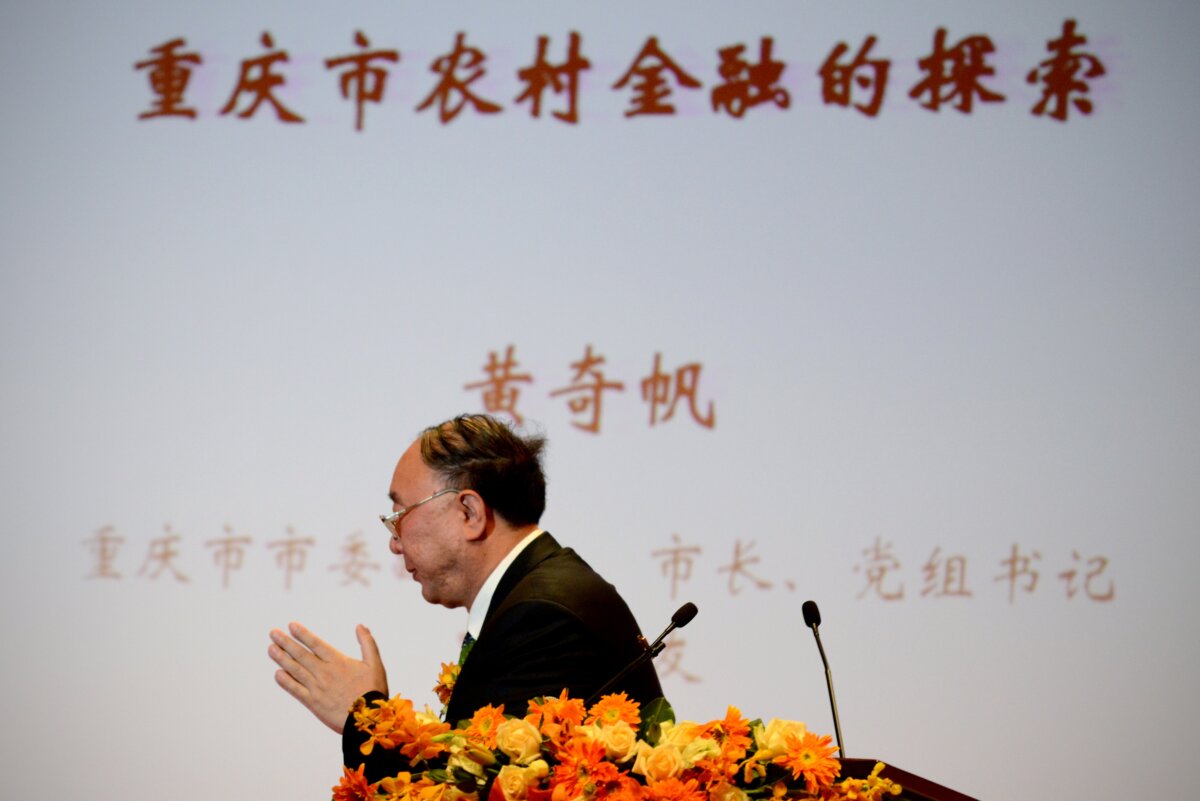
Former Chongqing Mayor Huang Qifan’s years of outspoken economic commentary may have put him on a collision course with Chinese leader Xi Jinping, according to analysts, as the recent investigation of the former mayor highlights the potential risks for retired officials who remain publicly influential.
It was announced on Oct. 13 that Huang, 74, was under investigation. The announcement came ahead of the Chinese Communist Party’s (CCP’s) Fifth Plenum, scheduled for Oct. 26–29 in Beijing, which is expected to focus on Party governance and discipline. The authorities have not publicly detailed the allegations against Huang or explained the reasons for the investigation.
Yuan Hongbing, a former head of law school at China’s top Peking University and renowned Chinese dissident based in Australia, told The Epoch Times that Huang’s economic commentary was a principal reason for his downfall, citing his sources from within the CCP. According to Yuan, Huang spent years expressing views on China’s economy that directly conflicted with those of Chinese leader Xi Jinping.
“The main reason Huang Qifan got into trouble was that the series of commentaries on China’s economy he had disseminated over the years directly conflicted with Xi Jinping’s current economic thinking,” Yuan said.
Huang, 74, served as Chongqing’s mayor until 2016 and held senior positions in the municipality for about 15 years. During that period, he worked under six municipal Party chiefs, including Bo Xilai and Sun Zhengcai, both of whom were later purged in political scandals. Huang’s survival through successive leadership upheavals earned him a reputation as a political survivor.
In subsequent years, Huang remained active in public life as an economic commentator, serving as vice chairman of the China Center for International Economic Exchanges and chairman of an industrial transformation advisory committee at China’s Tsinghua University. He traveled around the country to give speeches and became a prominent online figure known for his economic analysis.
Huang appeared as recently as Sept. 8 at the Silk Road Maritime International Cooperation Forum in Xiamen, China, where he delivered a speech. However, his planned lecture at Tsinghua University was subsequently canceled, as well as his planned speech on Oct. 26 in Hangzhou.
Yuan argued that Huang’s economic views were incompatible with Xi’s broader policy direction. He said Xi was seeking to shift China’s political, economic, and cultural systems toward a wartime footing in preparation for a possible conflict across the Taiwan Strait. That shift would entail a return to a planned economy and greater state control over key industries through state-owned enterprises.
Yuan explained that Huang, by contrast, continued to promote a market-oriented economic model. He described Xi as perceiving Huang’s rhetoric as an intolerable challenge to his economic doctrine.
Yuan said that even officials who had retired more than a decade earlier could face political repercussions if they retained influence in certain sectors or were not considered sufficiently loyal to Xi.
“All these retired officials must now be filled with hatred toward Xi Jinping deep down,” Yuan said.
U.S.-based China current affairs commentator Li Linyi told The Epoch Times that the timing of the investigation appeared deliberate, arguing that the regime intended to discourage officials from speaking out. He said the case also reflected what he viewed as Xi’s underlying concern about the stability of his hold on power.
Shen Ming-shi, a research fellow at Taiwan’s Institute for National Defense and Security Research, told The Epoch Times that Huang’s case suggested the leadership’s efforts to consolidate control over influential local political networks and officials associated with previous administrations were continuing.
Such investigations could intensify anxiety among local officials, Shen said. Given Huang’s longstanding connections to the financial sector, the case could precede a broader crackdown targeting the Party’s influential political figures who are deeply involved in businesses.
Tang Bing and Luo Ya contributed to this report.