
The Chinese regime has tightened control in Shenzhen before the annual Asia-Pacific Economic Cooperation forum (APEC), detaining citizens, forcing residents out of their homes, and severely disrupting daily life in the megacity, according to local residents and social media posts.
The annual APEC summit of the 21 member economies will be held in Shenzhen, a major city and manufacturing hub in Guangdong, this year from Nov. 18–19, with U.S. President Donald Trump, Chinese leader Xi Jinping, and Russian President Vladimir Putin set to hold a trilateral meeting on the last day.
The Guangdong Provincial Public Security Department on Nov. 1 held a province-wide mobilization meeting for security operations related to the APEC summit. Police from across the province were reassigned to support Shenzhen, with an increased presence on the streets to “ensure a heavy deployment of forces for strict management and control,” by intensifying patrols and preventive measures, perimeter checks and controls, and protection of key areas.
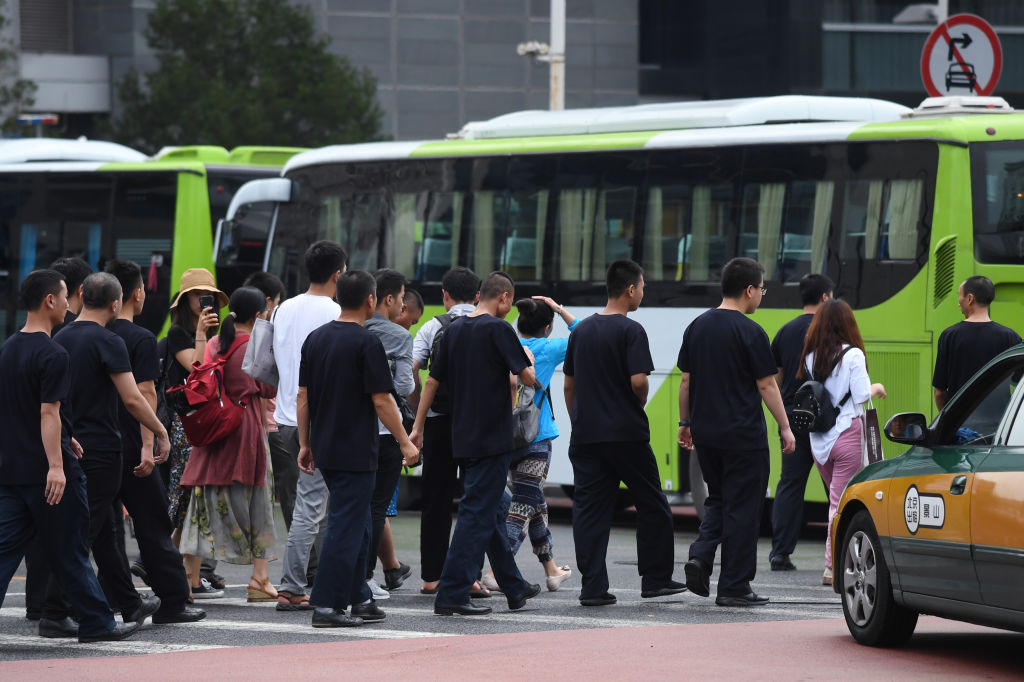
Security personnel conducted random checks of pedestrians on Shenzhen streets on Nov. 3, while security checks on the Shenzhen Metro have also increased, according to residents who spoke to The Epoch Times and to social media posts.
Yang Fan, a white-collar worker in Shenzhen who used a pseudonym out of fear of reprisal from the Chinese regime, told The Epoch Times that since last week the city has entered the “APEC time,” with daily life noticeably affected.
“The streets have become unusually quiet, and traffic control has grown significantly stricter,” he said.
Meanwhile, the Shenzhen Municipal Bureau of Ecology and Environment and the Traffic Police Bureau of the Shenzhen Municipal Public Security Bureau jointly issued a notice: Effective Nov. 1, a total ban on the use of vehicle horns will be implemented throughout the city of Shenzhen. This policy will remain in effect for five years, and violations will be subject to penalties in accordance with the law.
Yang said some companies in Shenzhen have already asked employees to work from home or work remotely, especially in areas with a high concentration of high-tech industries such as Nanshan. He said there has been a noticeable decline in the number of people commuting to and from work.
APEC is taking place at the Shenzhen International Exchange Center on the waterfront of Xiangmi Lake.
In a Nov. 1 post on X, prominent citizen journalism account @whyyoutouzhele, which focuses on China, further described Shenzhen as undergoing “Xinjiangization.”
The post stated that on Oct. 30, the owner of Jiudao Geng, a whole-beef specialty restaurant in Longhua District, Shenzhen, said police had chained and locked his kitchen cleavers to the food preparation area. The post came with a video reported by the account showing a man who identifies himself as the restaurant owner displaying a heavy meat cleaver chained to a metal bar inside the restaurant’s kitchen.
Chinese authorities have enforced strict security regulations on the purchase, ownership, and use of knives, including kitchen knives, in the Xinjiang Uyghur region since 2010s, where the population is subjected to mass surveillance, incarceration, forced sterilization, and slave labor. Now, the strict measures have been expanded to other regions in China.
Local residents posted on social media that during the economic forum, authorities barred some residents from returning to their homes. Public security authorities placed some residential buildings under lockdown, with security personnel stationed at each building. Affected households were offered a daily subsidy of 600 yuan ($90) as compensation, according to the post.
Yang confirmed to The Epoch Times that authorities had instructed residents near the APEC summit site to temporarily relocate.
“I even captured it on camera,” he said, adding that some of the residents had been transferred to designated hotels.
He said all the curtains were drawn shut in several high-rise apartment buildings near Xiangmi Lake, in what he saw as a clear consequence of the security measures implemented for the summit.
 Police detain a petitioner outside the Chaoyang Hospital, where a group protested medical and land grab issues in Beijing on May 8, 2012. (Mark Ralston/AFP/GettyImages)
Petitioners and Other Citizens Taken Away
Petitioners, Chinese citizens who have grievances against local authorities and go to higher authorities to file complaints to protect their rights, are often the targets of Chinese authorities’ tightened security controls during events the regime deems sensitive and important.
A video reposted on X by @candymbs, which describes itself as a Chinese dissident account, shows that on Nov. 15, a group of petitioners from various parts of China arrived in Shenzhen. They were intercepted upon arrival by Shenzhen police officers, forced into a Coaster minibus, and removed from the scene. It’s unclear where they were taken, according to the post.
Yang said it’s not only petitioners who are subjected to the regime’s preemptive control. Citizens noticed by the authorities for other reasons have also been targeted and placed under “stability maintenance” measures this time, including some people he knows, he said.
“Nowadays, there are people in China who, despite having no apparent connection to petitioning, are nonetheless deemed targets for ‘stability maintenance’ and are being subjected to such preemptive control,” Yang said.
Li Jing and Luo Ya contributed to this report.







