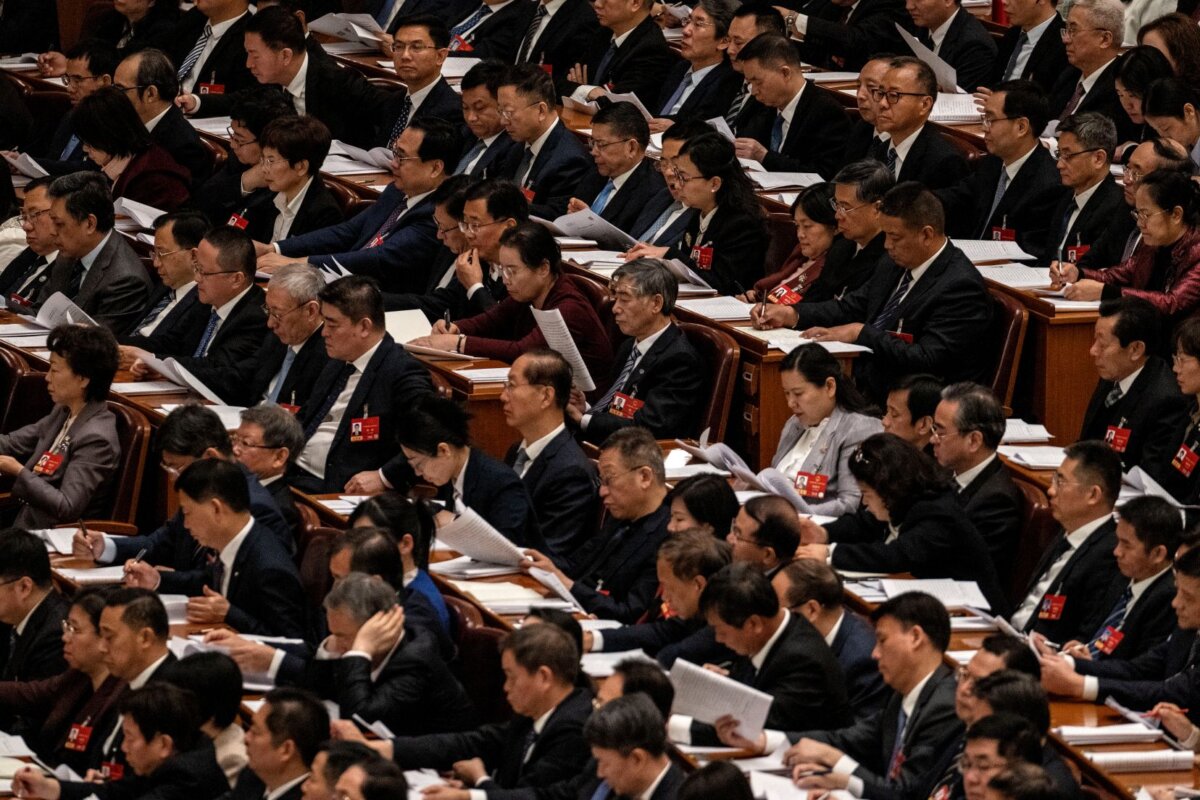
The latest provincial leadership shake-ups in the Chinese Communist Party (CCP) are drawing attention to the declining representation of younger officials in senior posts, with analysts linking the trend to Chinese leader Xi Jinping’s reluctance to cultivate a successor and his efforts to remain in power.
Provincial CCP congresses began this month, with Anhui Province and the Xinjiang region opening their meetings on Oct. 19, according to Chinese state news agency Xinhua. Other provinces are scheduled to hold congresses in November and December, with the nationwide reshuffle expected to conclude by June 2027.
A key question is whether more officials born in the mid-1970s or later will join provincial party standing committees, the top decision-making bodies of provincial Party organizations.
Chinese financial news outlet Caixin published data in July 2012 and July 2022 showing that officials born in the 1960s accounted for 29.1 percent of provincial party standing committee members after the 2011–2012 reshuffle. After the 2021–2022 reshuffle, officials born in the 1970s accounted for just 17.3 percent.
Xi’s Succession Strategy
U.S.-based China current affairs commentator Wang He told The Epoch Times that the aging of the leadership is closely linked to Xi’s decision not to designate a successor.
Under former Party leader Deng Xiaoping, the CCP promoted the advancement of younger officials. Xi himself rose to provincial-level leadership in his 40s, joined the Politburo Standing Committee at 59, and became China’s top leader that same year, in 2012.
Wang said Xi now favors older officials he trusts over younger cadres who could eventually become potential successors. Many officials born in the 1970s remain at the deputy-provincial level, limiting their advancement.
“Xi Jinping is the beneficiary of the trend toward younger officials,” he said. “But to remain in power for a long time, or even establish lifelong rule, he has artificially abolished the CCP’s succession system.”
Xi removed the two-term limit for China’s leader from the constitution in 2018, enabling him to remain in power beyond the previous limit.
Several other senior officials have continued serving at advanced ages, including Foreign Minister Wang Yi, Hong Kong and Macao Affairs Office Director Xia Baolong, Taiwan Affairs Office Director Song Tao, and Supreme People’s Procuratorate head Ying Yong.
Wang He said the concentration of senior positions among older officials could fuel frustration among younger cadres and contribute to political uncertainty.
Recent state media commentary has also criticized young officials for pursuing rapid advancement.
On Sept. 2, the CCP’s official newspaper, People’s Daily, criticized young officials for being impatient, avoiding difficult tasks, and pursuing achievements for their own sake.
In August 2025, a publication affiliated with the CCP’s Organization Department similarly warned against young officials seeking rapid promotion, saying that their development required a gradual approach.
Anti-Corruption Campaign
Xi’s anti-corruption campaign is another factor analysts say could affect personnel changes.
On Oct. 15, the CCP’s official theoretical journal Qiushi published an article by Xi calling for stricter Party discipline. He warned that no official should be spared from punishment for corruption because of rank or past contributions.
The article also warned against “two-faced” officials whose words and actions diverge, saying that they should not pass through leadership transitions without scrutiny. Xi specifically called for greater efforts to investigate young officials.
Feng Chongyi, an associate professor in China studies at the University of Technology Sydney, told The Epoch Times that Xi’s continued rule, while other officials are required to retire, could fuel dissatisfaction within the Party.
Feng said the anti-corruption campaign could also be used to remove officials who resist making way for Xi’s preferred appointees.
“Since he wants to promote new people who are loyal to him, and the people already in those positions do not want to make way and do not accept it, he uses anti-corruption measures to bring them down,” Feng said. “That is what it means when the anti-corruption campaign is always ongoing.”
Tang Bing and Luo Ya contributed to this report.