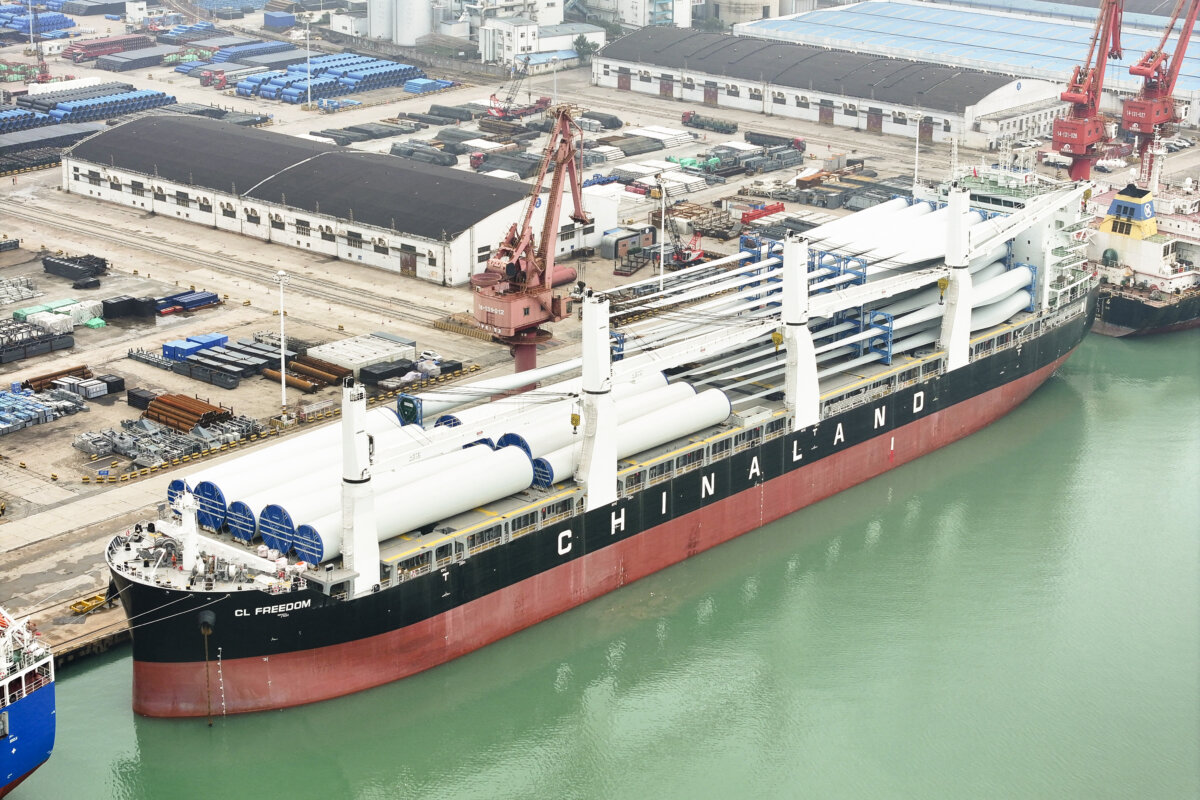

Economic coercion and a flood of surplus goods may give the Chinese regime short-term leverage, but they won’t restore growth and will only pit it against more of the world, analysts say.
The Quad—the four-nation bloc of the United States, Australia, Japan, and India—voiced serious concern on Oct. 31 about economic coercion, including arbitrary export restrictions, as well as nonmarket policies and practices that result in overcapacity.
The group made the remarks in a joint statement after talks in Atlanta on the sidelines of a G20 foreign ministers’ meeting.
China goes unnamed in the statement, but its overcapacity has been spilling into markets from Southeast Asia to Europe, while its coercion tactics have hit a string of countries.
“Economic coercion won’t revive China’s economy. If anything, the slowdown is draining that strategy of its punch,” Tsai Ming-fang, a professor of industrial economics at Tamkang University in Taiwan, recently told The Epoch Times.
China’s gross domestic product grew by 4.5 percent in the third quarter, according to an Oct. 19 release from the country’s National Bureau of Statistics.
This keeps China on track to meet its annual growth target of 4.5 to 5 percent—already the lowest in decades—but other data look bleaker.
The country’s fixed-asset investment fell 7.2 percent, and real estate investment plunged 20.6 percent in the first three quarters, while retail sales rose just 1.1 percent in September.
“Without the economic clout to back it up, economic coercion is nothing but coercion,” Tsai said. “That will only put China at odds with more of the world.”
Still, the regime has kept using rare-earth curbs as a pressure tool, notably against Japan.
Alicia Garcia-Herrero, senior research fellow at Brussels-based think tank Bruegel, said Beijing’s export restrictions and overcapacity strategies offer short-term leverage but are “not growth engines.”
“China’s growth is already export-dependent because domestic demand remains weak,” Garcia-Herrero told The Epoch Times.
“Restricting rare earths or dumping surplus goods accelerates decoupling, invites retaliation, and does nothing to fix the underlying domestic imbalance.”
China’s urban jobless rate for people aged 16 to 24, excluding students, stood at 18 percent in September, up from 17.7 percent a year earlier, according to National Bureau of Statistics data released on Oct. 21.
Coordinated Pushback
At a press conference in Atlanta on Oct. 31, U.S. Secretary of State Marco Rubio said the Quad is not an anti-China group, yet left little doubt about which country the bloc had in mind.
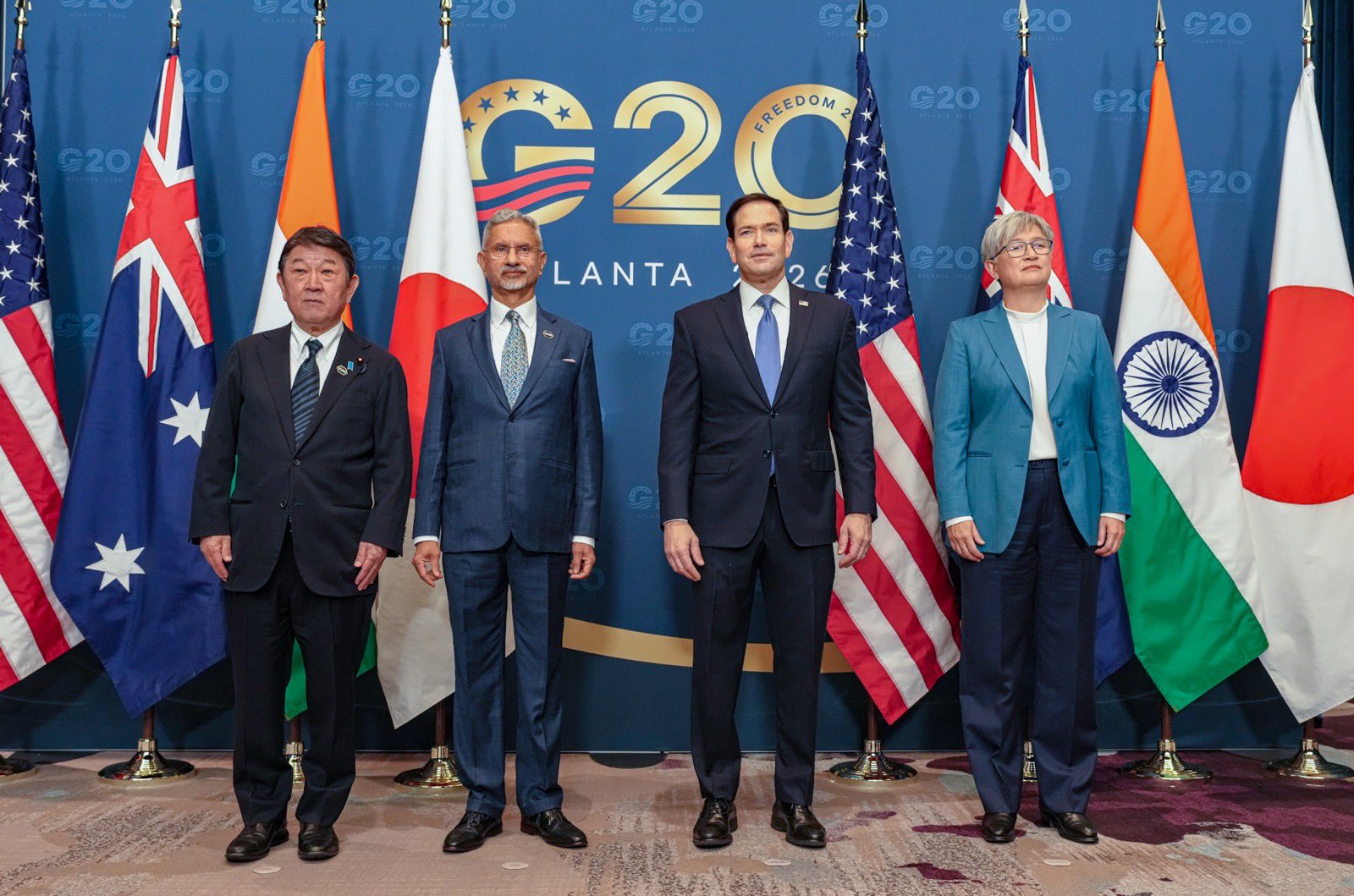 (L–R) Japanese Foreign Minister Toshimitsu Motegi, Indian External Affairs Minister S. Jaishankar, U.S. Secretary of State Marco Rubio, and Australian Foreign Minister Penny Wong pose for a photograph during a Quad foreign ministers’ meeting on the sidelines of the G20 gathering in Atlanta, Ga., on Oct. 31, 2026. (Courtesy of Secretary Marco Rubio)
Garcia-Herrero called the remarks “classic diplomatic hedging” with two meetings approaching, including possible talks between U.S. President Donald Trump and Chinese leader Xi Jinping at the Nov. 18–19 Asia-Pacific Economic Cooperation summit in Shenzhen, China.
“The line preserves flexibility ahead of the expected Trump–Xi meeting and the Manila Quad leaders’ summit, while still signaling coordinated pushback on overcapacity and export controls,” Garcia-Herrero said.
“It is not a softening of substance; it is careful wording to avoid an open ‘anti-China’ framing.”
Rubio said Quad leaders will likely meet in the Philippine capital of Manila, which will host the 49th Association of Southeast Asian Nations (ASEAN) Summit on Nov. 16–18.
‘Dominated by China’
The Quad’s statement came as China’s overcapacity eats into global markets for electric vehicles (EVs), lithium batteries, and petrochemicals.
Garcia-Herrero said high U.S. tariffs and Europe’s push for new trade barriers are driving Chinese exporters to send their surplus goods to Southeast Asia and the rest of Asia, where the impact is “significant and growing.”
“Chinese exports to ASEAN have surged, widening trade deficits for Vietnam, Thailand, Malaysia, and others,” she said.
“Local industries in steel, textiles, electronics components, and consumer goods are under pressure, prompting a wave of anti-dumping and safeguard measures across the region.”
China’s exports rose 16.4 percent to 23.2 trillion yuan (about $3.37 trillion) in the first nine months of 2026, according to data from the country’s General Administration of Customs.
ASEAN was the top market, with 4.32 trillion yuan (about $628 billion) in shipments over the same period.
Tsai warned that over time, Southeast Asian economies could end up “dominated by China,” costing local jobs and leaving the region under Beijing’s thumb.
“Low-priced Chinese cars are flooding into Thailand, so Thai car output is bound to fall, and that takes a heavy toll on the economy,” he said.
“Malaysian food makers are being badly squeezed by cheap rivals. You can see it on supermarket shelves, where Chinese products keep gaining ground.”
On May 14, ten Thai auto industry groups told the government the sector was in crisis, as local manufacturers struggled to compete with tariff-free Chinese EVs.
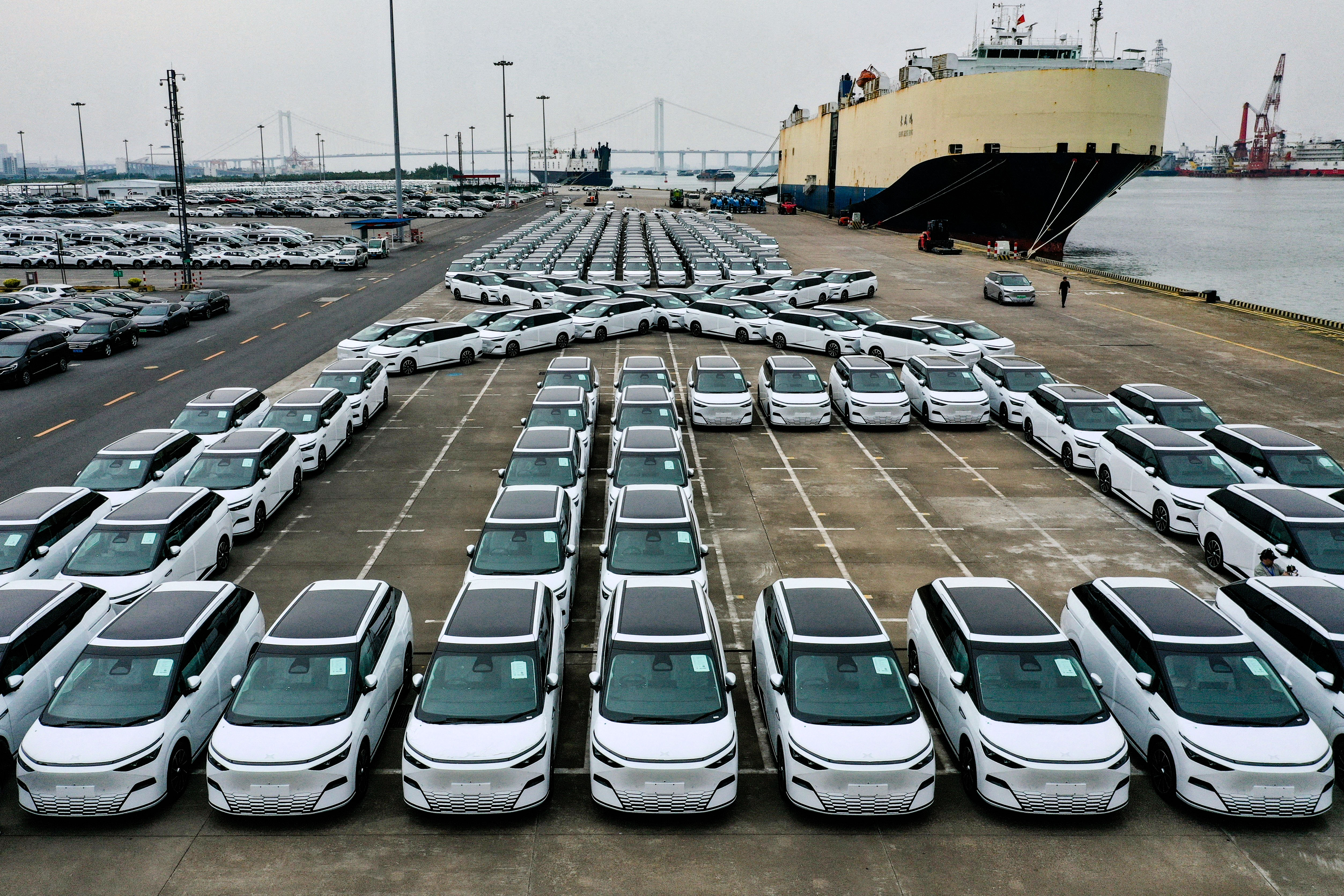 An aerial photo shows X9 electric vehicles by Chinese EV manufacturer XPeng waiting to be loaded onto an NYK Line ship bound for Thailand during a ceremony in the Port of Guangzhou, southern Guangdong Province, China, on Feb. 22, 2025. (Pedro Pardo/AFP via Getty Images)
Unrest in Europe
Tsai said China’s continued dumping of cheap goods could indirectly fuel more unrest in Europe.
“The European Union has been a little too slow to curb Chinese imports. As its industries lose sales, tax revenue falls with them,” he said.
“Then budget deficits widen, welfare suffers, and public anger slowly builds.”
Since mid-October, protesters in countries including France, Germany, and Italy have taken to the streets over soaring housing and living costs, strained schools and public services, and a gloomy economic outlook.
 Protesters light smoke flares in Berlin on Oct. 31, 2026. (Ralf Hirschberger/AFP via Getty Images)
Brittle Growth Ahead
Garcia-Herrero said that without a policy shift, China’s own economic growth will likely ease from around 4.5 percent in 2026 toward 4 percent in 2027, in line with major forecasts.
That slowdown would be “driven by fading export momentum, persistent property weakness, soft consumption, and rising trade friction,” she said.
She said the world would see “deeper supply-chain diversification away from China,” as protectionism spreads, Quad partners tighten critical-mineral ties, and the global market splinters.
“China’s industrial dominance in certain sectors persists, but the growth model becomes increasingly brittle and geopolitically contested,” she said.