
Beijing’s planned export bans on key technologies will only accelerate the world’s shift away from Chinese suppliers and ultimately leave its own economic pressure toothless, an expert says.
“In the short term, this approach does drive up costs for industries in countries that depend on China,” Tsai Ming-fang, a professor of industrial economics at Tamkang University in Taiwan, told The Epoch Times.
“But in the long run, it will backfire by pushing them to get serious about decoupling from China.”
Tsai said that if the expanded controls take effect and stay in force for long, countries will speed up efforts to drop Chinese suppliers, or to develop homegrown alternatives, to shield themselves from China’s economic coercion.
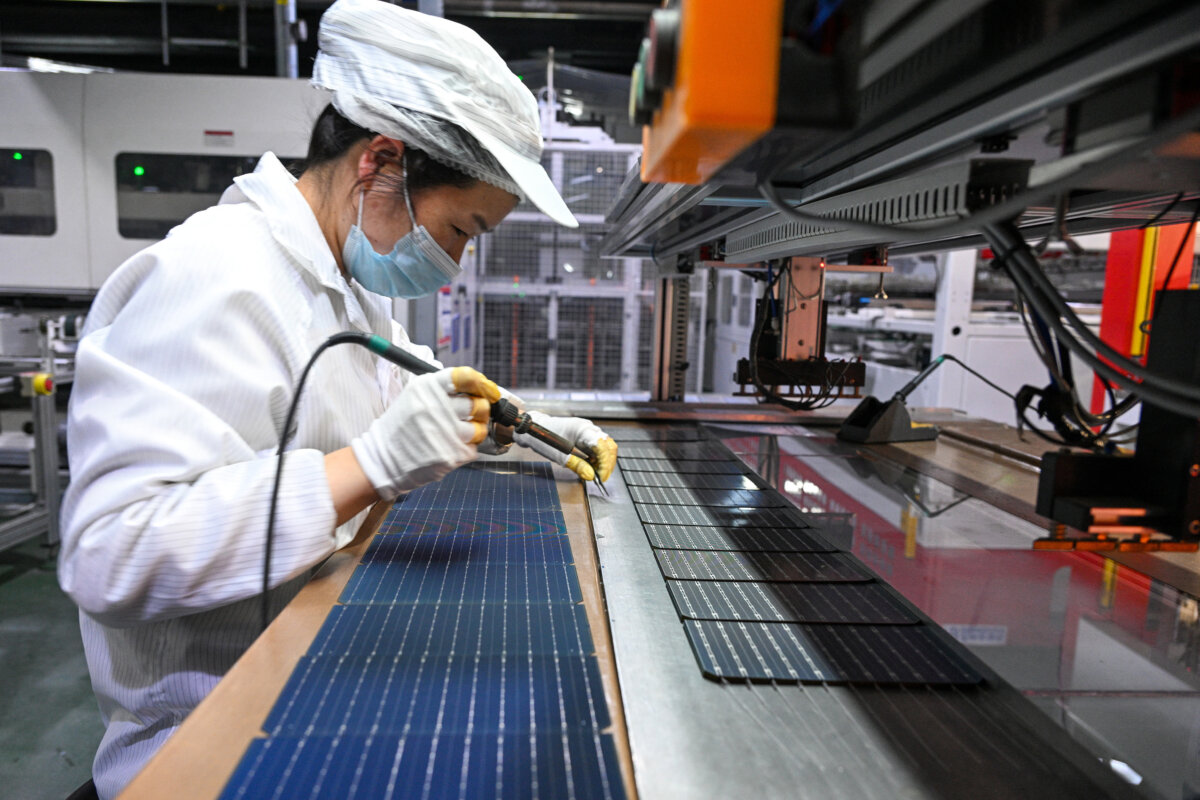
Tsai’s remarks come after China’s commerce and science ministries announced plans on Oct. 16 to curb exports of 40 key technologies in artificial intelligence (AI), biomedicine, and solar manufacturing, and opened them to public comment until Nov. 15.
Of those, 14 would be banned, including AI that generates malicious code, and 26 restricted, such as technology for mass-producing polysilicon—a core material for the solar industry.
A temporary rule already in force requires companies to register with the Commerce Ministry before sending any of the 40 abroad.
In AI, biomedicine and solar manufacturing alike, Chinese technology has been pouring into foreign markets.
Political Goals
Daphne Shiow-wen Wang, an assistant research fellow at the Institute for National Defense and Security Research in Taiwan, said the move serves political goals, particularly sending a message to Washington and Brussels.
“China wants more leverage in its trade talks with the United States so Washington won’t get too tough over the trade deficit,” Wang told The Epoch Times.
“The European Union is now sounding the alarm over its trade imbalance with China as well. Beijing may want to flex its muscles first so the bloc thinks twice before imposing penalties.”
Chinese leader Xi Jinping visited the United States from Sept. 23 to Sept. 25, where he and President Donald Trump agreed to extend a pause in their trade war until January 2027.
The EU’s trade deficit with China hit 1 billion euros ($1.1 billion) a day last year, a gap European Commission President Ursula von der Leyen called “structural” and “unsustainable” on Oct. 16.
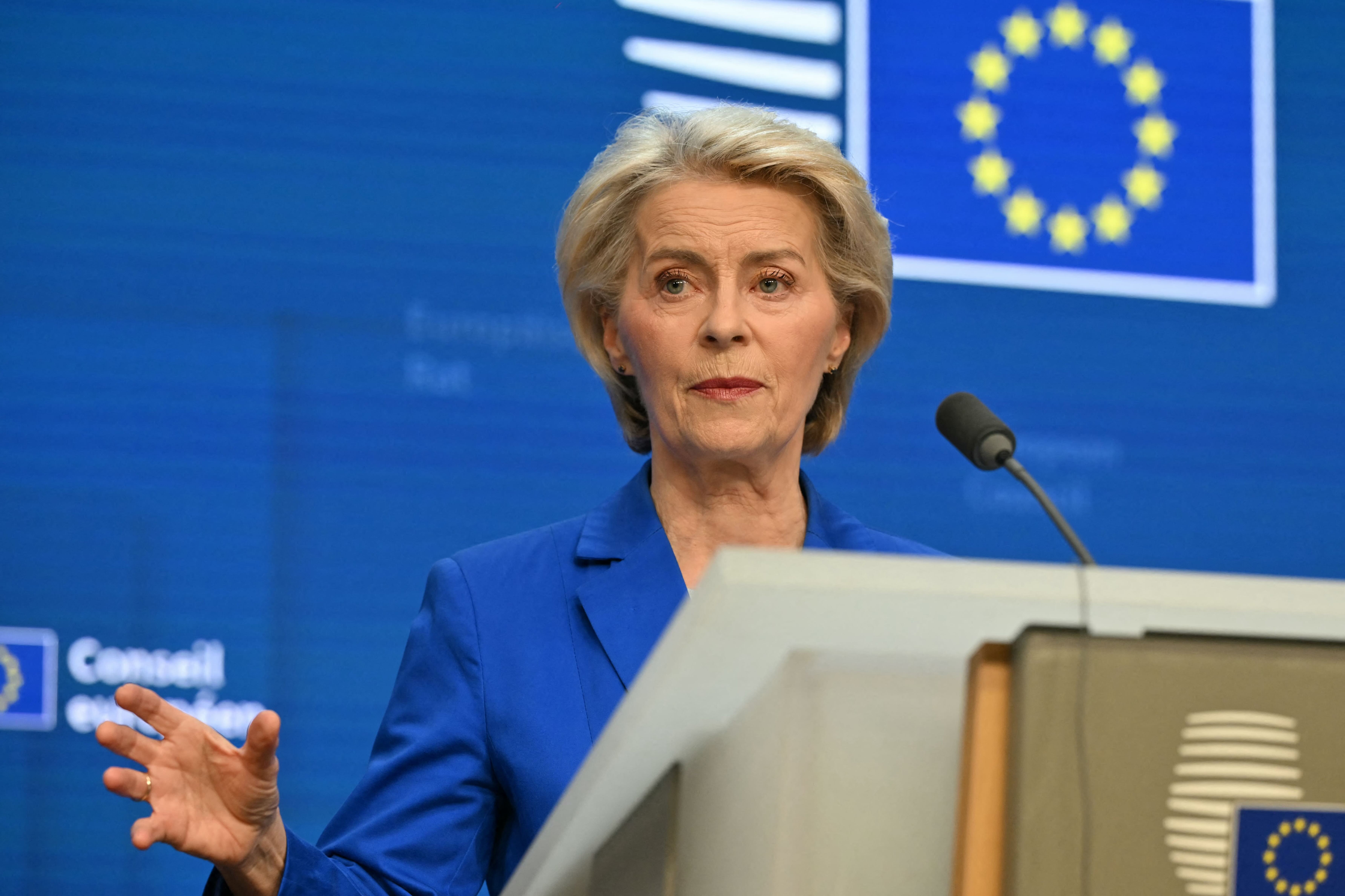 European Commission President Ursula von der Leyen gives a press conference at the end of a European Union summit at the European Union headquarters in Brussels on Oct. 16, 2026. (Nicolas Tucat/AFP via Getty Images)
The gathering is set for Nov. 18 and Nov. 19 in Shenzhen, China, where Trump is expected to meet Xi again on the sidelines.
“Beijing expects Washington to press for the controls to be eased, giving it the chance to turn the tables and demand something of equal value in return,” Lee told The Epoch Times.
Solar Lead in Doubt
Tsai said the measures could sway international negotiations, especially over solar products.
“The EU and Taiwan were once major producers, but neither could match China’s rock-bottom prices, and most production eventually moved there,” he said.
China now produces more than 80 percent of the world’s solar panels and has dominated the industry for years.
But Tsai said the curbs may not work, because China won its lead by undercutting rivals, and the know-how to make the panels remains within other countries’ reach.
“If these restrictions push others to gradually build their own solar industries, that won’t necessarily be good news for Beijing,” he said.
Offensive AI
China’s Commerce Ministry said some of the listed technologies, such as AI-powered malware generation, could be used to attack critical information infrastructure, defense and government systems, threatening the security of nations and humanity if they fall into the wrong hands.
Lee said the statement amounts to a tacit admission that the regime itself is building dangerous AI capabilities.
“Some of China’s AI companies look private on the surface, but they are backed by the military, or the state, and are developing weapons or offensive AI,” Lee said.
“The move shows there is so much of this technology that Beijing now needs a public notice to regulate it.”
On Oct. 21, Microsoft said a group aligned with the Chinese state had used an AI-driven tool to breach IT services firm ConnectWise, as part of a campaign aimed at hundreds of organizations worldwide in sectors including defense, the military, government, energy, aerospace and semiconductors.
 Prince, a member of the hacking group Red Hacker Alliance who refused to give his real name, uses a website that monitors global cyberattacks on his computer at their office in Dongguan, Guangdong Province, China, on Aug. 4, 2020. (Nicolas Asfouri/AFP via Getty Images)
Wang said that if China can hack into rival countries’ infrastructure, it could easily throw their societies into chaos.
“That could mean blackouts or communications outages in some countries,” Wang said.
“Or AI could be used to launch nonstop attacks, crack codes tied to weapons development and steal sensitive information, which would be a global nightmare.”
Wang said China appears to have long wanted to strike adversaries this way but fears becoming a victim itself, since its own society may be no better able to withstand such an assault.
“If AI were used to completely breach a dam on the Yangtze River, the Chinese regime would struggle to cope,” Wang said.
The Yangtze River supports nearly a third of China’s population, and its dams generate electricity and hold back floods.
Tsai said that even if the rules are finalized, China could still turn AI against other countries’ defense industries and infrastructure, so the world must stay on guard.
“As long as such threats can sow fear, the impact will be enormous,” he said.