The Chinese regime is continuing to use state violence to suppress religious freedom while applying pressure to human rights lawyers, experts said.
Human Rights Watch reported on Sept. 9 that, in the first half of 2026, more than a dozen cities across China introduced measures to reward citizens for reporting “illegal” religious activities, as authorities tighten surveillance nationwide.
The rights group cited the case of Chinese lawyer Ruth Wang as the latest example. She fled to Taiwan on Sept. 2 after authorities threatened to shut down VDoor Law Firm, where she is a partner.
VDoor represents members of Zion Church, one of China’s largest underground churches.
Wang told The Associated Press on Sept. 4 that Chinese officials said she and her colleagues must dissolve the firm themselves or expect a forced closure.
“I believe it will definitely seriously affect my career development and other aspects of my life,” she said.
Shen Ming-shih, a research fellow at Taiwan’s Institute for National Defense and Security Research, told The Epoch Times, “Wang’s decision to seek asylum during a layover in Taipei reflects the regime’s continued use of state violence or systemic methods to suppress religious freedom.”
The Chinese Communist Party (CCP) detained Zion Church founder and pastor Ezra Jin Mingri, along with several congregants, in October 2025. He was freed in July after Washington and Beijing engaged in senior-level diplomatic talks.
 Ezra Jin Mingri, founder and head pastor of the Zion church in Beijing, sits in the congregation hall of the unofficial Protestant “house” church in Beijing on Aug. 28, 2018. (Thomas Peter/Reuters)
“Beijing’s strategy is to eliminate their legal counsel, leaving all religious organizations completely isolated and entirely without a voice,” Shen said.
China recognizes five faiths—Buddhism, Catholicism, Islam, Protestantism, and Taoism—through “patriotic religious associations” but “severely restricts religious groups and micromanages their affairs,” U.S. Commission on International Religious Freedom Chair Vicky Hartzler said in a hearing in October 2025.
Tseng Chien-yuan, an adjunct associate professor at Taiwan’s National Central University, said Beijing permits only state-sanctioned churches as it aggressively pushes “Sinicization,” rewriting texts such as the Bible and the Quran to “crudely interfere with faith,” while demanding total loyalty from religious groups.
“Their forced veneration of the communist regime and Chinese leader Xi Jinping operates exactly like a religion, with Xi acting as the supreme leader,” Tseng told The Epoch Times.
He also said that the Chinese Communist Party’s suppression of Wang bypasses standard legal procedures entirely.
“By directly pressuring the firm to dissolve, the regime is applying raw political coercion against the profession,” Tseng said.
Taiwan’s Mainland Affairs Council, a government agency that handles cross-strait affairs, said it has established procedures to handle such cases, although the island lacks a formal asylum system, Taiwan’s Central News Agency reported on Sept. 4.
Judiciary for Suppression
Shen said that under Xi, the regime exerts total control over human rights lawyers in the name of “stability maintenance.”
“The ‘709 crackdown’ more than a decade ago shows that while Beijing emphasizes ‘comprehensive rule of law,’ this law is entirely dictated by the Party,” he said.
The “709 crackdown” was a sweeping arrest campaign on July 9, 2015, when Chinese authorities rounded up hundreds of lawyers and dissidents across 23 provinces—an episode that analysts widely viewed as a judicial leap backward for China.
 Lawyers and activists gather for a silent protest at the court of final appeal in Hong Kong on the fourth anniversary of the “709 crackdown” on human rights lawyers across China, on July 9, 2019. (Anthony Wallace/AFP/Getty Images)
“Through travel bans and fabricated charges to imprison defenders, the regime has turned the law from a protective shield into a weapon to purge dissent,” he said. “There is absolutely no independent or impartial rule of law in China.”
Weaponizing Border Controls
Shen said Beijing is likely furious over Wang’s decision, potentially viewing the escape as a smear on its national image, and could leverage legal mechanisms to prevent recurrences.
“Although Taiwan lacks refugee or asylum laws, past practice shows the island will help asylum seekers resettle in the United States, Canada, or Europe,” he said.
“The regime will see Taiwan’s approach as ‘colluding with foreign forces’ and will intensify domestic travel controls through its new exit-entry regulations.”
Beijing unveiled new border rules on July 31. Analysts told The Epoch Times in August that the state could exploit the measures to restrict citizens’ departure without providing a clear reason.
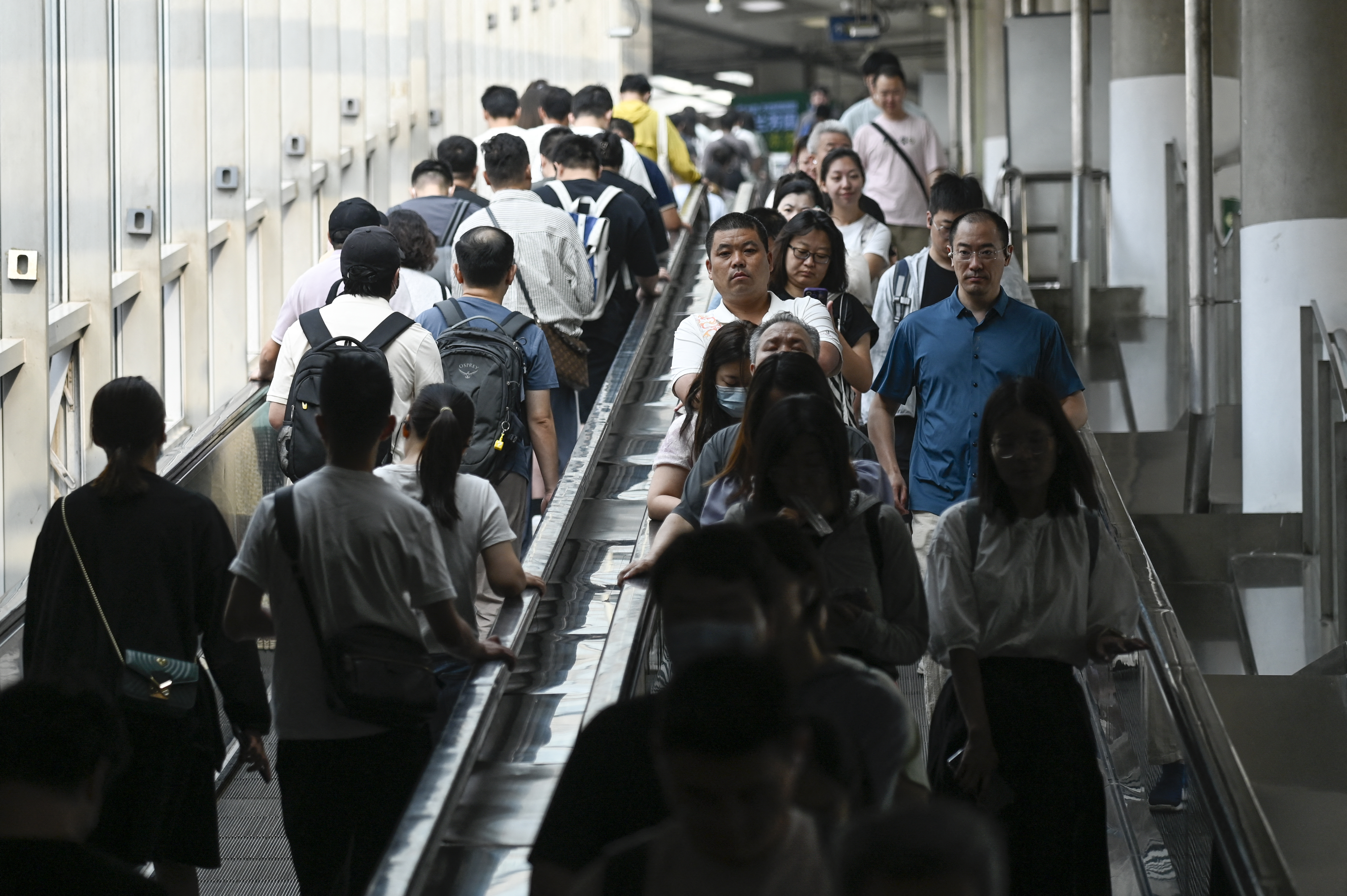 Commuters use the escalators at a subway station in Beijing on July 10, 2024. (Wang Zhao/AFP via Getty Images)
“For example, anyone associated with Wang or Zion Church will likely be barred from leaving the country, normalizing the strict approval process,” he said.
“Beijing will use every possible means to keep these ‘unstable elements’ within the country, further tightening its control over dissent and personal liberty.”
Tseng agreed.
“Intellectuals who are better able to access outside information will face strict curbs on their ability to travel,” Tseng said.
“To preserve the regime’s grip on power, it treats social stability as one of its top priorities.”