In a speech marking the 160th anniversary of Dr. Sun Yat-sen’s birth on Nov. 12, Chinese Communist Party (CCP) leader Xi Jinping claimed the political legacy of the Republic of China (ROC) founder while promoting the annexation of Taiwan, a move analysts said betrays Sun’s legacy.
At a commemorative meeting for Sun held in Beijing’s Great Hall of the People, Xi said Sun firmly upheld national unity and ethnic solidarity, and claimed that the Chinese communists are successors to Sun’s cause.
Xi said that “resolving the Taiwan issue” and achieving complete reunification with Taiwan remains an “unswerving historical mission” for the CCP.
Analysts said that Xi is appropriating Sun’s legacy to launch cognitive warfare against Taiwan, the last territory of the ROC that Sun founded.
Sun led the revolution that overthrew the imperial Qing dynasty in 1911, established the ROC, and was inaugurated as the republic’s first provisional president in Nanjing. He died in 1925.
After World War II, the CCP and its guerrilla forces defeated the ROC on the mainland and forced the ROC government to retreat to Taiwan in 1949. Meanwhile, the CCP established the Chinese communist regime—the People’s Republic of China (PRC)—on the mainland.
Taiwan said in a Nov. 12 statement from its Mainland Affairs Council that the ROC founded by Sun is a sovereign state whose existence has remained uninterrupted in Taiwan to this day.
According to Taiwan, the ROC has never been overthrown or replaced and is not subordinate to the People’s Republic of China.
The Mainland Affairs Council urges the CCP to heed Sun’s legacy of peace by ending its intimidation of Taiwan through actions it said threaten peace and stability across the Taiwan Strait and throughout the Indo-Pacific region.
It said the CCP should engage in dialogue with Taiwan’s democratically elected government to address cross-strait differences pragmatically.
The council further stated that if the CCP wishes to commemorate Sun, it should commit to realizing the ideals of democracy and civil rights that Sun pursued throughout his life by advancing political reform and democratization in mainland China.
Sun Yat-sen was born in 1866 and was educated in Hawaii as a teenager. As an adult, Sun spent years traveling to the United States, especially Honolulu and San Francisco, to rally the overseas Chinese community and raise funds to overthrow the Qing Dynasty.
Japan also became Sun’s primary base of operations for raising funds, securing political alliances, and organizing support for the anti-Qing revolutionary movement.
Sun Yat-sen is recognized as the ROC’s “Father of the Nation.” However, under the policy of “aligning with the Soviet Union and the Chinese Communist Party”—a strategy initiated by Sun in order to counter Western and Japanese imperialism—a large number of CCP members infiltrated the Kuomintang, the nationalist party, assuming high-ranking positions in the ROC government, which gave an opportunity for the CCP to grow bigger.
Ultimately, the ROC was defeated by the CCP in China’s civil war and retreated to Taiwan in 1949.
CCP’s Political Scheme
From Xi’s rhetoric, it’s clear that the CCP is now attempting to use Sun’s name to call for cooperation between the Kuomintang and the CCP to conquer Taiwan (ROC) and eliminate its sovereignty against the CCP’s tyranny, Yuan Hongbing, a Chinese legal scholar living in exile in Australia, told The Epoch Times.
“This is a hypocritical and cunning political scheme by the CCP, which should raise serious concerns,” Yuan said.
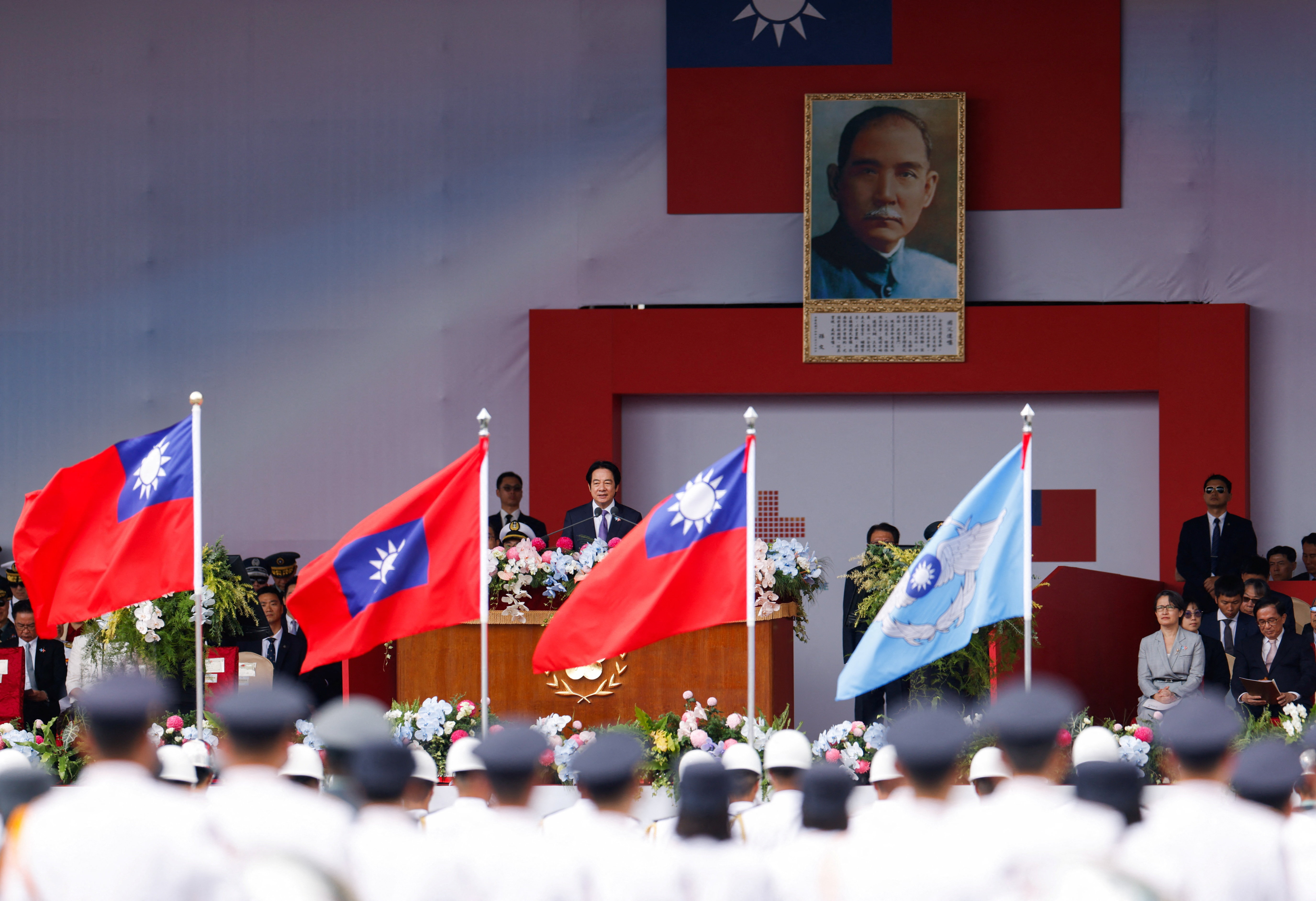 Taiwan President Lai Ching-te delivers a speech next to a portrait of Sun Yat-sen, the founding father of the Republic of China, during National Day celebrations in front of the Presidential Office in Taipei, Taiwan, on Oct. 10, 2026. (Reuters/Ann Wang)
Sun introduced and included the principles in 1905 in his revolutionary group—Tongmenghui—aiming to rid China of Qing imperial rule and Western and Japanese occupation of Chinese land.
Tseng noted that the CCP’s current conduct toward other countries reflects a hegemonic, imperialist power—the very behavior Sun opposed.
“The Republic of China is the primary target of the CCP’s external oppression,” Tseng said.
Tseng said the CCP’s actions run counter to Sun’s three principles.
By establishing the “Chinese Soviet Republic” within the ROC’s territory in the first half of the 20th century, the CCP itself split the nation—an endeavor Tseng noted was backed by the Communist International’s headquarters in Moscow.
Furthermore, today, a vast number of people in mainland China under the CCP’s rule live at or below the poverty line, while CCP officials and their associates spend money with reckless abandon, creating a severe wealth gap, Tseng noted.
“Given that the CCP allows such social inequality to persist, how can they possibly have the audacity to commemorate Sun Yat-sen? It is such an irony,” he said.
Li Yingzhi, a Chinese scholar and human rights activist in exile in the United States, also noted that while the CCP claims to be Sun’s most faithful successor, the reality is quite different.
“Sun Yat-sen overthrew the despotic Manchu Qing dynasty with the goal of establishing a republic rooted in freedom and democracy—yet the CCP continues to practice despotism today,” Li told The Epoch Times.
“Sun Yat-sen championed civil rights, whereas China currently lacks freedom of speech and freedom of religious belief.
“Furthermore, while Sun Yat-sen advocated for a republic comprising the ‘five ethnic groups’—a multi-ethnic state formed through the equal union of five major ethnic groups in China: the Han, Manchu, Mongol, Hui, and Tibetan—the CCP today operates concentration camps for Tibetans and Uyghurs, and prevents Mongolian and Tibetan children from learning their own native cultures,” Li said.
“The CCP’s current promotion and veneration of Sun Yat-sen is merely a form of propaganda designed to brainwash the public.”
Luo Ya, Tang Bing, and Yi Ru contributed to this report.