
News Analysis
After a slight weekly loss the previous week, U.S. stocks regained upward momentum, with both the S&P 500 and Nasdaq Composite reaching new highs amid optimism about corporate earnings and the broader economy.
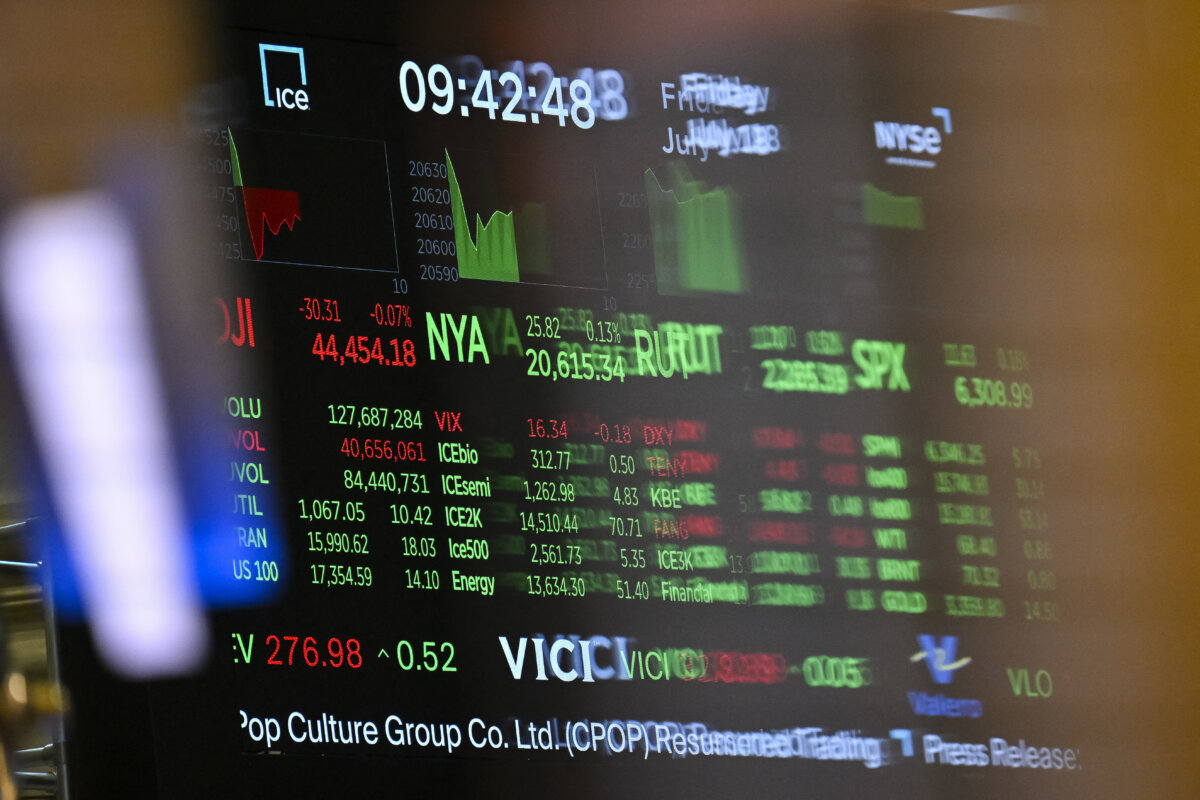
The S&P 500 Index closed at 6,296 on July 18, up by 0.59 percent for the week and near its all-time high reached during the day. The Dow Jones Industrial Average declined by 0.07 percent to finish at 44,342. The Nasdaq Composite Index rose by 1.51 percent, to 20,895, also near the all-time high, while the Russell 2000 gained 0.23 percent.
Trading during the new week followed the playbook of the recent bull run: It began with profit-taking on the morning of July 14, as traders locked in profits on the winners of the previous week. However, things turned around quickly, as dip-buying emerged once again, helping to stabilize the market.
The market turned choppy in the middle of the day amid a flurry of corporate news and fresh data on the U.S. economy, fueling a tug-of-war between bulls and bears.
On the corporate front, news that Nvidia received clearance from Washington to resume sales of its H20 GPU chips to China helped ease trade tensions between the United States and China. It provided another boost to the semiconductor sector, helping market bulls gain the upper hand in the tech-heavy Nasdaq, which closed higher for the day.
Elsewhere in the corporate sector, earnings from the nation’s large banks came mixed, weighing on both the Dow Jones and the S&P 500.
Adding to the market volatility was the release of fresh data on the U.S. economy.
On July 15, the Bureau of Labor Statistics released the June consumer price index (CPI), a broad measure of inflation affecting consumers.
It showed that inflation accelerated for a second consecutive month, to 2.7 percent, in June, led by higher costs for household energy, auto insurance, housing, and restaurant meals, partially offset by lower costs for gasoline and airfare.
It’s the highest reading since February, up from 2.4 percent in May, dashing hopes of an interest rate cut by the nation’s central bank later in the month.
“While it’s a relief to see Tuesday’s CPI in line with expectations, it still showed that inflation was hotter in June than it was in May,” Skyler Weinand, chief investment officer of Dallas-based Regan Capital, told The Epoch Times.
“With Tuesday’s inflation data, we are now even further from the Fed’s 2 percent target, which means the Fed is in no position to cut interest rates until at least September. The Fed will want to monitor the next several inflation and jobs reports before making any moves on rates.”
Bond traders and investors eagerly awaited these reports, pushing bond prices lower and yields higher. The U.S. 10-year Treasury note held above 4.48 percent on July 15, near a five-week high.
Higher bond yields hit the interest rate-sensitive sectors, such as homebuilders, which ended the day sharply lower.
On July 16, the Bureau of Labor Statistics released the producer price index (PPI), a measure of producer inflation in the United States, which declined to 2.3 percent in June. It’s the lowest since September 2024, compared with an upwardly revised 2.7 percent in May and market expectations of 2.5 percent.
The easing of producer inflation helped stabilize the bond market, with the 10-year Treasury note rate trending toward the 4.45 percent mark, fueling broad market gains by the end of the trading session.
The stream of economic data continued for the rest of the week, adding to the market optimism.
On July 17, the U.S. Census Bureau reported that retail sales rose at a monthly rate of 0.6 percent in June, marking a sharp turnaround from the declines in the prior two months and exceeding market expectations of a 0.1 percent gain.
The sales turnaround was led by miscellaneous store retailers (1.8 percent), motor vehicles and parts (1.2 percent), building material and garden equipment (0.9 percent), and clothing (0.9 percent), indicating that U.S. consumers and the economy remain resilient.
On July 18, the University of Michigan reported that the consumer sentiment index rose to 61.8 in July—its highest reading in five months—offering further evidence of U.S. consumers’ resilience.
Meanwhile, American Express said that affluent consumers continue to spend, boosting the company’s top line and adding another sign of consumer strength.
The resilience of the consumer sector—which accounts for nearly two-thirds of the U.S. economy—along with strong earnings from Taiwan Semiconductor, helped market bulls gain the upper hand during trading on July 17 and July 18, with both the S&P 500 and Nasdaq reaching new record highs on the morning of July 18.
However, several stocks, such as Netflix, American Express, and 3M, lost ground despite reporting solid earnings, indicating that investors may be reassessing valuations in certain market sectors.
At the close of trading on July 18, the S&P 500 and the Dow fell by 0.01 percent and 0.32 percent, respectively, while the Nasdaq rose by 0.05 percent.
Weinand said he remains optimistic about U.S. equities.
“Consumers and corporations are strong, and even though bond yields offer attractive alternatives to the stock market, we are returning to the era of TINA—there is no alternative, and that dynamic can help to keep stock prices elevated,” he said.